
- 0
- 2,044 words
Have you ever seen the word “warf” in writing and wondered whether it’s a real word—or just a misspelling of “wharf”? You’re not alone. This is one of those English spelling mix-ups that looks believable at first glance, especially because both words sound nearly identical in everyday speech.
If you’ve been searching for Wharf vs Warf, the short answer is simple: “wharf” is the correct standard English spelling, while “warf” is usually a misspelling. But there’s more to the story than that. In this guide, you’ll learn what a wharf actually is, why people often write “warf” instead, how the word is used in real contexts, and how to avoid the mistake in professional or academic writing.
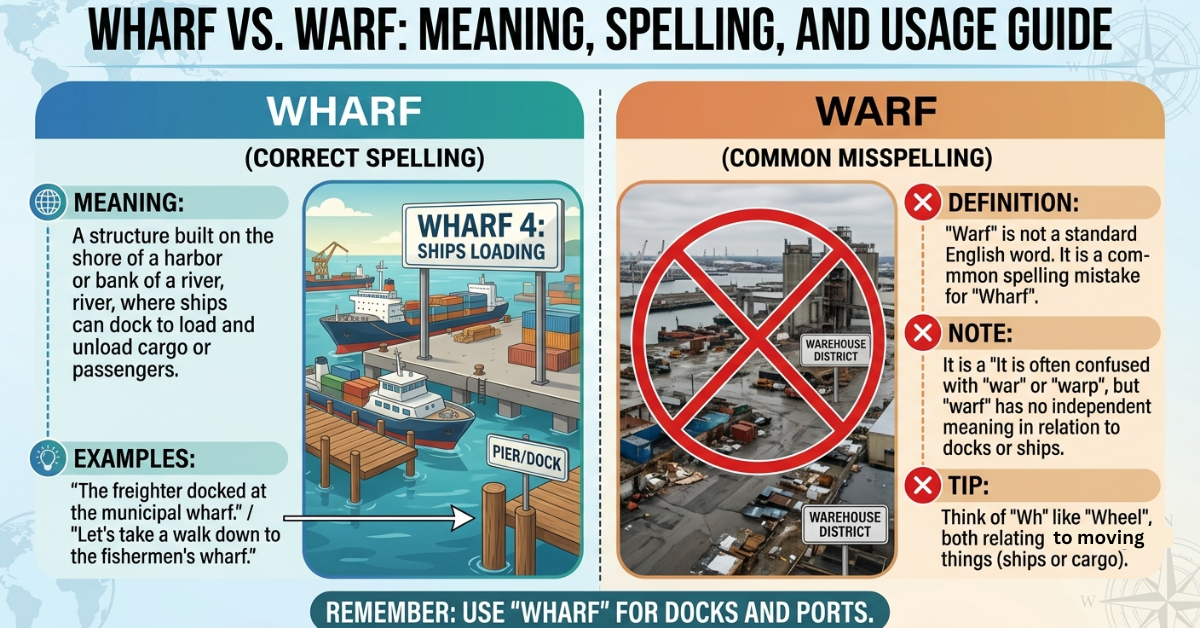
Wharf vs Warf: The Short Answer
Let’s clear it up immediately:
- Wharf = the correct English word
- Warf = generally an incorrect spelling of wharf
A wharf is a structure built along the shore of a harbor, river, canal, or waterfront where ships can dock to load and unload goods or passengers.
So if you’re writing about a dock, port structure, waterfront loading platform, or harbor-side landing area, wharf is the word you want.
What Does “Wharf” Mean?
A wharf is a man-made platform or landing area built on the edge of water. It allows boats or ships to stop beside it so cargo, vehicles, or people can move on and off.
Simple definition of wharf
A wharf is:
- A dock-like structure built on a shoreline
- Used for mooring ships
- Often used for loading and unloading cargo
- Common in ports, harbors, and commercial waterfronts
Example sentences
- The fishing boats were tied up at the wharf before sunrise.
- Workers spent the morning unloading containers at the wharf.
- Tourists walked along the old stone wharf overlooking the bay.
Is “Warf” a Real Word?
In standard English, “warf” is not the accepted spelling for the waterfront structure. In almost all cases, when someone writes warf, they actually mean wharf.
Why does “warf” appear so often?
There are a few reasons:
- Pronunciation confusion
In casual speech, the “h” in wharf isn’t strongly pronounced, so it can sound close to “warf.” - Typing or spelling error
Since “warf” looks plausible, people often type it by mistake. - Lack of familiarity with maritime vocabulary
Not everyone regularly uses words like wharf, pier, quay, or jetty, so spelling errors are common. - Search behavior
Many users search the web using the misspelled version first, which is why the query Wharf vs Warf comes up so often.
Wharf vs Warf: Side-by-Side Comparison
| Term | Correct? | Meaning | Common Usage |
| Wharf | Yes | A platform or dock where ships load, unload, or moor | Standard English |
| Warf | No, usually not | Usually intended to mean “wharf” | Misspelling or typo |
If you’re writing anything formal—an article, school assignment, travel guide, historical description, or business content—use “wharf,” not “warf.”
How to Pronounce “Wharf”
Wharf is commonly pronounced like:
- /wɔːrf/ in many varieties of English
- Similar to “worf” or “warf” depending on accent
That pronunciation is one reason the spelling gets confused. English often has silent or softened letter combinations, and “wh” words can be inconsistent across accents.
Other words with “wh” that confuse people
- who
- whole
- what
- wharf
- whirl
So while warf may sound close to the spoken word, the correct spelling remains wharf.
What Is a Wharf Used For?
A wharf has practical, commercial, and sometimes recreational functions depending on the location.
Common uses of a wharf
- Docking ships and boats
- Loading and unloading cargo
- Passenger boarding
- Fishing operations
- Storage and port activity
- Tourism and waterfront access
In older port cities, wharves were essential parts of trade and transportation systems. Even today, the word still appears in shipping, logistics, urban planning, and tourism.
Wharf vs Dock vs Pier vs Quay
One reason people get confused about Wharf vs Warf is that wharf belongs to a family of waterfront terms that overlap in meaning. Let’s sort them out.
Wharf vs Dock
A dock is a broader term. It can refer to:
- The place where a ship is moored
- An enclosed area of water for loading or repair
- A structure extending into the water
A wharf, by contrast, is specifically a structure built along the shore for ships to berth beside.
Quick distinction
- Dock = broader, more general
- Wharf = a specific waterfront loading/berthing structure
Wharf vs Pier
A pier usually projects out into the water from the shore and may be used for walking, fishing, docking, or recreation.
A wharf is often built parallel to the shore or positioned to allow vessels to pull up alongside for loading and unloading.
Think of it this way:
- Pier = often extends outward into water
- Wharf = usually serves practical port or shipping functions along the waterfront
Wharf vs Quay
A quay is a platform lying alongside or projecting into water for loading and unloading ships. In many contexts, quay and wharf are very close in meaning.
The main difference is often regional usage:
- Quay is more common in British and international port terminology
- Wharf is more common in North American usage
Wharf vs Jetty
A jetty is usually built to protect a shoreline, harbor, or channel from currents and waves. It may also help guide water flow.
Unlike a wharf, a jetty is not primarily designed for loading cargo or serving as a commercial docking platform.
Why “Wharf” Is the Correct Spelling
English dictionaries, style guides, educational resources, and historical texts all recognize wharf as the standard spelling.
Standard usage examples include:
- shipping wharf
- cargo wharf
- fishing wharf
- harbor wharf
- waterfront wharf
You’ll also see wharf in place names and well-known locations, such as:
- Fisherman’s Wharf
- Canary Wharf
- Darling Harbour wharf references in transport contexts
- historical port districts in cities like Boston, London, and Sydney
In all of these cases, the spelling is wharf, not warf.
Why People Misspell Wharf as Warf
Misspellings usually happen when a word is heard more often than it is seen in print. That’s especially true with words tied to specific industries like shipping, architecture, navigation, or waterfront infrastructure.
Here’s why “warf” happens so often:
1. It sounds phonetic
“Warf” looks like how many people think wharf should be spelled based on pronunciation.
2. The word isn’t used every day
Unless you work with ports, coastal travel, marine history, or geography, wharf may not be a word you type often.
3. Search engines don’t always stop the mistake
People often search misspelled words, and because search engines still understand intent, the typo keeps circulating.
4. It resembles other simple English spellings
Words like warm, ward, warp, and warf look visually familiar, which makes the error feel “right” even when it isn’t.
Examples of Wharf in Real-World Context
To understand the word better, it helps to see it in context.
Maritime and shipping
- Cargo was transferred from the vessel to the wharf before being trucked inland.
- The port authority upgraded the concrete wharf to support larger ships.
Travel and tourism
- Visitors gathered at the wharf to catch the ferry at sunset.
- The seafood market sits right beside the old wharf.
Historical writing
- In the 19th century, the city’s wharf was a center of trade and immigration.
- Merchants once lined the wharf waiting for overseas shipments.
Urban waterfront development
- The abandoned wharf district was converted into shops, cafes, and pedestrian walkways.
- Architects preserved the timber wharf as part of the waterfront redesign.
Is “Wharf” Singular or Plural?
Yes—wharf is singular.
Plural forms of wharf
There are two accepted plural forms:
- wharfs
- wharves
Both are used, though wharves is often considered the more traditional or stylistically polished plural.
Examples
- Several fishing wharves line the coast.
- The city restored its old shipping wharfs for tourism.
If you’re writing formal content, wharves is usually the smoother choice, but both are correct.
When to Use “Wharf” in Writing
Use wharf when referring to:
- A structure where ships dock beside the shore
- Port infrastructure
- Harbor or waterfront loading areas
- Maritime transport and shipping facilities
- Historical waterfront architecture
- Tourist waterfront districts that retain the original term
Good sentence examples
- The ferry leaves from the main wharf every morning.
- The old wharf has been turned into a public promenade.
- Goods were unloaded at the wharf before customs inspection.
When Not to Use “Warf”
Avoid warf in:
- essays
- reports
- travel blogs
- academic writing
- signage copy
- marketing content
- captions or historical descriptions
Unless you’re quoting someone’s typo or discussing the misspelling itself, warf should not be used as the correct form.
Memory Trick: How to Remember Wharf vs Warf
If you keep mixing them up, use this simple trick:
Think of “wharf” as a real harbor word with an “H”
The H helps remind you that it’s the historical, correct English form.
Another easy memory cue:
- Wharf = the word you’ll see in dictionaries and place names
- Warf = the version spellcheck should make you question
Common Sentences: Correct vs Incorrect Usage
Here’s a quick visual comparison.
Correct
- We walked down to the wharf to watch the boats arrive.
- The fishermen unloaded their catch at the wharf.
- The city redeveloped the old wharf district.
Incorrect
- We walked down to the warf to watch the boats arrive.
- The ship was tied at the warf.
- The seafood market is next to the warf.
Practical Writing Tips to Avoid the Mistake
If you write about travel, geography, architecture, history, or shipping, these tips can help.
1. Learn the word in context
Don’t memorize wharf as an isolated spelling. Link it to images of:
- harbors
- ferries
- cargo docks
- waterfront districts
2. Use spellcheck—but don’t rely on it blindly
Spellcheck can catch warf, but it’s still worth knowing why wharf is correct.
3. Read related words together
Group these terms in your mind:
- wharf
- pier
- quay
- dock
- harbor
That makes it easier to remember where wharf fits.
4. Watch for place names
Words like Fisherman’s Wharf or Canary Wharf reinforce the correct spelling in real-world use.
Key Takeaways: Wharf vs Warf
If you only remember a few things from this guide, make it these:
- Wharf is the correct spelling.
- Warf is usually a misspelling of wharf.
- A wharf is a structure along the shore where ships dock, load, or unload.
- The confusion happens because wharf is often pronounced in a way that sounds close to “warf.”
- Related words like dock, pier, quay, and jetty are similar but not identical.
FAQs About Wharf vs Warf
Is it wharf or warf?
The correct spelling is wharf. Warf is generally considered a misspelling unless it appears as part of a nonstandard name or typo discussion.
What does wharf mean?
A wharf is a structure built along the shore where boats or ships can dock to load and unload cargo or passengers. It’s commonly found in ports, harbors, and waterfront areas.
Why do people spell wharf as warf?
People often write warf because the pronunciation of wharf can sound very similar in casual speech. It’s a common phonetic spelling mistake.
Is warf a dictionary word?
In standard English usage related to harbors and docks, warf is not the accepted form. Dictionaries recognize wharf as the proper spelling.
What is the plural of wharf?
The plural can be wharfs or wharves. Both are accepted, though wharves is often more traditional in formal writing.
Is a wharf the same as a pier?
Not exactly. A wharf is typically a structure used for docking and loading along a waterfront, while a pier often extends out into the water and may be used for recreation, access, or docking.
Conclusion
The debate over Wharf vs Warf is actually much simpler than it looks: wharf is the correct word, and warf is almost always a spelling mistake. Once you know that a wharf refers to a dockside structure used for ships, trade, or waterfront access, the distinction becomes easy to remember.
If you write about ports, travel, history, or coastal places, using the correct spelling matters—not just for grammar, but for credibility too. Keep wharf in your vocabulary, skip warf, and you’ll sound sharper and more precise every time. If you’re exploring other tricky word pairs, it’s worth building the habit of checking spelling, meaning, and context together—that’s where real clarity starts.
Author

linguaezone.com@gmail.com
Related Posts

Kill Two Birds With One Stone Alternative: 50 Better Options
- 0
- 1,569 word
Have you ever paused before saying “kill two birds with one stone” because it sounded too violent or simply didn’t fit the...
Read out all
Happy Sabbath Meaning: A Complete Guide to Its Significance
- 0
- 1,632 word
Have you ever received the message “Happy Sabbath” and wondered what it truly means? Is it simply another way of saying “have...
Read out all
I’m So Proud of You in Other Words: 120+ Heartfelt Alternatives
- 0
- 1,562 word
Have you ever wanted to tell someone you’re proud of them but felt like saying “I’m so proud of you” sounded repetitive?...
Read out all
How Do You Spell Happy Anniversary? Correct Spelling Guide
- 0
- 1,221 word
Have you ever paused before writing an anniversary card and wondered, “How do you spell happy anniversary?” You’re not alone. Whether you’re...
Read out all
Waiting for Your Response Email: Best Examples & Tips
- 0
- 1,483 word
Have you ever sent an important email and found yourself wondering whether you should follow up or simply wait? Whether you’re communicating...
Read out all
Great Asset to the Team: Meaning, Examples & Tips
- 0
- 1,494 word
Have you ever wanted to compliment a coworker but struggled to find words that sound professional and sincere? One of the most...
Read out all