
- 0
- 1,181 word
Have you ever paused mid-sentence and wondered whether the correct word is ware, wear, or where? You are not alone. These three words sound almost identical, but they mean very different things, and mixing them up can make your writing look careless.
In this guide, we will break down Ware vs Wear vs Where in a simple, memorable way. You will learn what each word means, how to use it in a sentence, common mistakes, and an easy trick to remember the difference every time.
What Does Each Word Mean?
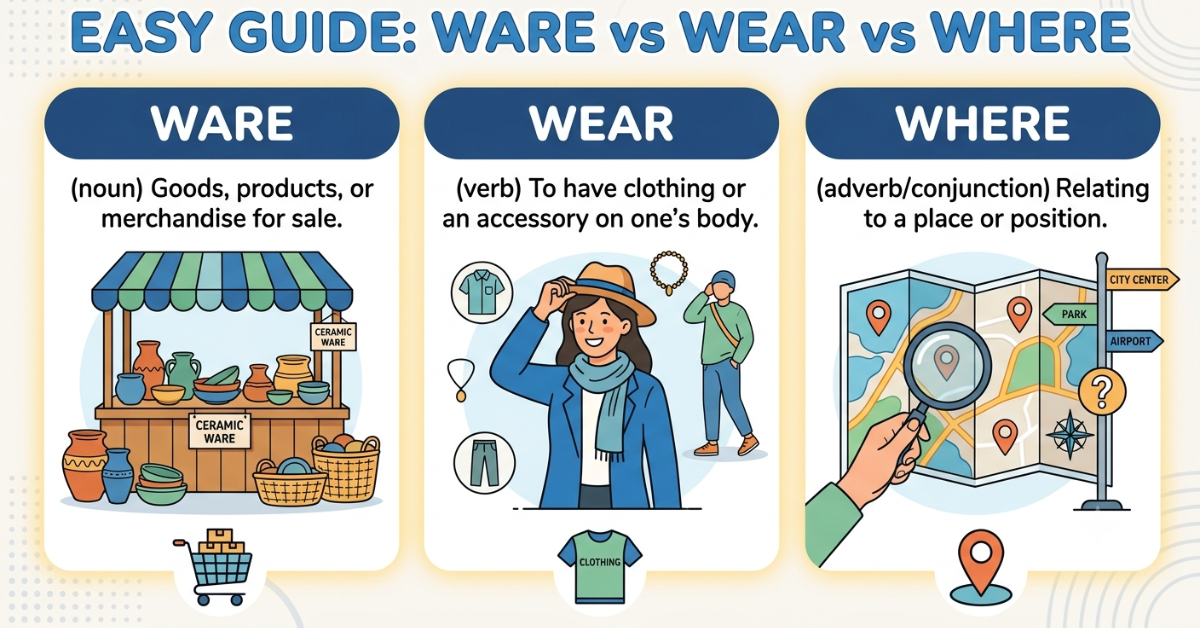
The easiest way to understand Ware vs Wear vs Where is to look at each word separately.
Ware
Ware usually refers to goods, products, or merchandise. You will often see it in words like software, glassware, kitchenware, or hardware.
Examples:
- The shop sells handmade ware.
- She packed her ceramic ware carefully.
- The market had beautiful craft ware.
Wear
Wear is usually a verb. It means to have clothing, accessories, or an expression on your body, or to become weaker over time from use.
Examples:
- I wear glasses.
- He likes to wear formal shirts.
- These shoes are starting to wear out.
Where
Where is a question word used to ask about place, location, or position.
Examples:
- Where are you going?
- Do you know where my keys are?
- Where is the nearest bookstore?
Ware vs Wear vs Where: A Simple Comparison
Here is the fastest way to separate them in your mind:
- Ware = things or goods
- Wear = to put on, or to get old from use
- Where = place or location
A quick sentence comparison helps a lot:
- The store sold kitchen ware.
- I wear a watch every day.
- Where did you buy that watch?
Even though they sound the same, their jobs in a sentence are completely different.
How to Remember the Difference
A good spelling trick can save you from confusion.
1. Ware = merchandise
Think of ware as something you can sell or store.
You may notice it in:
- tableware
- silverware
- hardware
- software
These all point to a type of product, item, or collection of goods.
2. Wear = clothing or damage
The word wear often connects to fashion or use.
Think:
- I wear a jacket.
- My socks are worn out.
The spelling also has ear, which may remind you of something you put on your body.
3. Where = location
Where always points to a place.
Think of the question:
- Where is it?
- Where are they?
If the word is asking about position, where is usually the right choice.
Ware vs Wear vs Where in Real Sentences
Here are more examples so the difference becomes automatic.
Ware in sentences
- The antique store displayed rare ware from Europe.
- Plastic ware is cheaper than glass.
- Their brand is known for eco-friendly ware.
Wear in sentences
- I like to wear comfortable shoes.
- The fabric will wear slowly over time.
- Heavy rain can wear away the paint.
Where in sentences
- Where do you live?
- Tell me where to send the package.
- Where did the bus stop?
Common Mistakes People Make
A lot of confusion happens because these words are homophones, which means they sound alike but differ in spelling and meaning.
Here are the most common mistakes:
Using “wear” when “where” is needed
Incorrect: Wear is my phone?
Correct: Where is my phone?
Using “where” when “ware” is needed
Incorrect: The store sells kitchen where.
Correct: The store sells kitchen ware.
Using “ware” when “wear” is needed
Incorrect: I like to ware blue jeans.
Correct: I like to wear blue jeans.
A simple check: ask yourself whether the sentence is about a thing, an action, or a place.
A Quick Grammar Breakdown
To really understand Ware vs Wear vs Where, it helps to know their grammatical roles.
Ware
Usually a noun. It refers to goods, products, or manufactured items.
Wear
Can be a verb or a noun.
- Verb: to put on clothing
- Noun: the act of wearing, or damage from use
Examples:
- The jacket shows signs of wear.
- She wears a uniform every day.
Where
Usually an adverb, sometimes a conjunction or pronoun in more advanced grammar use.
Examples:
- I know where you are.
- This is the place where we met.
Why These Words Matter in Writing
Spelling mistakes like this may seem small, but they can affect how professional your writing looks. Whether you are writing an email, a school essay, a blog post, or a social media caption, correct word choice helps your message feel clear and polished.
Using Ware vs Wear vs Where correctly also improves readability. Readers do not have to stop and guess what you meant, and your writing feels more confident and trustworthy.
Practical Tips to Avoid Confusion
Here are a few simple habits that help:
- Read the sentence aloud
If it is asking about a place, you probably need where. - Replace the word with a synonym
- For ware, try “goods” or “products.”
- For wear, try “put on.”
- For where, try “what place.”
- Check the part of speech
Is it a noun, verb, or question word? - Use familiar examples
Remember words like hardware, software, and tableware for ware.
The Easiest Memory Trick
Here is a tiny memory shortcut:
- Ware = things
- Wear = clothing
- Where = place
Or even shorter:
- Ware = what you buy
- Wear = what you put on
- Where = where you are
Once that pattern sticks, the spelling becomes much easier.
Key Takeaways
- Ware refers to goods, products, or items.
- Wear means to put on clothing or to become damaged from use.
- Where asks about a place or location.
- The three words sound alike, but their meanings are completely different.
- A quick meaning check usually helps you choose the right spelling.
FAQs
1. What is the difference between ware, wear, and where?
Ware means goods or products, wear means to put on or use up, and where refers to a place or location. They sound the same, but they are used in different ways.
2. How do I remember ware vs wear vs where?
A simple trick is: ware = things, wear = clothing or use, where = place. This helps you choose the correct word quickly.
3. Is ware ever used in daily English?
Yes, but usually in compound words like hardware, software, tableware, and glassware. On its own, ware is less common in everyday speech.
4. Can wear be a noun?
Yes. Wear can mean the damage caused by use, as in “The tire shows a lot of wear.” It can also be a verb, as in “I wear a coat.”
5. Why do people confuse where and wear?
They are homophones, so they sound almost identical when spoken. The difference only becomes clear in spelling and meaning.
6. Which one is the question word?
Where is the question word. It is used to ask about location, such as “Where are you going?”
Conclusion
Understanding Ware vs Wear vs Where is easier than it first looks. Once you remember that ware is about goods, wear is about clothing or use, and where is about location, the confusion starts to disappear.
The best way to master these words is to practice them in real sentences. Keep the meaning in mind first, and the spelling will follow naturally.
Author

linguaezone.com@gmail.com
Related Posts

Kill Two Birds With One Stone Alternative: 50 Better Options
- 0
- 1,569 word
Have you ever paused before saying “kill two birds with one stone” because it sounded too violent or simply didn’t fit the...
Read out all
Happy Sabbath Meaning: A Complete Guide to Its Significance
- 0
- 1,632 word
Have you ever received the message “Happy Sabbath” and wondered what it truly means? Is it simply another way of saying “have...
Read out all
I’m So Proud of You in Other Words: 120+ Heartfelt Alternatives
- 0
- 1,562 word
Have you ever wanted to tell someone you’re proud of them but felt like saying “I’m so proud of you” sounded repetitive?...
Read out all
How Do You Spell Happy Anniversary? Correct Spelling Guide
- 0
- 1,221 word
Have you ever paused before writing an anniversary card and wondered, “How do you spell happy anniversary?” You’re not alone. Whether you’re...
Read out all
Waiting for Your Response Email: Best Examples & Tips
- 0
- 1,483 word
Have you ever sent an important email and found yourself wondering whether you should follow up or simply wait? Whether you’re communicating...
Read out all
Great Asset to the Team: Meaning, Examples & Tips
- 0
- 1,494 word
Have you ever wanted to compliment a coworker but struggled to find words that sound professional and sincere? One of the most...
Read out all