
- 0
- 2,329 words
Have you ever typed authorisation into a document, only for your spell-checker to angrily underline it and suggest authorization instead? Or maybe the opposite happened because you were writing for a UK audience. It’s a tiny difference—just one letter—but it creates a surprising amount of confusion.
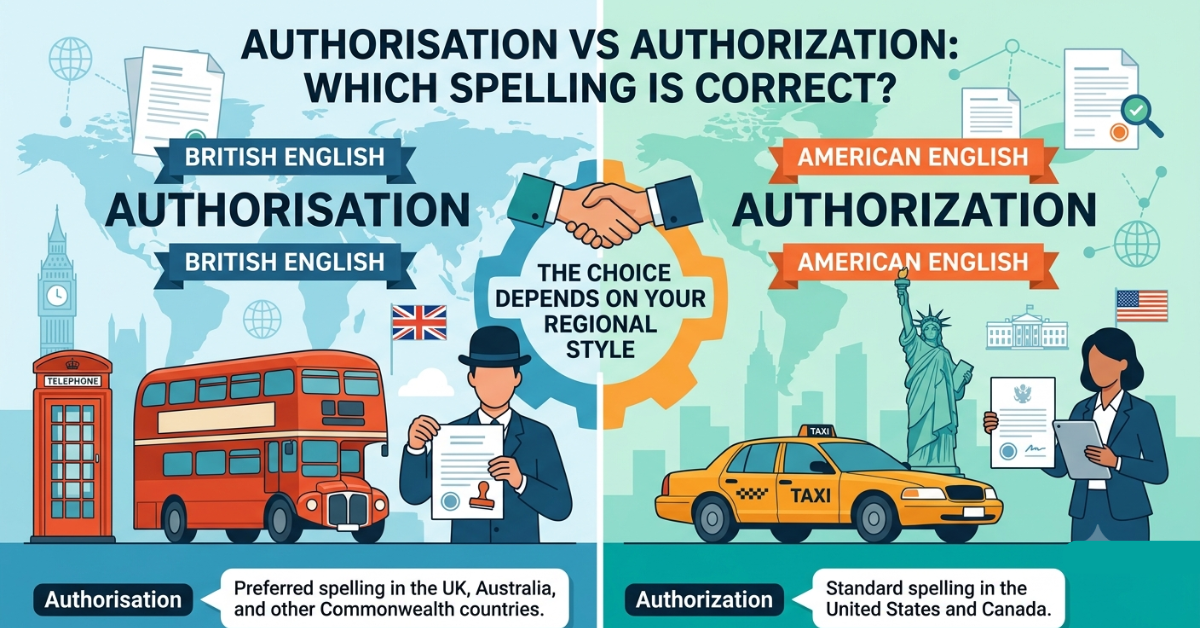
If you’ve been wondering about authorisation vs authorization, the short answer is simple: both spellings are correct. The difference comes down to regional spelling conventions. Authorisation is the standard form in British English, while authorization is preferred in American English. The meaning stays exactly the same.
In this guide, you’ll learn what each word means, why the spelling changes, where each version is used, how to choose the right one for your audience, and which form is more common in business, legal, academic, and digital contexts.
What Does “Authorisation” or “Authorization” Mean?
Both authorisation and authorization refer to the act of giving official permission, approval, or legal power to do something.
Simple definition
If a person, company, institution, or system gives someone approval to proceed, that is authorisation/authorization.
Common meanings include:
- Permission to access a system
- Approval to make a payment
- Legal consent to act on someone’s behalf
- Formal clearance to use information, property, or services
- Administrative approval in workplaces, banks, hospitals, and government offices
Example sentences
- You need authorization from the bank before the payment is processed.
- The manager gave written authorisation for the order.
- Two-factor authentication adds an extra layer of authorization for online accounts.
- The patient’s treatment required prior authorisation from the insurance provider.
So, in terms of meaning, there is no difference at all. The only real distinction is spelling style.
Authorisation vs Authorization: The Short Answer
Let’s make it crystal clear.
| Spelling | Preferred In | Meaning |
| Authorisation | British English, Australian English, New Zealand English, some international English contexts | Official permission or approval |
| Authorization | American English and many US-based technical, legal, and software contexts | Official permission or approval |
In one sentence:
- Use “authorisation” if you’re writing in British English
- Use “authorization” if you’re writing in American English
That’s the core of the authorisation vs authorization debate.
Why Are There Two Spellings?
The difference comes from the long-standing spelling divide between British English and American English.
British English tends to prefer -isation
Words are often spelled like this:
- authorisation
- organisation
- civilisation
- realisation
American English prefers -ization
Equivalent US spellings include:
- authorization
- organization
- civilization
- realization
This pattern appears in many English words, not just this one.
However, there’s an important twist: British English is not completely anti-“-ization.”
Is “Authorization” Wrong in British English?
Not necessarily.
This is where the topic gets more interesting than it first appears.
Some major British style guides, dictionaries, and publishers accept or even prefer -ization spellings in many words. For example, Oxford English has historically favored -ize/-ization spellings for certain words, including forms like organize and organization.
That means in some UK publishing or academic contexts, authorization may still appear, even in British English.
But in everyday British usage…
Authorisation is still the more familiar and widely expected spelling for general audiences in the UK and in many Commonwealth countries.
So if you’re writing for:
- a UK business website
- British schoolwork
- a UK customer support page
- a local audience in Pakistan following British-style English
- Australian or New Zealand readers
…authorisation is usually the safer natural choice.
Is “Authorisation” Wrong in American English?
Yes—at least in standard modern US English, it would generally be treated as a nonstandard spelling.
In the United States, authorization is the accepted form in:
- legal writing
- academic papers
- corporate communication
- software interfaces
- healthcare documents
- banking systems
- government forms
If you use authorisation in an American context, readers will usually understand it, but it may look foreign, inconsistent, or incorrect for that audience.
Authorisation vs Authorization in British and American English
Here’s the clearest way to think about it.
British English
Use:
- authorisation
- authorise
Example:
- We are awaiting written authorisation from the department.
- Only senior staff can authorise refunds.
American English
Use:
- authorization
- authorize
Example:
- The insurance company requested prior authorization.
- The admin must authorize access to the platform.
Which Spelling Is More Common Worldwide?
If you look at global internet usage, authorization often appears more frequently online. That’s largely because:
- American English dominates much of the web
- many software platforms are built in the US
- legal, technical, and payment-related systems often use American spelling by default
- global SaaS, fintech, and security platforms commonly use authorization
That said, authorisation remains very common in:
- UK publishing
- Commonwealth education systems
- British government and business communication
- regional websites that follow UK spelling standards
So “more common” depends heavily on where and why the word is being used.
The Meaning Never Changes—Only the Style Does
One of the easiest mistakes people make is assuming there must be a meaning difference between the two spellings. There isn’t.
Both forms can refer to:
- approval from a manager
- legal permission
- signed consent
- bank transaction approval
- insurance approval
- system access rights
- identity and security permissions
- delegated authority
Example in different contexts
Business
- The purchase required management authorisation.
- The purchase required management authorization.
Healthcare
- The patient needed pre-treatment authorisation.
- The patient needed pre-treatment authorization.
Technology
- User authorization determines what resources a person can access.
- In a UK-facing technical document, this might be written as authorisation.
The meaning stays constant. The spelling changes with the audience.
Authorisation vs Authorization in Technology and Cybersecurity
In tech, the word shows up constantly—especially in login systems, permissions, APIs, cloud platforms, and cybersecurity documentation.
Important distinction: authentication vs authorization
People often confuse authentication with authorization, but they are not the same thing.
Authentication = proving who you are
Example:
- logging in with a password
- entering a one-time code
- using fingerprint or face ID
Authorization = deciding what you’re allowed to do
Example:
- whether you can view files
- whether you can edit user settings
- whether you can access admin tools
- whether a payment action is approved
Simple example
- Authentication asks: Are you really Fatima?
- Authorization asks: What is Fatima allowed to access or change?
In American tech documentation, authorization is overwhelmingly more common. In British-style IT writing, you may still see authorisation, especially in local documentation, course material, or region-specific user guides.
Authorisation vs Authorization in Banking and Payments
This is one of the most common real-world places where people encounter the word.
In banking, authorization/authorisation can refer to:
- approval of a debit or credit card transaction
- permission to charge a payment method
- approval to access an account or service
- permission granted to a third party
- consent to process a direct debit or recurring payment
Example:
When you use a credit card online, the bank may check whether the transaction should be approved. That step is often called payment authorization.
If you’re reading British banking materials, you may see payment authorisation instead.
Authorisation vs Authorization in Legal and Business Writing
The word is also common in legal and administrative settings.
It may refer to:
- signed approval from a director
- written permission to act for someone else
- consent to release documents or records
- approval to enter a contract or agreement
- authority to access confidential information
- permission for medical treatment or insurance claims
Typical business examples
- expense authorisation
- travel authorization
- purchase authorisation
- payroll authorization
- data access authorization
- document release authorisation
Again, the spelling choice depends on whether the organization follows British or American English.
Why Spell-Checkers Often Cause Confusion
If you’ve ever been told one spelling is wrong, your software may be the reason.
Most writing tools follow the language settings on your device or document:
- English (US) → authorization
- English (UK) → authorisation
So if your laptop, browser, or word processor is set to US English, authorisation may be flagged. If it’s set to UK English, authorization may be highlighted instead.
Tip:
Before editing a document, check the language setting—especially if you write for international clients, academic work, websites, or business documents.
How to Choose the Right Spelling
If you’re unsure which version to use, follow this simple rule:
Choose based on your audience, not your personal habit
Use authorisation when:
- you’re writing in British English
- your school, university, or employer follows UK spelling
- your audience is mainly in the UK or Commonwealth countries
- the rest of your document uses spellings like organisation, realise, and labour
Use authorization when:
- you’re writing for an American audience
- the client, brand, or company uses US English
- you’re working in software, SaaS, fintech, or technical documentation with US style
- the document already uses spellings like organization, realize, and color
Best practice:
Pick one style and stay consistent throughout the entire document.
That matters more than the spelling itself.
Authorisation vs Authorization: Side-by-Side Examples
Here’s how the two versions compare in real sentences.
| British English | American English |
| Please wait for final authorisation before proceeding. | Please wait for final authorization before proceeding. |
| Written authorisation is required to access these records. | Written authorization is required to access these records. |
| The bank declined the payment due to missing authorisation. | The bank declined the payment due to missing authorization. |
| Managers can authorise overtime requests. | Managers can authorize overtime requests. |
Common Related Word Pairs
The same British vs American spelling pattern appears in related words too.
| British English | American English |
| authorisation | authorization |
| authorise | authorize |
| organisation | organization |
| recognise | recognize |
| civilisation | civilization |
| realise | realize |
This is useful because if you’re deciding between authorisation vs authorization, you should also check the rest of your spellings for consistency.
Does One Sound More Formal Than the Other?
No. Neither spelling is inherently more formal, more professional, or more correct in a universal sense.
The better question is: Which one fits the language style of your audience?
For example:
- A UK government-style document may look more natural with authorisation
- A US legal contract may look more natural with authorization
- A global tech dashboard may use authorization because of software convention
- A British university essay may prefer authorisation
Professional writing isn’t about choosing the “fancier” spelling. It’s about using the right standard for the context.
Which Form Should Students, Writers, and Businesses Use?
For students
Use the spelling your school, college, university, or professor expects. If you’re in a British-English academic environment, go with authorisation. If your coursework uses American English, use authorization.
For content writers and bloggers
Match your target audience and publication style. If you write for a UK blog, authorisation makes sense. If your article is aimed at US readers, authorization is the better fit.
For businesses
Follow your brand style guide. A consistent spelling style across your website, contracts, support pages, product interfaces, and emails makes your communication look polished and trustworthy.
For freelancers and agencies
Always ask the client whether they prefer:
- UK English
- US English
- Australian English
- a custom house style
That one question can save a lot of editing later.
A Quick Memory Trick
If you struggle to remember which one to use, try this:
Think of the matching family words
If your writing uses:
- organisation
- realisation
- authorise
…then authorisation is probably the right fit.
If your writing uses:
- organization
- realization
- authorize
…then go with authorization.
It’s less about memorizing a single word and more about matching the spelling pattern of the whole document.
Common Mistakes to Avoid
1. Mixing UK and US spellings in the same document
Example:
- “The manager gave authorisation for the organization update.”
That looks inconsistent unless there’s a specific editorial reason for it.
2. Assuming one version is always wrong
Both are valid English spellings. They’re just used in different language systems.
3. Ignoring your audience
A UK HR policy and a US app interface may need different spellings even if they’re talking about the same process.
4. Confusing authorization with authentication
Remember:
- authentication = verifying identity
- authorization/authorisation = granting permission
Key Takeaways
If you only remember a few things from this guide, make them these:
- Authorisation and authorization mean the same thing
- The difference is mainly British English vs American English
- Authorisation is standard in British-style writing
- Authorization is standard in American English and very common in tech and software
- Neither spelling is universally “better”
- The best choice depends on your audience, region, and style guide
- Consistency matters more than personal preference
FAQ: Authorisation vs Authorization
Is it authorisation or authorization?
Both are correct. Authorisation is the usual British English spelling, while authorization is the standard American English form.
Is authorization a real word in British English?
Yes, it can appear in British English, especially in Oxford-style spelling or certain academic and publishing contexts. However, authorisation is more common in everyday UK usage.
Is authorisation wrong in the US?
In most American contexts, yes—it would usually be treated as nonstandard or foreign-style spelling. US readers expect authorization.
What is the difference between authorisation and authorization?
There is no difference in meaning. The only difference is spelling preference based on regional English conventions.
Which spelling should I use in business writing?
Use the version that matches your company’s style guide or your audience’s region. For UK-based communication, authorisation often fits better; for US-based communication, authorization is usually the correct choice.
Is authorization the same as authentication?
No. Authentication confirms identity, while authorization decides what actions or resources a user is allowed to access after identity is verified.
Final Thoughts
The confusion around authorisation vs authorization is completely understandable because both words are correct, both mean the same thing, and both are used in professional writing. The real issue isn’t meaning—it’s spelling convention.
If you write for British audiences, authorisation will usually feel natural. If you write for American readers, authorization is the expected form. And if you work across regions, the smartest move is to choose a style at the start and apply it consistently.
When in doubt, don’t ask which spelling is “more right.” Ask which spelling is right for your reader. That one shift makes the choice much easier—and your writing much stronger.
Author

linguaezone.com@gmail.com
Related Posts

Kill Two Birds With One Stone Alternative: 50 Better Options
- 0
- 1,569 word
Have you ever paused before saying “kill two birds with one stone” because it sounded too violent or simply didn’t fit the...
Read out all
Happy Sabbath Meaning: A Complete Guide to Its Significance
- 0
- 1,632 word
Have you ever received the message “Happy Sabbath” and wondered what it truly means? Is it simply another way of saying “have...
Read out all
I’m So Proud of You in Other Words: 120+ Heartfelt Alternatives
- 0
- 1,562 word
Have you ever wanted to tell someone you’re proud of them but felt like saying “I’m so proud of you” sounded repetitive?...
Read out all
How Do You Spell Happy Anniversary? Correct Spelling Guide
- 0
- 1,221 word
Have you ever paused before writing an anniversary card and wondered, “How do you spell happy anniversary?” You’re not alone. Whether you’re...
Read out all
Waiting for Your Response Email: Best Examples & Tips
- 0
- 1,483 word
Have you ever sent an important email and found yourself wondering whether you should follow up or simply wait? Whether you’re communicating...
Read out all
Great Asset to the Team: Meaning, Examples & Tips
- 0
- 1,494 word
Have you ever wanted to compliment a coworker but struggled to find words that sound professional and sincere? One of the most...
Read out all