
- 0
- 2,396 words
Have you ever typed “repore” into Google while writing an email, assignment, or social media caption and paused for a second, wondering, “Wait… is that actually the right spelling?” You’re not alone. Many people search for terms like repore spelling, how do you spell repore, repore or rapport, and having a good repore with someone because the word is often heard in conversation but not always seen in writing.
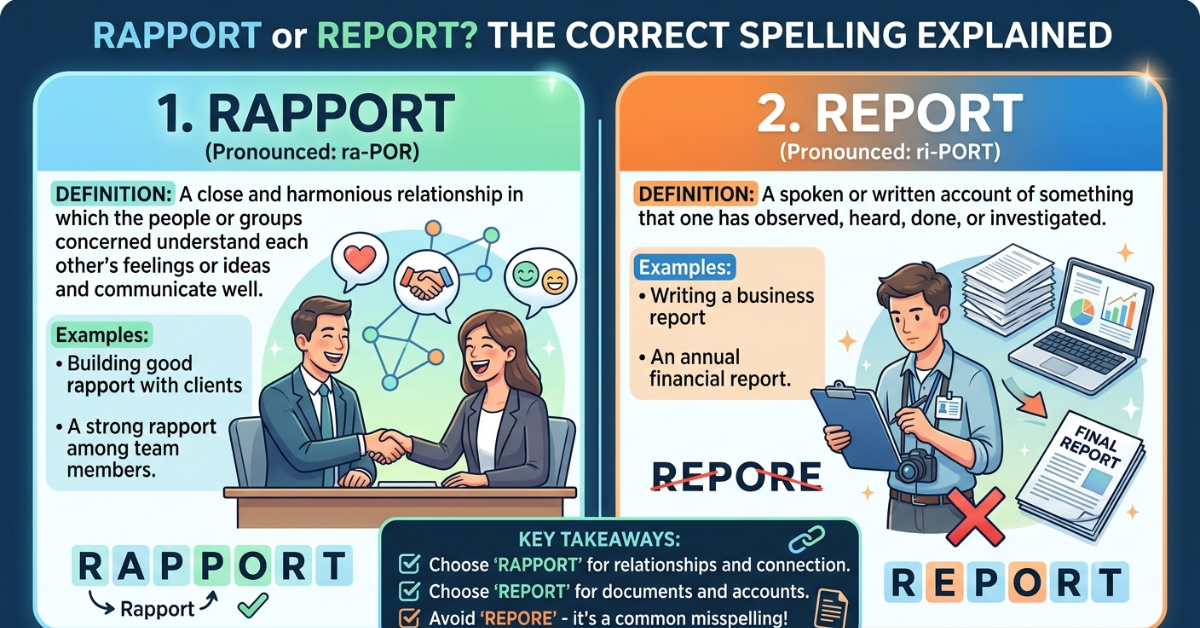
The short answer is this: “repore” is not the standard correct spelling. In most cases, the word people are looking for is rapport. It refers to a close, harmonious, and trusting relationship in which people understand each other well and communicate easily. In this guide, you’ll learn the correct spelling, what rapport means, why so many people spell it as “repore,” and how to build rapport in personal and professional relationships.
What Does “Repore” Mean?
If you’ve searched repore, you were most likely looking for the word rapport.
The simple answer
Repore is a misspelling or phonetic spelling of rapport. People often write “repore” because it sounds similar to how “rapport” is pronounced in casual speech.
The correct word is: rapport
Rapport means a positive connection between two or more people. It’s the feeling of ease, trust, mutual understanding, and comfort in a relationship.
You’ll often hear it in sentences like:
- “The teacher quickly built a strong rapport with her students.”
- “A good salesperson knows how to establish rapport with clients.”
- “Doctors need rapport with patients to communicate effectively.”
So if you’ve been wondering about spell repore or how do you spell repore, the correct spelling you want is rapport.
Repore Spelling: Why So Many People Get It Wrong
The confusion around repore spelling is completely understandable. “Rapport” is one of those English words that doesn’t look exactly the way it sounds.
Why “rapport” gets misspelled as “repore”
There are a few reasons this happens:
1. It’s often learned by hearing, not reading
A lot of people first encounter the word in spoken English—during interviews, business talks, therapy sessions, teaching, or workplace communication. When they later try to write it, they spell it the way it sounds to them: repore, rapore, rapor, or raport.
2. The spelling is influenced by its origin
The word rapport comes from French, which helps explain why the spelling doesn’t feel very intuitive in English.
3. English pronunciation can be misleading
In everyday speech, “rapport” may sound closer to “ra-PORE” or “ruh-PORE,” which makes a spelling like repore seem plausible even though it isn’t correct.
How Do You Spell Repore? The Correct Spelling Is “Rapport”
Let’s answer the question directly.
Correct spelling:
Rapport
Incorrect spellings:
- Repore
- Rapore
- Rappore
- Raport
- Repoor
Correct pronunciation:
Most commonly: ra-PORE or ruh-PORE
If you’re writing about a positive relationship, mutual understanding, trust, or easy communication, the word you want is rapport.
Repore or Rapport: Which One Is Correct?
If you’re comparing repore or rapport, the correct choice in standard English is rapport.
Quick comparison
| Word | Correct? | Meaning |
| Repore | No | Common misspelling of rapport |
| Rapport | Yes | A close, harmonious relationship marked by understanding and trust |
So if you’re writing a sentence like:
- “It’s important to have a good repore with customers.”
The corrected version should be:
- “It’s important to have a good rapport with customers.”
What Does Rapport Actually Mean?
Understanding the meaning helps the spelling stick.
Definition of rapport
Rapport is a relationship in which people feel comfortable, connected, and understood. It usually involves:
- Trust
- Mutual respect
- Ease in conversation
- Emotional comfort
- Strong communication
- A sense of connection
You can have rapport with:
- Friends
- Family members
- Colleagues
- Clients
- Patients
- Students
- Teachers
- Interviewers
- Managers
- Team members
In simple terms, rapport is the “click” between people that makes interaction smoother and more genuine.
Building Repore? The Correct Phrase Is “Building Rapport”
If you’ve searched building repore or build repore, what you’re really looking for is building rapport.
What does “building rapport” mean?
It means creating a connection with someone so they feel comfortable talking to you, trusting you, and engaging with you positively.
This is especially important in:
- Job interviews
- Customer service
- Teaching and mentoring
- Sales and marketing
- Healthcare
- Leadership and management
- Friendships and dating
- Networking and professional relationships
Why Building Rapport Matters in Real Life
Rapport isn’t just a “nice extra.” In many situations, it’s what determines whether a relationship works at all.
1. In the workplace
Employees who have good rapport with coworkers and managers often communicate better, solve problems faster, and feel more comfortable collaborating.
2. In business and sales
People are more likely to buy from, work with, or listen to someone they trust. Rapport makes conversations feel less forced and more human.
3. In teaching and learning
Students usually respond better to teachers who make them feel seen, respected, and understood. A strong teacher-student connection can improve motivation and participation.
4. In healthcare and counseling
Patients are more likely to open up, follow advice, and feel safe when they have rapport with a doctor, therapist, or counselor.
5. In personal relationships
Good rapport creates smoother conversations, fewer misunderstandings, and a stronger emotional bond.
Having a Good Repore With Someone: What It Really Means
The phrase having a good repore with someone should be written as having good rapport with someone.
What does it mean to have good rapport with someone?
It means:
- Conversations flow naturally
- You both feel comfortable
- There’s mutual trust and respect
- You understand each other’s tone, style, or feelings
- Communication feels easy rather than strained
Example sentences
- “She has a great rapport with her students.”
- “He built rapport with the client within minutes.”
- “A manager should develop rapport with the team.”
When someone says, “They have great rapport,” they usually mean those two people connect well and work well together.
How to Build Rapport With Someone
If your goal is to build rapport, here are practical, real-world strategies that actually work.
1. Listen more than you speak
People feel connected to those who genuinely listen. Instead of waiting for your turn to talk, pay attention to what the other person is saying.
Try this:
- Maintain eye contact
- Don’t interrupt
- Ask follow-up questions
- Reflect back key points
Example:
Instead of saying, “Yeah, I know exactly what you mean,” try:
“That sounds frustrating. What happened next?”
That small shift makes the other person feel heard.
2. Use the person’s name naturally
Hearing one’s own name can make communication feel warmer and more personal. Don’t overdo it, but using someone’s name occasionally helps create familiarity.
Example:
“Fatima, that’s a really interesting point.”
3. Show genuine interest
Rapport can’t be faked for long. People can usually tell when someone is asking questions just to be polite. If you want to connect, be curious.
Good rapport-building questions:
- “How did you get into that field?”
- “What do you enjoy most about your work?”
- “What made you choose that project?”
- “How did that experience affect you?”
4. Match the tone and energy of the conversation
This doesn’t mean copying someone awkwardly. It means adjusting your communication style so the interaction feels natural.
For example:
- If someone is speaking seriously, don’t respond with exaggerated jokes.
- If they’re warm and informal, sounding overly stiff may create distance.
- If they’re quiet and thoughtful, giving them space can help more than dominating the conversation.
This kind of subtle alignment often helps build rapport faster.
5. Find common ground
One of the easiest ways to create connection is to discover shared interests, experiences, or values.
Common ground could be:
- A mutual hobby
- Similar work experience
- Shared goals
- A common challenge
- Similar tastes in books, films, or travel
- Being from the same city or industry
Once people feel, “Oh, you get it,” rapport often starts to form naturally.
6. Be present, not performative
A lot of people damage rapport by trying too hard to impress. Instead of focusing on being interesting, focus on being engaged.
Presence looks like:
- Paying attention without checking your phone
- Responding thoughtfully
- Not rushing the conversation
- Being comfortable with short pauses
People remember how you made them feel more than how polished your words were.
7. Respect boundaries and social cues
Rapport grows when people feel safe—not pressured. If someone seems uncomfortable, distracted, or private, pushing too hard can have the opposite effect.
Signs to slow down:
- Very short responses
- Closed body language
- Avoiding eye contact
- Repeatedly changing the topic
- Looking rushed or uneasy
Good rapport includes emotional intelligence, not just friendliness.
8. Follow through on what you say
Trust is one of the foundations of rapport. If you say you’ll call, email, send a file, or show up at a certain time, do it.
Reliability turns a pleasant interaction into a trusted relationship.
How Rapport Looks in Different Settings
Rapport isn’t one-size-fits-all. It shows up differently depending on the context.
Rapport at work
At work, rapport often looks like:
- Easy communication
- Mutual respect
- Productive teamwork
- Openness to feedback
- A comfortable professional relationship
Example
A manager who checks in respectfully, listens to concerns, and communicates clearly is more likely to build rapport with the team.
Rapport in friendships
In friendships, rapport usually means:
- Shared humor
- Emotional ease
- Trust
- Honest conversation
- Feeling understood without overexplaining
Rapport in interviews
In interviews, rapport can help you come across as confident, likable, and easy to work with.
Ways to build rapport in an interview:
- Greet warmly
- Match the interviewer’s tone
- Show enthusiasm without forcing it
- Listen carefully before answering
- Mention shared goals or interests when relevant
Rapport in customer service or sales
Customers are more receptive when they feel they’re being treated like a person rather than a transaction.
Building rapport with clients can involve:
- Remembering previous details
- Personalizing your communication
- Being honest about timelines and expectations
- Asking useful questions instead of giving a rehearsed pitch
Common Mistakes People Make When Trying to Build Rapport
Sometimes people try to connect but accidentally make the interaction feel uncomfortable. Here are a few common mistakes.
1. Talking too much about yourself
Sharing can help, but dominating the conversation usually doesn’t build connection.
2. Asking overly personal questions too early
Rapport takes time. Pushing into sensitive topics before trust exists can create distance.
3. Being fake or overly polished
People tend to sense forced charm. Authenticity works better than performance.
4. Interrupting or “one-upping”
If someone shares an experience and you immediately top it with your own story, it can feel dismissive rather than engaging.
5. Ignoring body language
Words matter, but so do tone, facial expressions, and nonverbal cues.
Is “Rapport” Formal or Informal?
“Rapport” works in both formal and informal settings.
Formal use
You’ll often see it in:
- Business communication
- HR and management discussions
- Psychology and counseling contexts
- Education and training materials
- Medical communication
Informal use
People also use it casually in everyday speech:
- “We got along instantly.”
- “She has great rapport with everyone.”
- “He knows how to connect with people.”
Easy Ways to Remember the Correct Spelling of Rapport
If you keep typing repore by mistake, these memory tricks can help.
Trick 1: Remember the phrase “build rapport”
The phrase build rapport appears often in business, communication, teaching, and interview advice. Seeing it repeatedly can reinforce the correct spelling.
Trick 2: Focus on the double “p”
Ra-p-port
The double p helps separate it from phonetic spellings like repore.
Trick 3: Learn it as a whole word, not by sound
Because “rapport” doesn’t sound exactly like it looks, memorizing the full written form works better than trying to spell it phonetically.
Trick 4: Use it in a sentence
Write a few examples:
- I want to build rapport with my team.
- She has strong rapport with her clients.
- Good teachers create rapport with students.
Repore in Search: Why People Still Type It
Search behavior often reflects pronunciation, not dictionary spelling. That’s why people type queries like:
- repore spelling
- how do you spell repore
- repore or rapport
- spell repore
- having a good repore with someone
- building repore
- build repore
These searches all point to the same underlying question: What is the correct word, and how do I use it properly?
The answer remains the same: the correct spelling is rapport.
Key Takeaways
If you only remember a few things from this article, make them these:
- Repore is not the standard correct English spelling.
- The correct word is rapport.
- Rapport means a harmonious, trusting, and comfortable connection between people.
- If you want to write building repore, the correct phrase is building rapport.
- Having good rapport matters in work, friendships, teaching, interviews, healthcare, and customer relationships.
- Rapport is built through listening, empathy, trust, presence, and genuine interest.
Frequently Asked Questions
Is repore a real word?
In standard English, repore is not the accepted spelling for the relationship-related word most people mean. The correct word is rapport.
How do you spell repore correctly?
If you’re referring to a positive connection or understanding between people, the correct spelling is rapport.
Repore or rapport: which one should I use?
Use rapport. “Repore” is a common misspelling based on pronunciation, while rapport is the correct word in dictionaries and formal writing.
What does having good rapport with someone mean?
It means you and the other person communicate easily, trust each other, and feel comfortable around one another. There’s usually a sense of mutual understanding and respect.
What does building rapport mean?
Building rapport means developing trust, comfort, and a positive connection with another person. It’s especially important in work, interviews, teaching, sales, and relationships.
Why do people spell rapport as repore?
Mostly because of pronunciation. Many people hear the word spoken before they ever see it written, so they spell it the way it sounds.
Conclusion
If you’ve been searching for repore, repore spelling, repore or rapport, or how do you spell repore, the confusion makes sense—but the correct word is rapport. It’s the term used to describe a positive, trusting, and harmonious connection between people, whether in business, friendship, education, healthcare, or everyday conversation.
More importantly, understanding rapport isn’t just about spelling a word correctly. It’s about understanding how human connection works: listening well, showing genuine interest, communicating with respect, and making others feel comfortable around you. Once you know both the spelling and the meaning, you won’t just use the word correctly—you’ll be better equipped to actually build rapport in real life.
Author

linguaezone.com@gmail.com
Related Posts
Kill Two Birds With One Stone Alternative: 50 Better Options
- 0
- 1,569 word
Have you ever paused before saying “kill two birds with one stone” because it sounded too violent or simply didn’t fit the...
Read out all
Happy Sabbath Meaning: A Complete Guide to Its Significance
- 0
- 1,632 word
Have you ever received the message “Happy Sabbath” and wondered what it truly means? Is it simply another way of saying “have...
Read out all
I’m So Proud of You in Other Words: 120+ Heartfelt Alternatives
- 0
- 1,562 word
Have you ever wanted to tell someone you’re proud of them but felt like saying “I’m so proud of you” sounded repetitive?...
Read out all
How Do You Spell Happy Anniversary? Correct Spelling Guide
- 0
- 1,221 word
Have you ever paused before writing an anniversary card and wondered, “How do you spell happy anniversary?” You’re not alone. Whether you’re...
Read out all
Waiting for Your Response Email: Best Examples & Tips
- 0
- 1,483 word
Have you ever sent an important email and found yourself wondering whether you should follow up or simply wait? Whether you’re communicating...
Read out all
Great Asset to the Team: Meaning, Examples & Tips
- 0
- 1,494 word
Have you ever wanted to compliment a coworker but struggled to find words that sound professional and sincere? One of the most...
Read out all