
- 0
- 689 words
Have you ever written “grately appreciated” and stopped for a second, wondering if it looks correct? This is a very common mistake. The confusion between greatly vs grately often appears in everyday writing, especially in emails, messages, and academic work.
The truth is simple: “greatly” is correct, while “grately” is just a spelling error. In this article, you will learn the meaning of greatly, why people make this mistake, and how to avoid it in your writing.
What Does “Greatly” Mean in English?
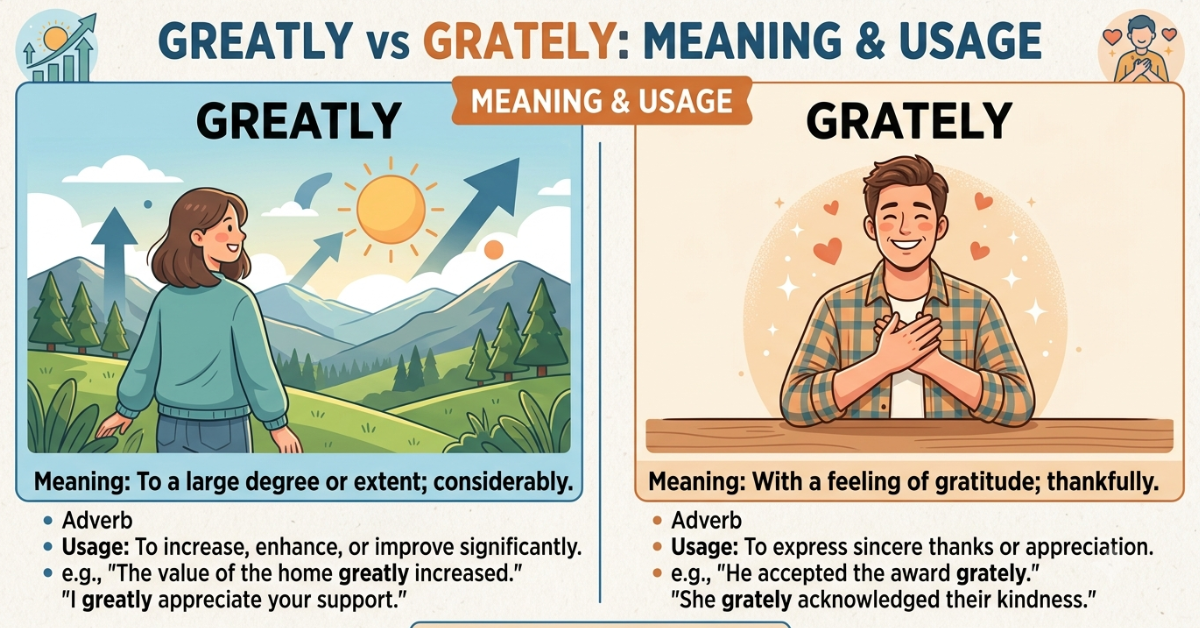
The word greatly works as an adverb. It comes from the adjective great and describes something done to a large extent or very strongly.
Meaning of “greatly”:
- To a large degree
- Very much
- In a strong or significant way
Examples:
- I greatly appreciate your help.
- The situation has greatly improved over time.
- She greatly values honesty in relationships.
In all these sentences, the word “greatly” increases the intensity of the action.
Is “Grately” a Correct Word?
Many writers wonder if grately is a valid alternative. The answer is no.
English dictionaries such as Oxford and Merriam-Webster do not recognize “grately” as a word. It does not carry any meaning in standard English.
Why people write “grately”:
- They confuse pronunciation with spelling
- They type quickly on mobile devices
- They mix it up with words like grateful or grate
So, whenever you see grately vs greatly, remember that only greatly is correct.
Greatly vs Grately: Key Differences
Let’s clearly compare both forms:
| Feature | Greatly (Correct) | Grately (Incorrect) |
| Spelling | Correct | Wrong |
| Meaning | Strongly / very much | No meaning |
| Usage | Formal & informal | Not used in English |
| Acceptance | Widely accepted | Not recognized |
This makes the difference between greatly vs grately very easy to understand.
Why This Mistake Happens So Often
People frequently misuse this word for a few simple reasons:
1. Pronunciation confusion
The word “greatly” sounds like “grate-ly,” which leads to incorrect spelling.
2. Fast typing habits
People often type messages quickly without checking spelling.
3. Lack of proofreading
Many errors appear when writers skip reviewing their text.
Common Phrases with “Greatly”
You will often see “greatly” in formal and professional writing.
Popular expressions:
- Greatly appreciated
- Greatly influenced
- Greatly improved
- Greatly concerned
Example sentences:
- Your support is greatly appreciated.
- The design greatly improved after feedback.
- He was greatly influenced by his teacher.
These phrases appear frequently in emails, reports, and academic writing.
How to Avoid Confusing Greatly vs Grately
You can easily avoid this mistake with a few simple habits:
- Break the word into “great + ly”
- Use spell-check tools while writing
- Practice writing correct sentences regularly
- Slow down when typing important messages
These small steps help you build accuracy over time.
Why Correct Usage Matters
Correct spelling plays an important role in communication. Using the wrong form like grately can:
- Reduce your writing credibility
- Create confusion in formal communication
- Affect academic or professional results
On the other hand, using greatly correctly improves clarity and strengthens your writing tone.
Key Takeaways
- “Greatly” is the only correct spelling
- “Grately” is a common spelling mistake
- The word “greatly” means very much or to a large extent
- It appears frequently in formal writing
- Proofreading helps prevent this error
FAQs: Greatly vs Grately
1. Is “grately” a real English word?
No, “grately” is not a valid English word. The correct form is “greatly.”
2. What does greatly mean?
“Greatly” means very much or to a large degree, showing strong intensity.
3. Why do people write grately instead of greatly?
People often confuse pronunciation and make typing mistakes while writing quickly.
4. Can I use grately in informal writing?
No, even in informal writing, “grately” is incorrect and should be avoided.
5. How can I remember the correct spelling?
Think of it as “great + ly,” which forms “greatly.”
6. Is “greatly appreciated” correct grammar?
Yes, “greatly appreciated” is a correct and commonly used phrase.
Conclusion
The confusion between greatly vs grately is common but easy to fix. Only greatly is correct in English, while “grately” remains a spelling error.
Once you understand the meaning and practice its usage, you can confidently use it in writing without hesitation. Strong communication always depends on correct spelling, and mastering small details like this improves your overall writing quality.
Author

linguaezone.com@gmail.com
Related Posts

Kill Two Birds With One Stone Alternative: 50 Better Options
- 0
- 1,569 word
Have you ever paused before saying “kill two birds with one stone” because it sounded too violent or simply didn’t fit the...
Read out all
Happy Sabbath Meaning: A Complete Guide to Its Significance
- 0
- 1,632 word
Have you ever received the message “Happy Sabbath” and wondered what it truly means? Is it simply another way of saying “have...
Read out all
I’m So Proud of You in Other Words: 120+ Heartfelt Alternatives
- 0
- 1,562 word
Have you ever wanted to tell someone you’re proud of them but felt like saying “I’m so proud of you” sounded repetitive?...
Read out all
How Do You Spell Happy Anniversary? Correct Spelling Guide
- 0
- 1,221 word
Have you ever paused before writing an anniversary card and wondered, “How do you spell happy anniversary?” You’re not alone. Whether you’re...
Read out all
Waiting for Your Response Email: Best Examples & Tips
- 0
- 1,483 word
Have you ever sent an important email and found yourself wondering whether you should follow up or simply wait? Whether you’re communicating...
Read out all
Great Asset to the Team: Meaning, Examples & Tips
- 0
- 1,494 word
Have you ever wanted to compliment a coworker but struggled to find words that sound professional and sincere? One of the most...
Read out all