
- 0
- 993 words
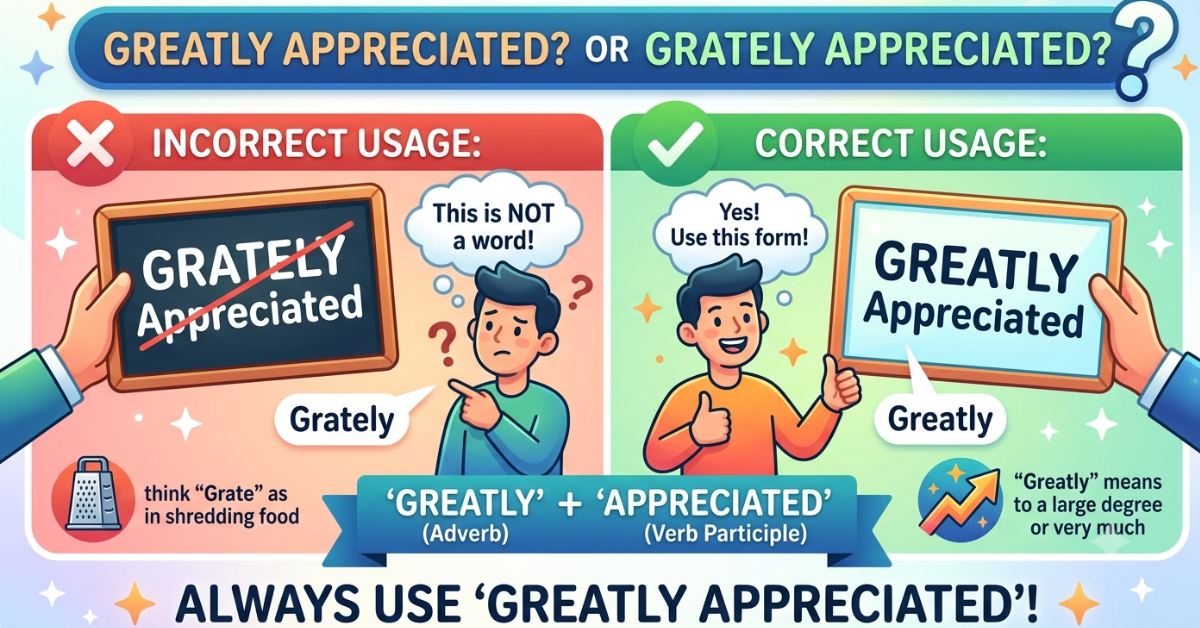
Have you ever written “grately appreciated” in an email and then paused, wondering if it looks correct? If so, you are not alone. Many people make this mistake while writing quickly, especially in formal messages or thank-you notes. However, the correct phrase is “greatly appreciated,” not “grately or greatly appreciated.”
In this guide, you will clearly understand the correct spelling, grammar rules, and real-world usage. Moreover, you will also learn how to use this phrase naturally in both professional and casual communication.
Is It Grately or Greatly Appreciated?
To begin with, the correct phrase is greatly appreciated.
- Incorrect: Your help is grately appreciated.
- Correct: Your help is greatly appreciated.
Although both words may look similar, only greatly is grammatically correct. Therefore, “grately” is simply a spelling error.
In addition, this mistake usually happens when people type quickly or rely on how the word sounds rather than how it is spelled.
What Does Greatly Appreciated Mean?
To understand the phrase better, let’s break it down.
Greatly appreciated means something is valued very highly or deeply acknowledged.
In simple terms, it expresses:
- Strong gratitude
- Deep recognition
- Sincere thankfulness
For example:
- Your quick response is greatly appreciated.
Here, the phrase does more than just say “thank you.” Instead, it adds emphasis and shows genuine respect.
Furthermore, it is commonly used in formal communication because it sounds polite and professional.
Why “Grately” Is Incorrect
To clarify further, “grately” is not a valid English word. The correct formation comes from:
great + ly = greatly
As a result, only “greatly” follows proper English grammar rules.
Moreover, many learners confuse it with similar spelling patterns, especially when typing quickly. Consequently, “grately” appears in informal writing but is not accepted in standard English.
Grammar Breakdown of “Greatly Appreciated”
To understand the structure more clearly, let’s analyze both words.
1. Greatly (Adverb)
Firstly, “greatly” functions as an adverb. It modifies verbs and shows intensity. In other words, it means:
- very much
- to a large extent
2. Appreciated (Verb form)
Secondly, “appreciated” refers to something being valued or recognized.
When combined, they create a stronger meaning:
something is valued to a very high degree
Thus, the phrase becomes a polite and powerful expression of gratitude.
How to Use Greatly Appreciated in Sentences
Now that the meaning is clear, let’s see how the phrase works in real communication. Importantly, its usage depends on context.
1. In Professional Emails
To start with, it is commonly used in workplace communication:
- Your support is greatly appreciated.
- Your prompt response is greatly appreciated.
2. In Polite Requests
Similarly, it is used to make respectful requests:
- It would be greatly appreciated if you could share the details.
- Your feedback would be greatly appreciated.
3. In Formal Acknowledgments
In addition, it works well when expressing gratitude:
- Your contribution is greatly appreciated.
- The team’s efforts were greatly appreciated.
As you can see, the phrase consistently maintains a polite and professional tone.
Common Mistakes with “Greatly Appreciated”
Although the phrase is simple, people still make errors. Let’s look at them carefully.
1. Spelling it as “grately appreciated”
First of all, this is the most common mistake. However, it should always be corrected to greatly appreciated.
2. Overusing the phrase
On the other hand, repeating it too often can make writing sound robotic. Therefore, it is better to use alternatives occasionally.
3. Using it in casual conversations
In addition, it may sound too formal in friendly chats. For example:
- Incorrect: Your help is greatly appreciated
- Correct: Thanks a lot
Thus, choosing the right tone is important.
Greatly Appreciated vs Much Appreciated
At this point, it is helpful to compare similar phrases.
Greatly Appreciated
- Firstly, it is more formal
- Secondly, it fits professional writing
- Finally, it sounds more polished
Much Appreciated
- In contrast, it is more casual
- Additionally, it works in everyday communication
- Overall, it feels more conversational
Therefore, your choice depends on the situation and tone.
Better Alternatives to Improve Writing
Since repetition can reduce impact, here are some useful alternatives.
Formal Alternatives
- Your assistance is sincerely appreciated
- Your support is highly valued
- Any help would be most appreciated
Neutral Alternatives
- I appreciate your help
- Thanks in advance
- Your feedback is welcome
Casual Alternatives
- Thanks so much
- Really appreciate it
- Much appreciated
By using these variations, your writing becomes more natural and engaging.
When Should You Use “Greatly Appreciated”?
Generally speaking, you should use this phrase when you want to sound:
- Respectful in formal communication
- Polite in professional emails
- Clear in structured requests
However, in casual conversations, simpler phrases often work better.
Why This Phrase Is Common in Professional Writing
In professional environments, tone matters a lot. Therefore, expressions like greatly appreciated help maintain respect and clarity.
For instance, it is widely used in:
- Business emails
- Academic communication
- Customer service messages
As a result, it has become a standard phrase in formal English writing.
Key Takeaways
To summarize the main points:
- First, the correct phrase is greatly appreciated
- Second, “grately appreciated” is incorrect
- Third, it expresses strong gratitude in formal writing
- Moreover, it is best suited for professional communication
- Finally, casual alternatives often sound more natural in everyday use
FAQ: Grately or Greatly Appreciated
1. Is it grately or greatly appreciated?
The correct form is greatly appreciated. “Grately” is a spelling mistake and should not be used.
2. What does greatly appreciated mean?
It means something is deeply valued or strongly acknowledged. In simple terms, it expresses sincere gratitude.
3. Is greatly appreciated formal?
Yes, it is mainly used in formal and professional communication, especially in emails and official messages.
4. Can I use highly appreciated instead?
Although it is understandable, greatly appreciated is more natural and widely used in English.
5. Is greatly appreciated too formal for texting?
Yes, in casual texting it can sound stiff. Instead, phrases like “thanks so much” are more natural.
Conclusion
In conclusion, understanding the difference between grately or greatly appreciated helps you avoid a common writing mistake. Clearly, the correct phrase is greatly appreciated, and it plays an important role in polite and professional communication.
Author

linguaezone.com@gmail.com
Related Posts
Kill Two Birds With One Stone Alternative: 50 Better Options
- 0
- 1,569 word
Have you ever paused before saying “kill two birds with one stone” because it sounded too violent or simply didn’t fit the...
Read out all
Happy Sabbath Meaning: A Complete Guide to Its Significance
- 0
- 1,632 word
Have you ever received the message “Happy Sabbath” and wondered what it truly means? Is it simply another way of saying “have...
Read out all
I’m So Proud of You in Other Words: 120+ Heartfelt Alternatives
- 0
- 1,562 word
Have you ever wanted to tell someone you’re proud of them but felt like saying “I’m so proud of you” sounded repetitive?...
Read out all
How Do You Spell Happy Anniversary? Correct Spelling Guide
- 0
- 1,221 word
Have you ever paused before writing an anniversary card and wondered, “How do you spell happy anniversary?” You’re not alone. Whether you’re...
Read out all
Waiting for Your Response Email: Best Examples & Tips
- 0
- 1,483 word
Have you ever sent an important email and found yourself wondering whether you should follow up or simply wait? Whether you’re communicating...
Read out all
Great Asset to the Team: Meaning, Examples & Tips
- 0
- 1,494 word
Have you ever wanted to compliment a coworker but struggled to find words that sound professional and sincere? One of the most...
Read out all