
- 0
- 2,053 words
Have you ever typed sleave and paused, wondering if it was a typo—or a real word? You’re not alone. The confusion around sleave or sleeve is surprisingly common, especially because one of them is a familiar clothing term while the other looks like it should be one too.
If you’ve been searching for the difference between sleave or sleeve, this guide breaks it down clearly. You’ll learn which spelling is correct in modern English, whether sleave is an actual word, how sleeve is used in everyday writing, and why people often mix the two up in the first place.
The Short Answer: Is It Sleave or Sleeve?
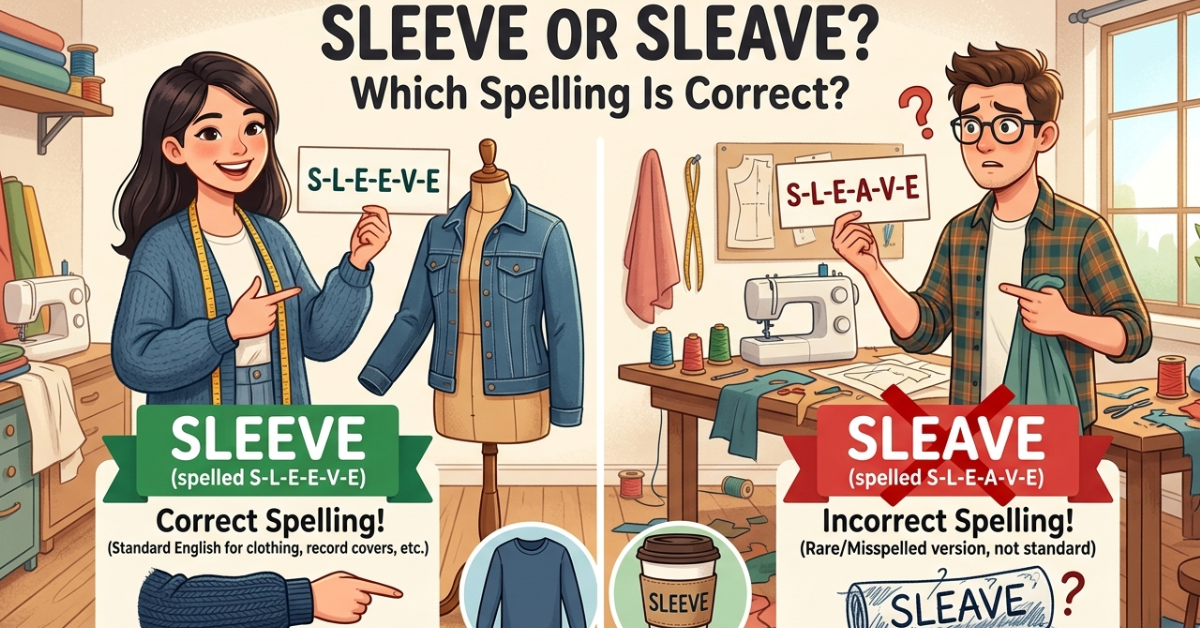
In almost every modern context, the correct word is sleeve.
A sleeve is the part of a garment that covers all or part of the arm. It can also be used in several extended meanings, such as a protective cover or a strategy someone is “hiding up their sleeve.”
Sleave, on the other hand, is not the standard modern spelling for anything related to clothing. It is an old and very rare English word that survives mostly in literary or historical contexts.
Quick rule to remember
- Sleeve = correct modern word for clothing and common expressions
- Sleave = archaic/obsolete word, rarely used today
So if you’re writing about shirts, dresses, jackets, tailoring, fashion, or everyday expressions, sleeve is the word you want.
What Does “Sleeve” Mean?
The word sleeve most commonly refers to the section of clothing attached to the armhole of a garment and designed to cover the arm.
Examples of sleeve in everyday use
- She rolled up her sleeves before starting work.
- This dress has long lace sleeves.
- His jacket sleeve was torn at the cuff.
- The tailor shortened the sleeves by two inches.
But sleeve isn’t limited to clothing. It also appears in other common uses.
Other meanings of sleeve
1. A protective cover
A sleeve can be a covering used to protect or store something.
Examples:
- Put the document in a plastic sleeve.
- The laptop came with a padded sleeve.
- Keep the vinyl record in its original sleeve.
2. A tube-like part in engineering or packaging
In manufacturing, design, or product packaging, a sleeve may refer to a cylindrical covering, liner, or outer wrap.
Examples:
- The cable passed through a metal sleeve.
- The coffee cup had a cardboard sleeve to protect hands from heat.
3. Part of an idiom
English uses sleeve in several popular expressions:
- Up your sleeve – a hidden plan or advantage
- Wear your heart on your sleeve – show emotions openly
- Laugh up your sleeve – laugh quietly or secretly
This wide range of meanings is one reason sleeve is such a common and important word in English.
Is “Sleave” a Real Word?
Yes—but not in the way most people assume.
Sleave is a real English word historically, but it is rare, archaic, and not used in normal modern writing. It does not function as the standard spelling of sleeve.
Historically, sleave has been used to refer to:
- untwisted silk or floss
- something delicate and thread-like
- older poetic or literary references
It’s the kind of word you’re more likely to encounter in old dictionaries, Shakespeare discussions, literary analysis, or historical texts than in everyday English.
Why this matters
If you’re writing:
- a fashion article
- a product description
- a school essay
- an Instagram caption
- a blog post about clothing
- a sewing or tailoring guide
then sleeve is the correct choice—not sleave.
Sleave vs Sleeve: The Difference at a Glance
| Word | Modern Use | Meaning | Common Today? | Correct for Clothing? |
| Sleeve | Standard English | Part of a garment covering the arm; also a cover or casing | Yes | Yes |
| Sleave | Archaic/literary | Old term related to silk floss or thread | No | No |
If your sentence involves a shirt, kurti, blazer, abaya, sweater, coat, or any arm-covering part of clothing, the answer is simple: use sleeve.
Why People Confuse Sleave or Sleeve
At first glance, sleave and sleeve look close enough to be alternate spellings. That’s where the confusion starts.
1. They sound similar
When spoken quickly, the two can sound almost identical depending on accent and pronunciation.
2. English spelling isn’t always intuitive
English is full of words where small vowel changes create completely different words—or no standard word at all. Because sleeve is familiar, some people assume sleave might be a valid variant.
3. Typing errors and autocorrect habits
A simple letter swap can create sleave, and if you’ve seen it online, you may wonder whether it’s accepted. In most cases, it’s either:
- a typo for sleeve
- a misspelling in user-generated content
- a rare literary use unrelated to clothing
4. Search engines often show mixed results
People search things like:
- is it sleave or sleeve
- sleave meaning
- how do you spell sleeve
- shirt sleave or sleeve
Because so many users make the same mistake, the confusion keeps circulating.
How to Use “Sleeve” Correctly in Sentences
If you want to make sure you’re using the word properly, it helps to see it in different contexts.
Clothing examples
- Her blouse has puffed sleeves.
- The sweater’s sleeves were too long for me.
- He stained the sleeve of his white shirt.
- The designer added embroidered sleeves to the dress.
Fashion and tailoring examples
- Choose three-quarter sleeves for a softer silhouette.
- The tailor widened the jacket sleeves for comfort.
- Bell sleeves can add movement and drama to an outfit.
Product and packaging examples
- Store the certificate in a protective plastic sleeve.
- I bought a tablet sleeve for travel.
- The café uses recyclable cup sleeves.
Idiom examples
- She always has a clever idea up her sleeve.
- He wears his heart on his sleeve.
- They thought they had won, but our team still had one trick up its sleeve.
Common Types of Sleeves in Fashion
Since the word sleeve is so strongly tied to clothing, it’s useful to understand the common sleeve styles you might see in fashion, tailoring, and design writing.
Popular sleeve styles
- Short sleeve – ends above the elbow
- Long sleeve – extends to the wrist
- Cap sleeve – a very short sleeve that just covers the shoulder
- Bell sleeve – flares out toward the bottom
- Puff sleeve – gathered to create volume
- Raglan sleeve – extends in one piece to the collar area
- Bishop sleeve – full sleeve gathered at the wrist
- Three-quarter sleeve – ends between elbow and wrist
- Off-shoulder sleeve – sits below the shoulder line
- Flutter sleeve – soft, loose, and flowing
If you’re writing about fashion, interior styling shoots, clothing descriptions, sewing patterns, or product listings, getting sleeve right matters because it affects both professionalism and clarity.
When Would You Ever Use “Sleave”?
For most writers, almost never.
Still, there are a few narrow situations where sleave might appear.
You may see “sleave” in:
1. Literary study
Older English texts and poetic writing sometimes preserve words that are no longer used in everyday language.
2. Historical dictionaries
Lexicographers and etymology resources may list sleave as an old term connected to silk fibers or thread.
3. Shakespeare discussions
The word is occasionally mentioned in literary commentary because of its historical appearance in older English forms and interpretations.
That said, unless you are writing about historical language, literary criticism, or obsolete vocabulary, you probably do not need to use “sleave” at all.
Spelling Tip: How to Remember the Correct Word
A simple memory trick can stop the confusion instantly:
Think of the “V” in sleeve as standing for “vest” or “visible arm.”
Both relate to clothing, which makes sleeve easier to remember as the garment word.
You can also use this rule:
If it goes on a shirt, dress, jacket, sweater, or coat, it’s sleeve.
That one sentence will solve the issue in nearly every real-world situation.
Sleave or Sleeve in Search Queries: What People Usually Mean
When someone types sleave or sleeve into Google, they’re usually trying to answer one of these questions:
- How do you spell sleeve correctly?
- Is sleave a word?
- Is it shirt sleeve or shirt sleave?
- What is the difference between sleave and sleeve?
- Why did spellcheck mark sleave as wrong?
The intent is mainly informational. People want a quick spelling answer, but they also want confidence that they understand the word properly. That’s why a useful explanation should do more than say “sleeve is correct.” It should also explain:
- why the confusion exists
- whether sleave is ever valid
- how sleeve is used in different contexts
- what to avoid in formal writing
Mistakes to Avoid in Writing
If you want polished, professional writing, watch out for these common errors.
1. Using “sleave” in clothing descriptions
Incorrect: This kurta has beautiful embroidered sleaves.
Correct: This kurta has beautiful embroidered sleeves.
2. Assuming “sleave” is a modern variant
It isn’t a standard alternate spelling in current English. In almost all modern writing, it will look like a spelling mistake.
3. Ignoring plural spelling
The plural of sleeve is sleeves, not sleaves in the clothing sense.
4. Mixing fashion language with archaic vocabulary
If you’re writing for customers, readers, or a general audience, using obscure old spellings can make the content feel incorrect rather than sophisticated.
How Editors, Students, and Content Writers Should Handle It
Whether you’re a student, blogger, fashion writer, or business owner, the best approach is straightforward:
Use “sleeve” for all modern content involving clothing or covers
That includes:
- product descriptions
- fashion blogs
- sewing instructions
- academic writing
- e-commerce listings
- Instagram captions
- wardrobe guides
- tailoring notes
- design portfolios
Only mention “sleave” if you’re discussing old language
For example:
- literary analysis
- historical linguistics
- dictionary comparisons
- archaic vocabulary studies
If your goal is clear communication, sleeve is almost always the correct choice.
Quick Examples: Right vs Wrong
Here are a few side-by-side examples to make the distinction stick.
Correct
- The shirt has rolled-up sleeves.
- I need a laptop sleeve for protection.
- Her wedding dress features sheer sleeves.
- He had one more trick up his sleeve.
Incorrect in modern everyday writing
- The shirt has rolled-up sleaves.
- I need a laptop sleave.
- Her dress has lace sleaves.
Possible only in rare historical/literary contexts
- The scholar explained the archaic word sleave in the poem.
Key Takeaways
If you only remember three things about sleave or sleeve, make them these:
- Sleeve is the correct modern word for the arm-covering part of clothing and for related meanings like protective covers.
- Sleave is a real but archaic word, not the normal spelling of sleeve.
- In everyday English—especially fashion, school, blogging, and product writing—you should use sleeve.
FAQ: Sleave or Sleeve
1. Is it sleave or sleeve?
The correct modern spelling is sleeve. If you’re talking about clothing, a jacket, a shirt, or a protective cover, sleeve is the word you should use.
2. Is “sleave” a real word in English?
Yes, sleave exists historically, but it’s archaic and very uncommon. It is not the standard modern spelling for the clothing word sleeve.
3. How do you spell shirt sleeve?
It’s spelled shirt sleeve, not shirt sleave. The same applies to dress sleeves, jacket sleeves, and sweater sleeves.
4. What does sleeve mean besides clothing?
A sleeve can also mean a protective cover, wrapper, or casing, such as a laptop sleeve, record sleeve, or coffee cup sleeve. It also appears in idioms like “up your sleeve.”
5. Why do people search for sleave or sleeve?
People often confuse them because they sound similar and differ by only one letter. In most online searches, users are trying to confirm that sleeve is the correct spelling.
6. Is “sleaves” ever correct?
Not as the plural of sleeve in modern English. The correct plural is sleeves. Sleaves may appear as a misspelling, but it isn’t standard usage for clothing.
Conclusion
The confusion between sleave or sleeve is understandable, but the rule itself is simple: use “sleeve” in modern English. Whether you’re describing a blouse, editing a product listing, writing a fashion article, or checking grammar, sleeve is the correct and standard spelling.
Sleave does exist, but it belongs to older, highly specialized language rather than everyday writing. So the next time you hesitate, remember this: if it’s part of a shirt, dress, coat, or jacket, it’s sleeve—every time.
If you’re writing regularly about fashion, language, or common spelling confusions, this is one of those small distinctions that instantly makes your content cleaner and more credible.
Author

linguaezone.com@gmail.com
Related Posts

Kill Two Birds With One Stone Alternative: 50 Better Options
- 0
- 1,569 word
Have you ever paused before saying “kill two birds with one stone” because it sounded too violent or simply didn’t fit the...
Read out all
Happy Sabbath Meaning: A Complete Guide to Its Significance
- 0
- 1,632 word
Have you ever received the message “Happy Sabbath” and wondered what it truly means? Is it simply another way of saying “have...
Read out all
I’m So Proud of You in Other Words: 120+ Heartfelt Alternatives
- 0
- 1,562 word
Have you ever wanted to tell someone you’re proud of them but felt like saying “I’m so proud of you” sounded repetitive?...
Read out all
How Do You Spell Happy Anniversary? Correct Spelling Guide
- 0
- 1,221 word
Have you ever paused before writing an anniversary card and wondered, “How do you spell happy anniversary?” You’re not alone. Whether you’re...
Read out all
Waiting for Your Response Email: Best Examples & Tips
- 0
- 1,483 word
Have you ever sent an important email and found yourself wondering whether you should follow up or simply wait? Whether you’re communicating...
Read out all
Great Asset to the Team: Meaning, Examples & Tips
- 0
- 1,494 word
Have you ever wanted to compliment a coworker but struggled to find words that sound professional and sincere? One of the most...
Read out all