
×
Recieve or Receive? The Correct Spelling Guide
In

Have you ever typed recieve and stopped to wonder whether it looks right? You are not alone. This spelling mistake is extremely common, and it happens to people of all ages, even confident writers.

In this guide, you will learn the correct form, why the mistake happens, how to remember the right spelling, and how receive is used in English and Spanish. By the end, recieve vs receive will feel much easier to understand.

Is It Recieve or Receive?

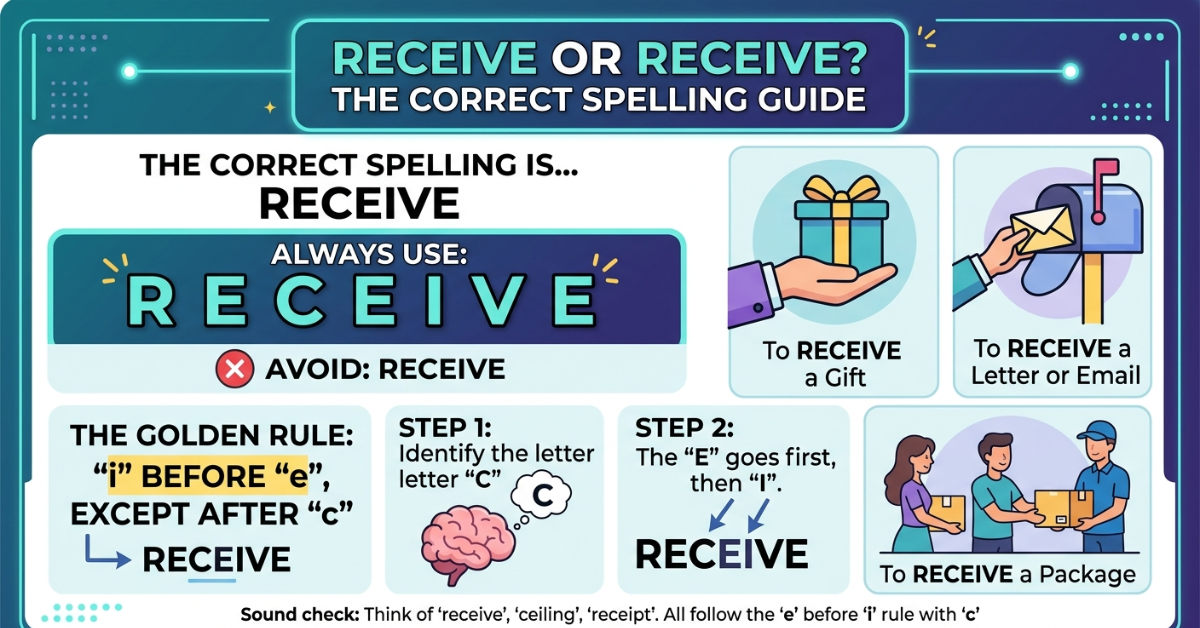
The correct spelling is receive.

Recieve is incorrect, while receive is the standard English spelling used in dictionaries, schools, and professional writing.

Although the mistake looks small, it matters. In formal writing, using the wrong version can make your work look rushed or careless. Therefore, it is worth learning the correct form once and for all.

Quick Example

  • Correct: I receive emails every morning.
  • Incorrect: I recieve emails every morning.

Why Do People Misspell Recieve?

English spelling can be confusing, and this word causes trouble because of a familiar rule: “I before E, except after C.”

Since receive comes after the letter C, the spelling changes to ei instead of ie. That is why the correct version is receive, not recieve.

In other words, the word follows a pattern many learners forget in the moment. As a result, the letters get swapped.

Helpful Memory Trick

Think of it this way:

C + EI = receive

That simple pattern can help you avoid the mistake when writing quickly.

Receive vs Recieve: What’s the Difference?

There is no meaning difference between the two because only one is correct in standard English.

  • Receive = correct
  • Recieve = misspelling

So, whenever you see receive vs recieve, the answer is always the same: use receive.

How to Spell Recieve Correctly Every Time

If you often search for how to spell recieve, a few small habits can help.

1. Remember the rule

“I before E, except after C.”

Because receive follows C, the correct order is ei.

2. Write it in full

Instead of memorizing only the beginning, try repeating the whole word:

re-ceive

That extra focus makes the spelling easier to remember.

3. Use it in sentences

For example:

  • I receive messages every day.
  • She will receive the package tomorrow.
  • They received great news last night.

When you use the word often, the spelling starts to feel natural.

4. Watch for related forms

Once you know receive, you can spell other forms correctly too:

  • received
  • receiving
  • receiver

Because they all come from the same root, the spelling stays consistent.

Recieve Spelling Mistakes People Commonly Make

A lot of people do not just misspell the base word. They also misspell its related forms.

Common incorrect forms

  • recieve
  • recieved
  • recieving

Correct forms

  • receive
  • received
  • receiving

Since the same pattern appears in every form, learning one helps with all the others.

What Does Receive Mean?

The word receive means to get, accept, or be given something. It can also mean to welcome someone or something.

Examples in everyday English

  • I received your text.
  • We receive visitors at noon.
  • She received an award for her work.

In business, school, and daily conversation, this word appears all the time. That is why spelling it correctly is so useful.

To Recieve in Spanish

Many people search for to recieve in spanish, but the correct English spelling is still receive.

In Spanish, receive is usually translated as recibir.

Examples

  • I receive a letter. → Yo recibo una carta.
  • We receive good news. → Nosotros recibimos buenas noticias.
  • She received a gift. → Ella recibió un regalo.

Because recibir is such a common Spanish verb, it is helpful to connect the English and Spanish forms in your memory.

Easy Tips to Avoid the Mistake

Fortunately, a few simple tricks can keep this error out of your writing.

  • Use the phrase “I before E, except after C.”
  • Slow down when typing the middle of the word.
  • Read your sentence aloud and notice whether the spelling looks right.
  • Let spell-check help you, but do not rely on it completely.
  • Practice writing the word several times in real sentences.

Meanwhile, regular reading also helps. The more often you see receive written correctly, the more natural it becomes.

Key Takeaways

  • Receive is the correct spelling.
  • Recieve is always wrong in standard English.
  • The word follows the rule “I before E, except after C.”
  • Receive means to get, accept, or be given something.
  • In Spanish, the closest translation is recibir.

Frequently Asked Questions

Is recieve a correct spelling?

No, recieve is not correct. It is a common spelling mistake, and the proper form is receive.

Why is receive spelled with ei?

Because the word comes after the letter C, it follows the spelling pattern ei rather than ie.

How do you remember the spelling of receive?

A simple trick is to remember: “I before E, except after C.” That rule explains why receive uses ei.

What is the difference between recieve and receive?

There is no real difference in meaning. Receive is correct, while recieve is just a misspelling.

How do you spell received?

You spell it received. Just keep the same ei pattern from receive.

What does receive mean in Spanish?

The Spanish word for receive is usually recibir. It is used in many of the same everyday situations.

Conclusion

Now you know the answer to recieve or receive: the correct spelling is receive. Even though the mistake is common, the rule is easy to remember once you see the pattern.

So, the next time you write it, pause for a second and remember the ei after C. With a little practice, you will spell it correctly every time and write with more confidence.

Leave a Reply

Your email address will not be published. Required fields are marked *

Author

britsx85@gmail.com

Related Posts

Humor or Humour: Meaning & Usage Explained
In

Humor or Humour: Meaning & Usage Explained

Have you ever paused while writing and wondered whether it should be humor or humour? You’re not alone—this small spelling difference often...

Read out all
No Later Than or Then: Which One Is Correct?
In

No Later Than or Then: Which One Is Correct?

Have you ever written a sentence like “Submit the form no later than Friday or then Friday” and suddenly paused, unsure if...

Read out all
Get Past or Get Passed: The Clear Grammar Difference
In

Get Past or Get Passed: The Clear Grammar Difference

Have you ever felt unsure about whether to use get past or get passed in a sentence? This is a very common...

Read out all
Repass or Repast: Which Term Is Correct for a Funeral?
In

Repass or Repast: Which Term Is Correct for a Funeral?

Have you ever heard someone mention a funeral gathering and wondered whether it’s repass or repast? You’re not alone. Many people encounter...

Read out all
What Does Lexus Stand For? Meaning Explained
In

What Does Lexus Stand For? Meaning Explained

Have you ever looked at a luxury car and wondered, what does Lexus stand for and why this name sounds so sleek...

Read out all
Peace vs Piece: Meaning, Difference & Easy Tips to Remember
In

Peace vs Piece: Meaning, Difference & Easy Tips to Remember

English can be tricky, especially when two words sound exactly the same but mean totally different things. One of the most confusing...

Read out all