Pail vs Pale: Meaning, Differences & Easy Guide
- 0
- 785 words
The confusion between pail vs pale is more common than you might think. These two words look almost identical, sound similar in some accents, but their meanings are completely different. If you’ve ever paused while writing, wondering which spelling is correct, you’re not alone.
In this guide, we’ll break down the difference between pail vs pale in a simple, human-friendly way. You’ll learn what each word means, how to use them correctly, and how to never mix them up again.
What is a Pail?
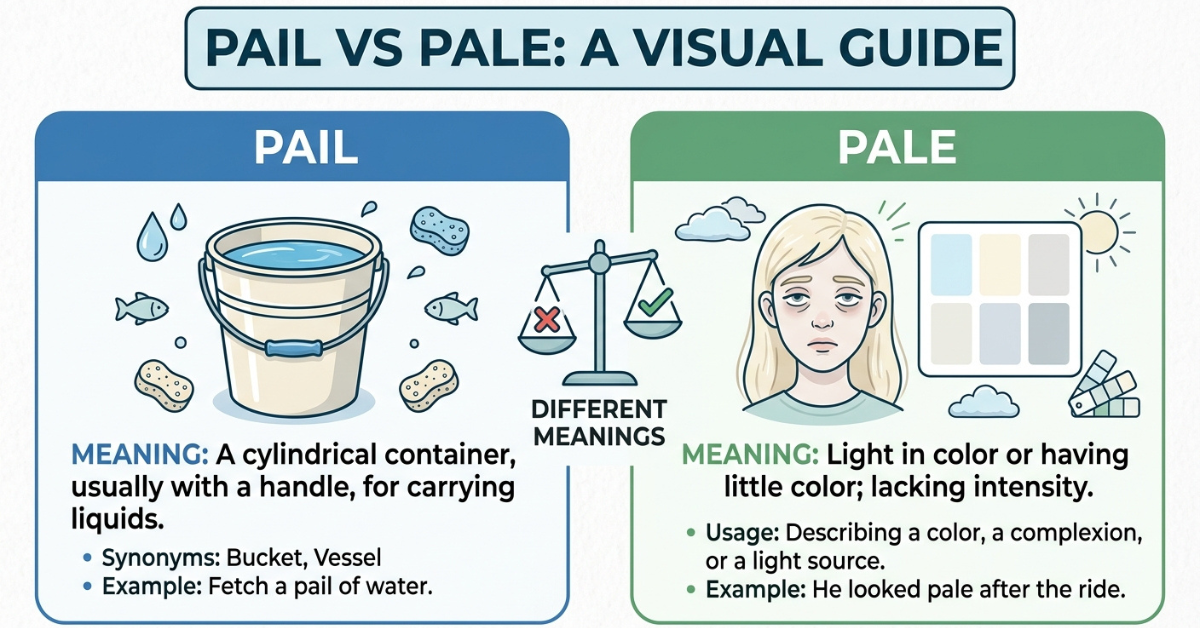
A pail is a noun that refers to a container, usually with a handle, used for carrying liquids or small items.
Think of it as a bucket—but “pail” is often used in more specific or traditional contexts.
Common Uses of a Pail:
- Carrying water from a well
- Holding paint or cleaning supplies
- Used in farming or gardening tasks
- Storing small household materials
Example Sentences:
- She filled the pail with water from the pump.
- The farmer carried a metal pail of milk.
- We used a plastic pail to clean the floor.
In simple words, a pail is always something you can physically hold and carry things in.
What is a Pale?
Now let’s talk about the other half of pail vs pale.
Pale is an adjective (and sometimes a verb or noun) that generally refers to something that is light in color or lacking intensity.
Common Meanings of Pale:
- Light in color (skin, objects, light shades)
- Weak or faint appearance
- Lack of strength or energy
Example Sentences:
- He looked pale after being sick.
- The sky turned a pale shade of blue.
- Her excitement made his worries seem pale in comparison.
So unlike “pail,” which is a physical object, “pale” is descriptive and abstract.
Pail vs Pale: Key Differences
Understanding pail vs pale becomes easy when you compare them side by side.
| Feature | Pail | Pale |
| Part of speech | Noun | Adjective / Verb / Noun |
| Meaning | A container (bucket-like) | Light color or weak appearance |
| Usage context | Physical objects | Descriptions or qualities |
| Example | Water pail | Pale skin or pale light |
Quick Summary:
- Pail = thing (container)
- Pale = description (color or condition)
Easy Ways to Remember Pail vs Pale
If you still mix up pail vs pale, here are some simple memory tricks:
1. Link “Pail” with “Paint”
Both words start with “Pa” and involve containers or objects.
- Paint goes in a pail
- Both are physical things
2. Think of “Pale” = “Pale Face”
When someone is sick or scared, their face becomes pale.
3. Vowel Trick
- Pail = “A” for “Able to carry” (object)
- Pale = “E” for “Expression” (description)
These small tricks make spelling easier to remember in daily writing.
Common Mistakes People Make
Even fluent English speakers sometimes confuse pail vs pale, especially in fast typing or texting.
Frequent errors include:
- Writing “pale of water” instead of “pail of water”
- Using “pail skin” instead of “pale skin”
- Mixing meanings in casual writing
The key is to slow down and check whether you’re talking about a thing or a description.
Why People Confuse Pail vs Pale
There are a few reasons this confusion happens:
- They are homophones in some accents (sound similar)
- They differ by only one letter
- Autocorrect doesn’t always catch the mistake
- Both words are used in everyday English
Once you understand the meaning, the confusion disappears quickly.
Quick Practice Examples
Try choosing the correct word:
- She carried a ___ of water.
- He looked very ___ after the long journey.
- The old metal ___ was full of sand.
- The room was painted in a ___ yellow shade.
Answers:
- pail
- pale
- pail
- pale
FAQs about Pail vs Pale
1. What is the main difference between pail vs pale?
The main difference is meaning: pail is a container, while pale describes light color or weakness.
2. Is pail the same as bucket?
Yes, a pail is very similar to a bucket, often used in older or more specific contexts.
3. Can pale be used as a verb?
Yes, “pale” can be used as a verb meaning to become less bright or less important in comparison.
4. Why do people confuse pail vs pale?
They look and sometimes sound similar, but their meanings are completely unrelated.
5. How can I remember the difference easily?
Think: pail = thing you carry, pale = color or appearance.
Conclusion
Understanding pail vs pale is all about recognizing context. One refers to a physical container used for carrying things, while the other describes color, appearance, or intensity.
Once you get used to the difference, you’ll never confuse them again. The trick is simple: if you can hold it, it’s a pail; if you can describe it, it’s pale.
Keep practicing with real sentences, and soon this common English confusion will be completely out of your writing mistakes list.
Author
britsx85@gmail.com
Related Posts
Peace vs Piece: Meaning, Difference & Easy Tips to Remember
- 0
- 698 words
English can be tricky, especially when two words sound exactly the same but mean totally different things. One of the most confusing...
Read out all
Patience vs Patients: Meaning & Differences Explained
- 0
- 639 words
The confusion between patience vs patients is more common than you might think, especially for English learners and even native speakers. These...
Read out all
Overdo vs Overdue: Meaning, Difference & Examples
- 0
- 603 words
Confused between overdo vs overdue? You’re not alone—these two words look similar, but they have completely different meanings and uses. Many English...
Read out all
Oar vs Ore: Meaning, Differences & Easy Guide Explained
- 0
- 661 words
The confusion between oar vs ore is more common than you might think. Even native English speakers sometimes mix them up because...
Read out all
Naval vs Navel: Meaning, Difference & Easy Guide
- 0
- 859 words
English words can sometimes be confusing, especially when they look almost identical but carry completely different meanings. One such commonly mixed-up pair...
Read out all
Muscle vs Mussel: Key Differences Explained Simply
- 0
- 688 words
If you’ve ever seen the words muscle vs mussel, you’re not alone in wondering why they sound identical but mean completely different...
Read out all