
- 0
- 1,057 word
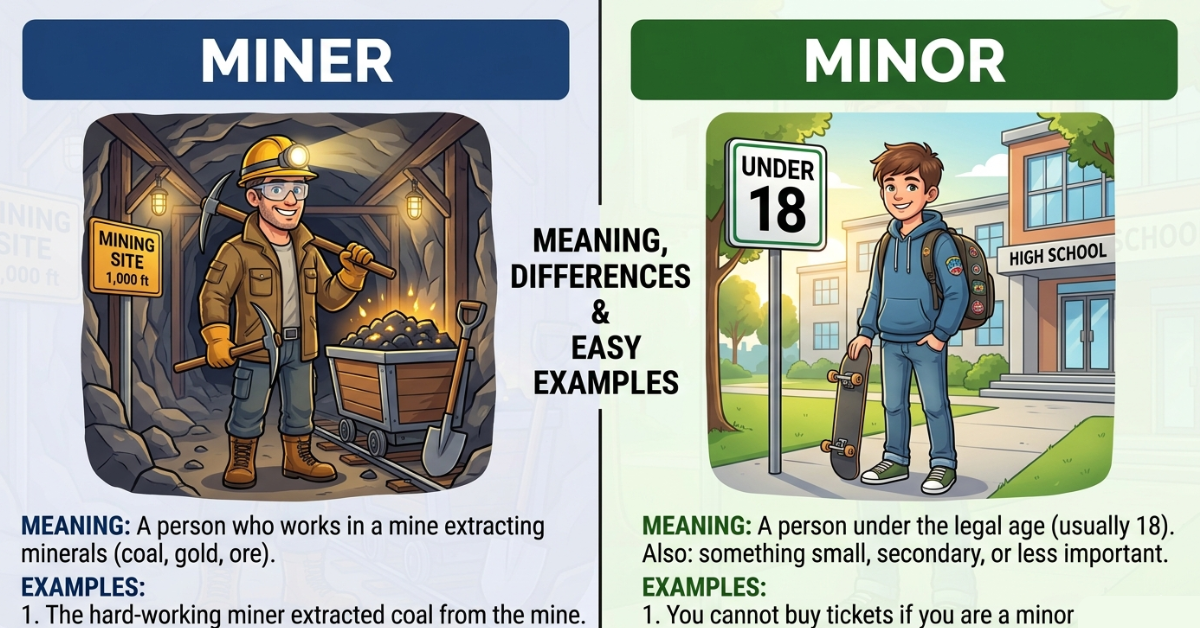
English is full of words that sound the same but mean completely different things. One of the most commonly confused pairs is miner vs minor. Since both words are pronounced similarly, many people accidentally mix them up in writing, emails, schoolwork, and even professional communication.
But here’s the good news: understanding the difference is surprisingly simple. A miner works with mines or extracts resources, while a minor usually refers to someone under legal age or something smaller or less important. Once you understand the context, choosing the right word becomes much easier.
In this guide, we’ll break down the meanings, spelling differences, examples, grammar tips, and common mistakes so you never confuse these two words again.
What Does “Miner” Mean?
A miner is a person who works in a mine, extracting natural resources from the earth. These resources may include:
- Coal
- Gold
- Silver
- Copper
- Diamonds
- Other valuable minerals
The word comes from the noun mine, which refers to a place where minerals or natural materials are extracted.
Examples of “Miner” in Sentences
- The miner spent long hours underground searching for coal.
- Gold miners played an important role during historical gold rushes.
- Safety equipment is essential for every miner working in dangerous conditions.
In modern conversations, the word may also refer to someone involved in cryptocurrency mining, though the traditional meaning still relates to physical mining work.
Different Types of Miners
There are several categories of miners depending on the industry:
- Coal miners – extract coal for energy production
- Gold miners – search for and extract gold deposits
- Cryptocurrency miners – use computers to validate blockchain transactions
- Industrial miners – extract minerals used in manufacturing
The meaning usually becomes obvious from the sentence context.
What Does “Minor” Mean?
A minor generally refers to someone who has not yet reached the legal age of adulthood. In many countries, a person under 18 is considered a minor, although laws can vary.
The word can also describe something smaller, less important, or secondary.
Examples of “Minor” in Sentences
- A minor cannot legally sign some contracts without parental approval.
- She suffered only minor injuries after the accident.
- The issue caused a minor delay in the project timeline.
As you can see, the word has multiple uses depending on the situation.
Common Meanings of “Minor”
Here are the most common ways the word is used:
1. Legal Meaning
A person below the legal adult age.
Example:
- The movie is not suitable for minors.
2. Less Important or Small
Used to describe something that is not serious or significant.
Example:
- The software update fixed several minor problems.
3. Academic Meaning
In education, a minor can be a secondary field of study at college or university.
Example:
- She majored in psychology with a minor in business.
Key Differences Between Miner and Minor
Although these words sound almost identical, their meanings are entirely different.
| Word | Meaning | Example |
| Miner | A person who extracts minerals or works in mines | The miner worked underground. |
| Minor | Someone under legal age or something less important | He is still a minor. |
The easiest way to remember the difference is this:
- Miner = Mine = digging or extraction
- Minor = Not major = smaller or underage
That simple memory trick can save you from future spelling mistakes.
Why People Confuse These Words
Confusion happens because miner and minor are homophones, meaning words that sound alike but have different meanings and spellings.
Here are the most common reasons people mix them up:
- Similar pronunciation
- Fast typing mistakes
- Autocorrect errors
- Lack of context understanding
For example:
In correct: The minor worked underground in dangerous conditions.
Correct: The miner worked underground in dangerous conditions.
Incorrect: A miner cannot legally vote yet.
Correct: A minor cannot legally vote yet.
One small spelling change completely alters the meaning.
Memory Tricks to Remember the Difference
Need an easy way to remember which word to use? Try these quick tricks:
Remember “Mine” Inside Miner
The word miner contains mine, which connects directly to digging and extracting resources.
Example association:
Miner → Mine → Underground work
Think “Minor Means Not Major”
A minor is the opposite of major, meaning smaller, younger, or less important.
Example association:
Minor → Not major → Smaller or underage
These mental shortcuts work surprisingly well in everyday writing.
Common Mistakes to Avoid
Many writers accidentally misuse these words in casual and professional communication.
Incorrect Usage Examples
Incorrect: The minor discovered gold underground.
Correct: The miner discovered gold underground.
Incorrect: He is legally a miner until he turns 18.
Correct: He is legally a minor until he turns 18.
Reading your sentence carefully usually reveals which word fits naturally.
Miner and Minor in Modern Context
Today, the meanings have expanded slightly.
For example, a miner can refer to someone involved in cryptocurrency systems who helps process blockchain transactions using computing power.
Meanwhile, minor continues to appear frequently in:
- Legal documents
- Educational systems
- Medical reports
- Everyday conversation
Understanding the context makes it easy to tell them apart.
Quick Comparison Summary
Here’s a fast recap:
Use “Miner” When:
- Talking about mining jobs
- Discussing resource extraction
- Referring to cryptocurrency mining
Use “Minor” When:
- Talking about someone under legal age
- Describing something small or less important
- Referring to a secondary academic subject
FAQs
Is miner the same as minor?
No, they have completely different meanings. One relates to mining, while the other usually refers to age or something less significant.
How do you remember the difference?
Think of mine inside miner and not major for minor. These word associations make remembering easier.
Can miner refer to cryptocurrency?
Yes. Today, the term is also used for people or systems that process blockchain transactions.
Is a child considered a minor?
In most countries, yes. A person below the legal age of adulthood is generally considered a minor.
Why do people confuse these words?
They sound nearly identical, making them easy to mix up when speaking or typing.
Conclusion
Understanding the difference between miner vs minor is easier than it first seems. A miner is connected to mining, extraction, and underground work, while a minor usually refers to someone under legal age or something less important.
The best way to avoid mistakes is to focus on context. Ask yourself: Am I talking about mining or age/importance? That one question will usually point you to the correct word.
Want to sharpen your grammar even more? Explore other commonly confused English words to make your writing clearer and more professional.
Author

linguaezone.com@gmail.com
Related Posts
Kill Two Birds With One Stone Alternative: 50 Better Options
- 0
- 1,569 word
Have you ever paused before saying “kill two birds with one stone” because it sounded too violent or simply didn’t fit the...
Read out all
Happy Sabbath Meaning: A Complete Guide to Its Significance
- 0
- 1,632 word
Have you ever received the message “Happy Sabbath” and wondered what it truly means? Is it simply another way of saying “have...
Read out all
I’m So Proud of You in Other Words: 120+ Heartfelt Alternatives
- 0
- 1,562 word
Have you ever wanted to tell someone you’re proud of them but felt like saying “I’m so proud of you” sounded repetitive?...
Read out all
How Do You Spell Happy Anniversary? Correct Spelling Guide
- 0
- 1,221 word
Have you ever paused before writing an anniversary card and wondered, “How do you spell happy anniversary?” You’re not alone. Whether you’re...
Read out all
Waiting for Your Response Email: Best Examples & Tips
- 0
- 1,483 word
Have you ever sent an important email and found yourself wondering whether you should follow up or simply wait? Whether you’re communicating...
Read out all
Great Asset to the Team: Meaning, Examples & Tips
- 0
- 1,494 word
Have you ever wanted to compliment a coworker but struggled to find words that sound professional and sincere? One of the most...
Read out all