
- 0
- 996 words
Money conversations can feel surprisingly confusing, especially when words sound similar. One common example is loan vs lend. People often use these terms interchangeably, but they actually mean different things.
If you’ve ever paused mid-sentence wondering whether to say “Can you loan me money?” or “Can you lend me money?”, you’re not alone. Understanding the distinction matters in both everyday conversations and financial settings.
This guide breaks everything down in plain English, including meanings, examples, grammar rules, and common mistakes people make.
What Does “Loan” Mean?
The word loan generally refers to something that is given temporarily and expected to be returned. Most commonly, it refers to money borrowed from a person, bank, or financial institution.
Traditionally, loan is used as a noun.
Examples of Loan as a Noun:
- She applied for a home loan.
- The bank approved his business loan.
- I need a small loan to cover expenses.
In modern English, especially in American English, loan can sometimes be used as a verb. However, many grammar experts still prefer lend as the verb in formal writing.
Examples of Loan as a Verb:
- Can you loan me your notebook?
- The library loaned him several books.
What Does “Lend” Mean?
Lend is a verb that means giving something temporarily with the expectation that it will be returned.
Unlike loan, lend focuses more on the action rather than the thing itself.
Examples of Lend:
- Can you lend me your pen?
- She agreed to lend her car for the weekend.
- The bank lends money to qualified applicants.
Think of it this way:
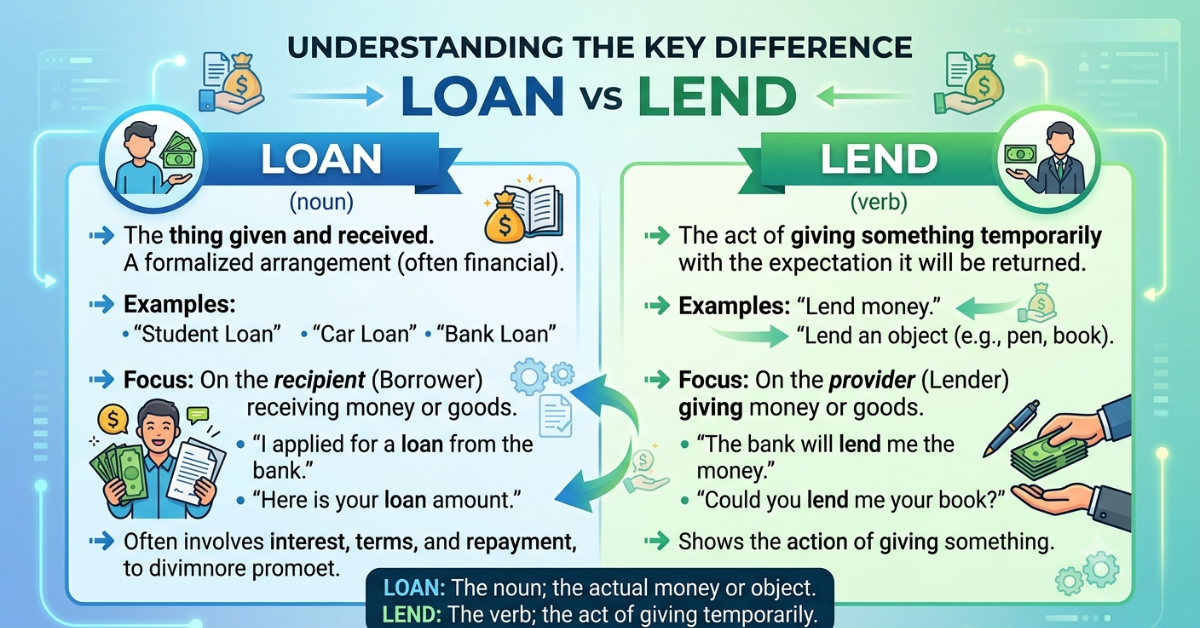
- Loan = the thing
- Lend = the action
That simple distinction makes it easier to remember.
Loan vs Lend: The Main Difference
Although these words are closely related, they are not identical.
| Loan | Lend |
| Usually a noun | Always a verb |
| Refers to the item or money borrowed | Refers to the act of giving temporarily |
| Common in financial contexts | Common in daily conversation |
Here’s an easy sentence comparison:
- Correct: The bank gave me a loan.
- Correct: The bank agreed to lend me money.
The first sentence describes the financial product. The second explains the action.
When Should You Use “Loan”?
Use loan when talking about the actual borrowed amount or item.
Common Types of Loans
- Personal loans
- Home mortgages
- Auto loans
- Student loans
- Business financing
In finance, this term appears frequently because it represents a formal borrowing agreement.
For example:
“He took out a loan to start his company.”
This refers to money borrowed under agreed terms.
When Should You Use “Lend”?
Use lend when someone temporarily gives something to another person.
This doesn’t always involve money. You can lend objects, time, or assistance.
Everyday Examples:
- Lend a jacket to a friend
- Lend support during hard times
- Lend money to family members
- Lend a helping hand
Because it emphasizes action, it works naturally in requests and conversations.
For example:
“Could you lend me your charger?”
Common Grammar Mistakes People Make
Many people accidentally mix these words up. Here are some common errors.
Mistake 1: Using Loan as a Verb in Formal Writing
Less preferred (formal English):
- Can you loan me your pen?
Preferred:
- Can you lend me your pen?
While loan as a verb is accepted in American English, lend sounds more natural and professional.
Mistake 2: Confusing Borrow With Lend
People sometimes say:
Incorrect: “Can you borrow me money?”
Correct version:
Correct: “Can you lend me money?”
Remember:
- Borrow = receive temporarily
- Lend = give temporarily
Easy Trick to Remember the Difference
A quick memory tip can help.
Ask yourself this question:
Are you giving or receiving?
- If someone is giving, use lend.
- If you’re talking about the thing borrowed, use loan.
Example:
- My uncle will lend me cash.
- I received a loan from the bank.
Simple and practical.
Why the Difference Matters in Finance
In banking and legal documents, word choice matters. Financial institutions use precise language to avoid misunderstandings.
For example, banks lend money, while customers receive loans.
This distinction becomes especially important when discussing:
- Interest rates
- Repayment schedules
- Credit agreements
- Legal contracts
Using the wrong term won’t always confuse people, but correct usage helps you sound more informed and professional.
Everyday Examples You’ll Hear
Here are some real-life sentence examples:
Using Loan
- I finally paid off my student loan.
- The company offered a low-interest loan.
- Her loan application was approved.
Using Lend
- Can you lend me twenty dollars?
- My brother refused to lend me his bike.
- They often lend books to neighbors.
Seeing them in context makes the difference easier to understand.
Is It Ever Okay to Say “Loan Me”?
Yes, especially in American English.
You’ll often hear:
“Can you loan me five dollars?”
This is widely accepted in casual speech. However, in formal or professional writing, lend is generally preferred.
If you want to sound polished and grammatically safe, choose lend as the verb.
Frequently Asked Questions
Is “loan” a noun or a verb?
Traditionally, loan is a noun, but it can also function as a verb in modern American English.
Can I say “loan me money”?
Yes, especially in casual American English. However, lend me money is more widely accepted in formal settings.
What is the difference between borrow and lend?
Borrow means receiving something temporarily, while lend means giving something temporarily.
Do banks loan or lend money?
Banks lend money, and customers receive loans.
Which word sounds more professional?
In formal communication, lend is usually the safer and more professional choice.
Final Thoughts
Understanding loan vs lend is easier than it first seems. One refers to the thing being borrowed, while the other describes the action of temporarily giving something.
Once you remember that a bank lends money and offers a loan, the confusion starts to disappear. Whether you’re writing professionally, studying English, or handling financial discussions, using the right word improves clarity and confidence.
Want to strengthen your grammar even more? Exploring similar word pairs can help sharpen your communication skills and make everyday writing feel effortless.
Author

linguaezone.com@gmail.com
Related Posts

Kill Two Birds With One Stone Alternative: 50 Better Options
- 0
- 1,569 word
Have you ever paused before saying “kill two birds with one stone” because it sounded too violent or simply didn’t fit the...
Read out all
Happy Sabbath Meaning: A Complete Guide to Its Significance
- 0
- 1,632 word
Have you ever received the message “Happy Sabbath” and wondered what it truly means? Is it simply another way of saying “have...
Read out all
I’m So Proud of You in Other Words: 120+ Heartfelt Alternatives
- 0
- 1,562 word
Have you ever wanted to tell someone you’re proud of them but felt like saying “I’m so proud of you” sounded repetitive?...
Read out all
How Do You Spell Happy Anniversary? Correct Spelling Guide
- 0
- 1,221 word
Have you ever paused before writing an anniversary card and wondered, “How do you spell happy anniversary?” You’re not alone. Whether you’re...
Read out all
Waiting for Your Response Email: Best Examples & Tips
- 0
- 1,483 word
Have you ever sent an important email and found yourself wondering whether you should follow up or simply wait? Whether you’re communicating...
Read out all
Great Asset to the Team: Meaning, Examples & Tips
- 0
- 1,494 word
Have you ever wanted to compliment a coworker but struggled to find words that sound professional and sincere? One of the most...
Read out all