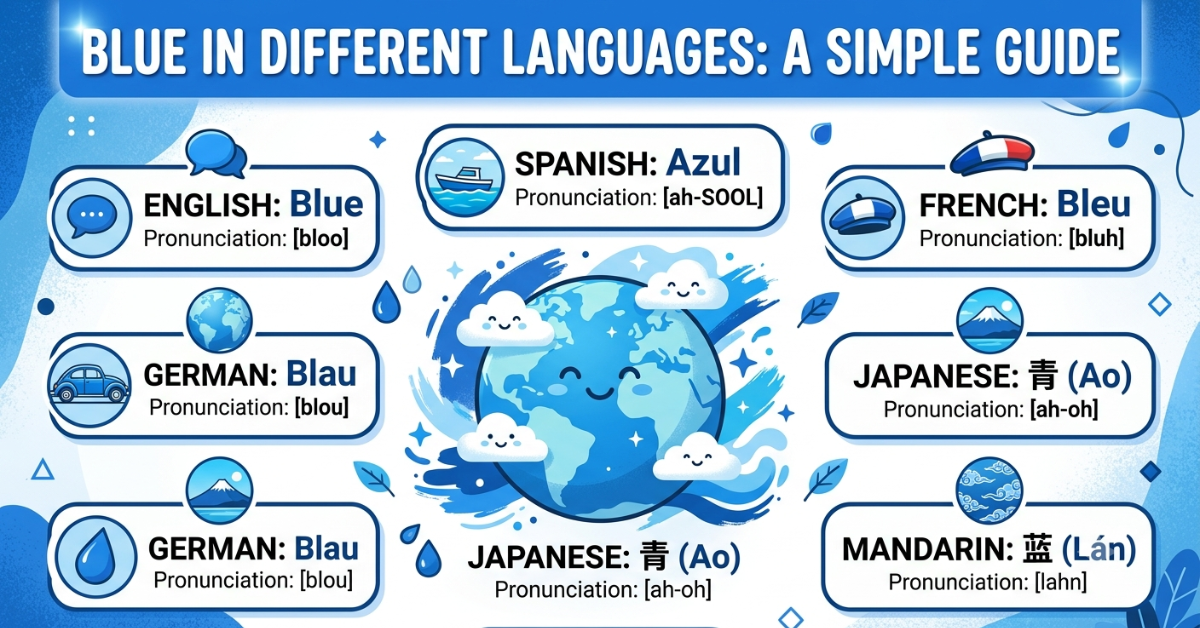
Color words seem easy until you start comparing them across cultures. Blue in different languages is a great example: in some places, the translation is straightforward, while in others, the word carries shades of meaning that do not match English exactly.
If you are searching for how do you say blue in different languages or how to say blue in different languages, this guide gives you a clear, practical overview. You will see common translations, a few pronunciation-friendly notes, and why the color blue in different languages is more interesting than it first appears.
Why the Word “Blue” Changes Across Languages
Not every language divides color the same way. Some languages use one word for a broad range of blue tones, while others separate dark blue, light blue, or even blue-green more carefully.
That is why the word blue in different languages can look simple on paper but feel different in real life. The translation may be correct, but the cultural meaning, shade, or everyday usage may vary.
Blue in Different Languages: Common Translations
Here are some of the most common ways to say blue around the world:
- Spanish: azul
- French: bleu
- German: blau
- Italian: blu
- Portuguese: azul
- Dutch: blauw
- Russian: синий (dark blue), голубой (light blue)
- Arabic: أزرق
- Hindi: नीला
- Chinese (Mandarin): 蓝色
- Japanese: 青
- Korean: 파란색
- Turkish: mavi
- Greek: μπλε
- Swahili: bluu
These translations are the starting point, but the real value comes from understanding how people actually use them.
How Do You Say Blue in Different Languages?
If you are learning languages, traveling, or writing content for a global audience, it helps to know more than just the word itself. You also need to know whether the word is used for everyday speech, formal writing, or specific shades.
1. Romance languages keep it familiar
In many Romance languages, the word is easy to recognize:
- Spanish: azul
- Portuguese: azul
- French: bleu
- Italian: blu
These are useful because they are common in conversation and usually easy to remember.
2. Some languages separate shades more clearly
Russian is a famous example. It often uses two different basic words:
- синий for darker blue
- голубой for lighter blue
That does not mean English is wrong or Russian is complicated. It just shows that color categories can be organized differently.
3. Japanese can be especially interesting
Japanese traditionally uses 青 (ao) in ways that can cover blue and some related shades. In modern contexts, ブルー (burū) is also used, especially in borrowed or contemporary usage.
That is a good reminder that translations are not always one-to-one. A word can be correct and still carry local nuance.
The Color Blue in Different Languages and Culture
The meaning of blue is not only linguistic. It also has symbolic value in many cultures.
Blue is often connected with:
- calm and peace
- trust and stability
- sky and water
- depth and distance
- loyalty and professionalism
In branding, design, fashion, and everyday communication, blue tends to feel safe, clean, and dependable. That is one reason it appears so often in logos, uniforms, and websites.
But symbolism is not identical everywhere. In some cultures, blue may carry religious, traditional, or regional meaning that goes beyond general emotion. So when you study the color blue in different languages, you are really studying both language and culture at the same time.
Easy Ways to Remember Blue Vocabulary
If you are learning these words for study, travel, or content writing, a simple method helps more than memorizing a long list.
Try this approach:
- Start with 5 to 7 high-frequency languages.
- Group similar-looking words together, such as azul in Spanish and Portuguese.
- Learn the pronunciation out loud.
- Practice with a sentence, not just the single word.
- Compare dark and light shades when a language makes that distinction.
For example:
- The sky is blue.
- That shirt is blue.
- I like blue tones in design.
Using the word in context makes it easier to remember and far more useful in real life.
Blue in Different Languages: A Quick Comparison Table
Here is a compact reference you can revisit:
- Spanish: azul
- French: bleu
- German: blau
- Italian: blu
- Portuguese: azul
- Russian: синий / голубой
- Arabic: أزرق
- Hindi: नीला
- Chinese: 蓝色
- Japanese: 青
- Korean: 파란색
- Turkish: mavi
This kind of list is helpful when you need a fast translation, but always remember that spoken usage can vary by region.
Common Mistakes to Avoid
When people look up blue in different languages, they sometimes make a few easy mistakes.
Avoid these:
- Assuming every language has only one blue word
- Treating written translation as the full meaning
- Ignoring shade differences
- Using a borrowed word when a native word is more natural
- Forgetting pronunciation matters too
A translation can be correct and still sound unusual if it is used in the wrong setting.
FAQ
How do you say blue in different languages?
The word changes by language. Common examples include azul in Spanish, bleu in French, blau in German, and mavi in Turkish.
What is blue in Japanese?
The traditional word is 青 (ao), and in modern usage you may also see ブルー (burū).
Is blue the same in every language?
No. Some languages use different words for light and dark blue, and some may group blue with related shades.
What is the most common translation of blue?
There is no single global translation. It depends on the language, but azul, bleu, blau, and mavi are among the most widely recognized forms.
Why does the word blue in different languages vary so much?
Because languages divide color differently. Culture, history, and everyday usage all shape how a color word develops.
Conclusion
Learning blue in different languages is a small topic with a surprisingly big payoff. It improves your vocabulary, gives you a better feel for cultural nuance, and helps you understand how language shapes everyday thought.
Whether you are asking how to say blue in different languages, building multilingual content, or just exploring color words for fun, the key takeaway is simple: translations are useful, but context matters too. From here, you can explore other color words, compare shades across languages, or build a full multilingual vocabulary list for design, travel, or study.