
- 0
- 591 words
If you’ve ever paused while writing and wondered infact or in fact, you’re definitely not alone. This small phrase confuses even fluent English speakers because it looks like it could be one word—but grammar says otherwise.
In this guide, we’ll break down the correct form, explain why it matters, and show you how to use it naturally in sentences without sounding awkward or incorrect.
Is it infact or in fact?
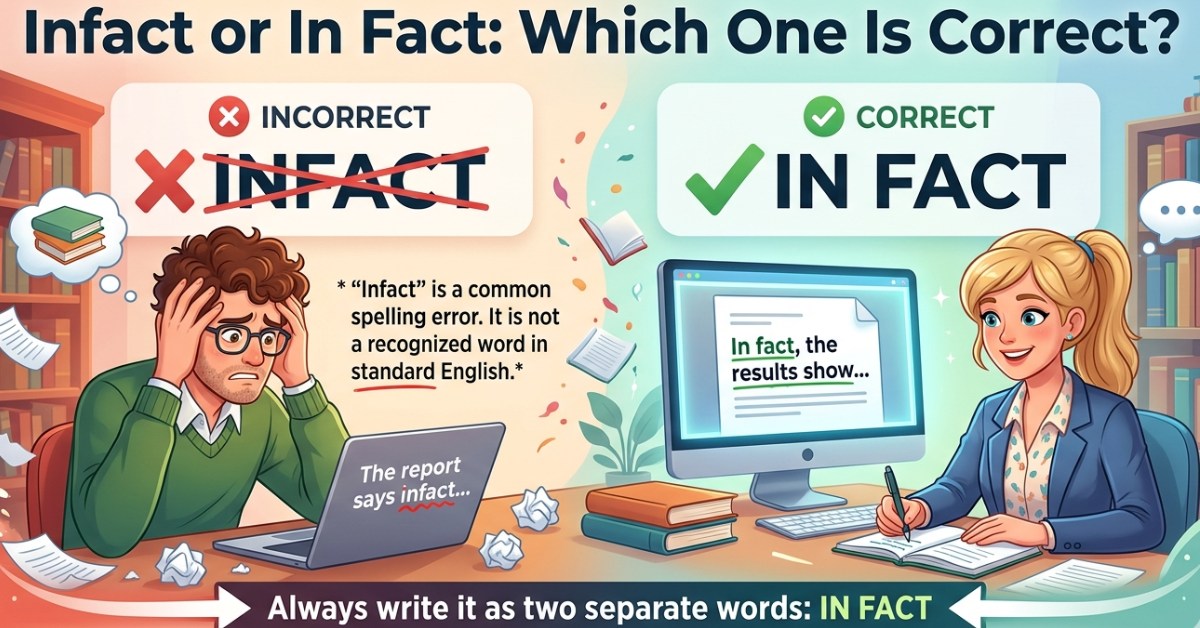
Let’s clear the confusion right away: the correct form is “in fact”, written as two separate words.
The phrase infact or in fact often appears in searches because people assume it might be a single word due to fast typing or casual speech. However, in standard English grammar, “infact” as one word is incorrect.
So whenever you’re writing formally or even casually, always use in fact.
Why “in fact” is the correct form
The phrase in fact is an adverbial expression used to emphasize a statement or add extra truth. It helps strengthen or clarify what you are saying.
Meaning and usage
“In fact” is used to:
- Emphasize a point
- Introduce additional information
- Correct a misunderstanding
- Strengthen an argument
Grammar breakdown
- “In” is a preposition
- “Fact” is a noun
Together, they form a phrase—not a single word.
That’s why infact or in fact should always be understood as two separate words in correct English writing.
Common mistakes people make
Many learners mistakenly write it as one word because of typing habits or autocorrect. Here are some common errors:
- Writing “infact” instead of in fact
- Using it too frequently in one paragraph
- Placing it where it doesn’t add emphasis
Quick tip
If you can replace it with “actually” in a sentence, then in fact is being used correctly.
Example:
- She is, in fact, very talented.
- She is actually very talented.
Simple examples of correct usage
Here are a few natural examples to help you understand better:
- In fact, I was already aware of the situation.
- The project is, in fact, completed ahead of time.
- He is not late; in fact, he arrived early.
- The weather is cold; in fact, it’s freezing today.
Notice how the phrase adds emphasis and clarity in each sentence.
Why people still search “infact or in fact”
Even though the correct form is simple, the confusion continues because:
- Fast typing merges words together
- Social media encourages informal spelling
- Autocorrect sometimes doesn’t correct it
- Spoken English blends words together
This is why the question infact or in fact remains one of the most searched grammar doubts online.
FAQs
1. Is “infact” a correct word in English?
No, “infact” is not correct. The proper form is in fact.
2. Why do people write infact or in fact incorrectly?
Mostly due to fast typing, informal writing habits, or confusion in spoken English.
3. Can “in fact” start a sentence?
Yes, absolutely. For example: In fact, she was the best performer.
4. Is “in fact” formal or informal?
It can be used in both formal and informal writing depending on context.
5. What is a simple replacement for “in fact”?
Words like “actually” or “indeed” can sometimes replace it.
Conclusion
To wrap it up, the correct form is always in fact, not “infact.” Understanding this small but important grammar rule helps improve both your writing accuracy and clarity.
Next time you’re unsure about infact or in fact, just remember—it’s always two words, used to emphasize truth or add clarity to a statement. Keep practicing with real examples, and it will quickly become second nature.
Author

linguaezone.com@gmail.com
Related Posts
Kill Two Birds With One Stone Alternative: 50 Better Options
- 0
- 1,569 word
Have you ever paused before saying “kill two birds with one stone” because it sounded too violent or simply didn’t fit the...
Read out all
Happy Sabbath Meaning: A Complete Guide to Its Significance
- 0
- 1,632 word
Have you ever received the message “Happy Sabbath” and wondered what it truly means? Is it simply another way of saying “have...
Read out all
I’m So Proud of You in Other Words: 120+ Heartfelt Alternatives
- 0
- 1,562 word
Have you ever wanted to tell someone you’re proud of them but felt like saying “I’m so proud of you” sounded repetitive?...
Read out all
How Do You Spell Happy Anniversary? Correct Spelling Guide
- 0
- 1,221 word
Have you ever paused before writing an anniversary card and wondered, “How do you spell happy anniversary?” You’re not alone. Whether you’re...
Read out all
Waiting for Your Response Email: Best Examples & Tips
- 0
- 1,483 word
Have you ever sent an important email and found yourself wondering whether you should follow up or simply wait? Whether you’re communicating...
Read out all
Great Asset to the Team: Meaning, Examples & Tips
- 0
- 1,494 word
Have you ever wanted to compliment a coworker but struggled to find words that sound professional and sincere? One of the most...
Read out all