
- 0
- 746 words
In everyday communication, especially in customer service, emails, or professional conversations, you’ve likely seen the phrase “thank you for your patience”. This simple expression carries a lot of weight in maintaining respect and professionalism.
Understanding the thank you for your patience meaning helps you use it correctly in real-life situations where delays or misunderstandings occur. In this article, we’ll break down what it really means, when to use it, and why it matters in both personal and professional communication.
What Does “Thank You for Your Patience” Mean?
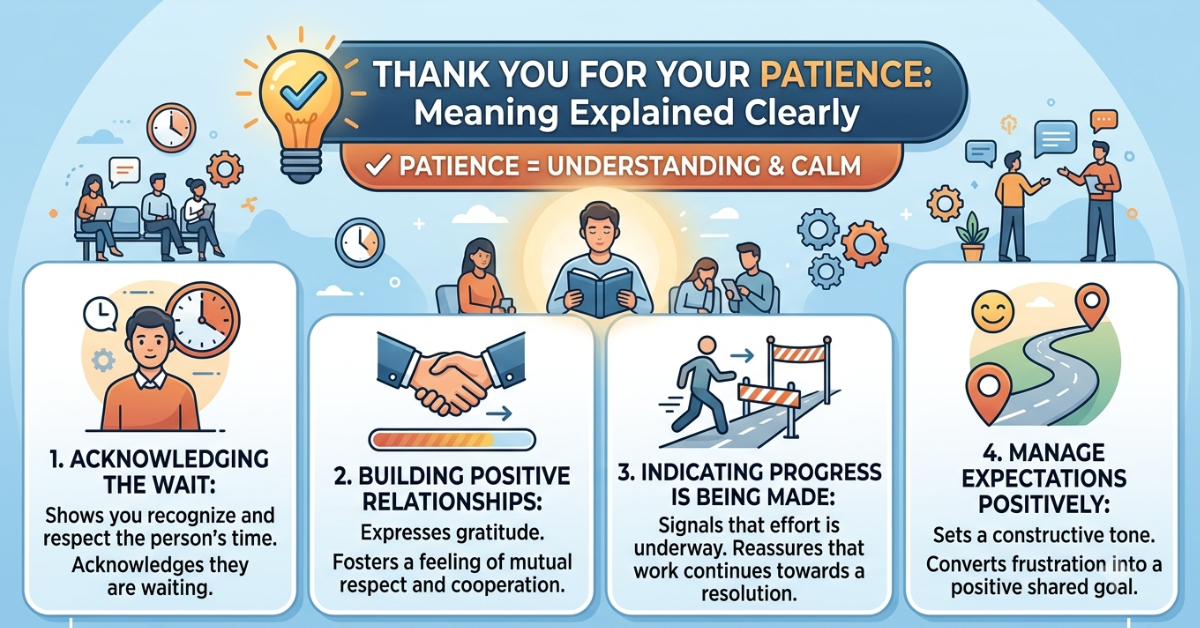
The phrase is a polite way of appreciating someone for waiting calmly without frustration. It acknowledges that the person has experienced a delay but handled it with understanding.
Simple meaning:
It basically says: “We appreciate that you waited without getting upset.”
This expression is commonly used in:
- Customer support responses
- Email replies with delays
- Service updates
- Workplace communication
The meaning is rooted in respect, empathy, and acknowledgment of inconvenience.
Why People Use “Thank You for Your Patience”
When delays happen—whether in service, response time, or project completion—this phrase helps soften frustration.
It is used to:
- Show respect to the other person
- Acknowledge inconvenience
- Maintain professionalism
- Build trust and goodwill
In professional settings, saying it helps keep communication positive even when things are not going smoothly.
When Should You Say “Thank You for Your Patience”?
Knowing the right moment to use this phrase is important. It is not used randomly—it is used when someone has been waiting or experiencing delays.
Common situations include:
- Customer service delays
When a support agent takes time to resolve an issue. - Technical problems
When systems, apps, or services are temporarily down. - Workplace communication
When a manager or colleague responds late. - Email follow-ups
When replying after a long gap.
In all these cases, it is often used to make the message more complete and empathetic.
“Thank You for Your Patience and Understanding” vs Other Variations
A slightly longer version, thank you for your patience and understanding, adds an extra layer of appreciation. It doesn’t just thank the person for waiting but also for accepting the situation calmly.
Key difference:
- Thank you for your patience → Focuses on waiting
- Thank you for your patience and understanding → Focuses on waiting + emotional understanding
Both phrases are polite, but the extended version is more formal and emotionally expressive.
Is It Always Appropriate to Use This Phrase?
While generally positive, context matters.
It works best when:
- There is a real delay
- The other person was inconvenienced
- You want to maintain professionalism
It may not be needed when:
- There was no delay
- The conversation is casual and instant
- The issue was resolved immediately
Using it too often can make communication feel repetitive, so balance is important.
Variations You Can Use Instead
If you want to sound more natural or avoid repetition, here are some alternatives:
- “We appreciate your patience during this time.”
- “Thanks for bearing with us.”
- “We’re grateful for your understanding.”
- “Thank you for staying patient while we resolve this.”
These variations still carry the same meaning but sound fresh and less repetitive.
Common Mistakes People Make
Even a simple phrase can be misused. Here are a few common errors:
- Overusing it in every message
- Using it when no delay occurred
- Making it sound robotic or copied
- Forgetting to follow up with a solution
The phrase should always feel genuine, not automatic.
FAQs
1. What does “thank you for your patience” mean?
It means you appreciate someone for waiting calmly during a delay or inconvenience.
2. Is “thank you for your patience and understanding” more formal?
Yes, it is slightly more formal and expresses deeper appreciation.
3. When should I use “thank you for your patience”?
Use it when someone has experienced a delay and remained calm or understanding.
4. Can I use it in casual conversation?
Yes, but it is more common in professional or customer service settings.
5. Is it okay to shorten the phrase?
Yes, saying thank you for your patience alone is perfectly acceptable in most cases.
Conclusion
The phrase thank you for your patience may seem simple, but it plays an important role in respectful and professional communication. Understanding the thank you for your patience meaning helps you use it more effectively in emails, conversations, and customer interactions.
Whether you choose the shorter version or thank you for your patience and understanding, the goal is the same: to show respect, appreciation, and empathy.
Using it naturally and at the right time can improve communication and leave a positive impression.
Author

linguaezone.com@gmail.com
Related Posts

Kill Two Birds With One Stone Alternative: 50 Better Options
- 0
- 1,569 word
Have you ever paused before saying “kill two birds with one stone” because it sounded too violent or simply didn’t fit the...
Read out all
Happy Sabbath Meaning: A Complete Guide to Its Significance
- 0
- 1,632 word
Have you ever received the message “Happy Sabbath” and wondered what it truly means? Is it simply another way of saying “have...
Read out all
I’m So Proud of You in Other Words: 120+ Heartfelt Alternatives
- 0
- 1,562 word
Have you ever wanted to tell someone you’re proud of them but felt like saying “I’m so proud of you” sounded repetitive?...
Read out all
How Do You Spell Happy Anniversary? Correct Spelling Guide
- 0
- 1,221 word
Have you ever paused before writing an anniversary card and wondered, “How do you spell happy anniversary?” You’re not alone. Whether you’re...
Read out all
Waiting for Your Response Email: Best Examples & Tips
- 0
- 1,483 word
Have you ever sent an important email and found yourself wondering whether you should follow up or simply wait? Whether you’re communicating...
Read out all
Great Asset to the Team: Meaning, Examples & Tips
- 0
- 1,494 word
Have you ever wanted to compliment a coworker but struggled to find words that sound professional and sincere? One of the most...
Read out all