
- 0
- 1,034 word
Building a jewelry brand involves much more than selecting attractive designs. Businesses must also find a manufacturing partner that can translate product ideas into consistent, market-ready collections while supporting branding, packaging, sampling, and future production.
Choosing the right private label jewelry manufacturer is therefore an important business decision, particularly for startups, independent jewelry labels, boutique retailers, and growing e-commerce businesses.
A manufacturer should not be evaluated only by its product catalog or quoted unit price. The real question is whether its production process, product capabilities, communication, and order structure fit the brand’s long-term plans.
Here are eight factors worth evaluating before starting a manufacturing partnership.
1. Check Whether the Manufacturer Understands Your Product Category
Not every jewelry manufacturer specializes in the same products.
Some focus on fine jewelry, precious metals, and gemstones, while others concentrate on fashion jewelry, stainless steel, brass, or plated accessories.
Before requesting a quotation, identify the product categories your brand intends to develop.
- Earrings, hoops, and statement earrings
- Necklaces, pendants, and layered chains
- Bracelets, cuffs, and bangles
- Fashion rings and coordinated jewelry sets
Ask the supplier about its experience with your intended product types, materials, construction methods, and finishing requirements. A manufacturer that understands your product category is more likely to identify technical issues before sampling begins.
2. Understand the Difference Between Existing Designs and Custom Development
Private label manufacturing does not always mean creating every product from scratch. There are generally three possible approaches.
Existing designs: The brand selects suitable styles from an available collection and coordinates branding and packaging.
Adapted designs: Existing products are adjusted according to the brand’s requirements. Depending on feasibility, adjustments may involve colors, finishes, dimensions, components, or other details.
Original product development: The brand provides sketches, reference images, CAD files, or technical specifications for a new product.
These approaches involve different development requirements, costs, and timelines. Brands should clarify which approach a manufacturer can support and whether additional development or tooling costs apply.
3. Request Samples Before Approving Bulk Production
A product image or digital rendering cannot fully demonstrate the quality of a finished jewelry piece. Sampling provides an opportunity to review important details, including:
- Product dimensions and proportions
- Material and surface finish
- Color consistency
- Stone placement and setting
- Component connections and construction
- Logo positioning and appearance
Before approving a sample, prepare a written specification that records the important product details. If revisions are necessary, document the changes and obtain approval for the final reference sample. This reference becomes particularly important when the same design is manufactured again.
4. Understand How MOQ Is Calculated
Minimum order quantity (MOQ) is one of the most important considerations for growing jewelry brands. However, there is no universal MOQ that applies to every product.
The minimum quantity may depend on:
- Product design and construction
- Material selection
- Plating or finishing requirements
- Size and color variations
- Logo application
- Custom packaging
- Number of individual SKUs
For example, a simple existing design may have different production requirements from a newly developed product with customized components. Buyers should ask whether MOQ is calculated per style, color, size, or complete order. A clear quotation should also distinguish sample costs, development costs, production costs, and packaging costs where applicable.
5. Evaluate Branding and Packaging Support
A private label collection needs a consistent brand presentation. Depending on the product and supplier capabilities, branding requirements may include:
- Logo engraving or application
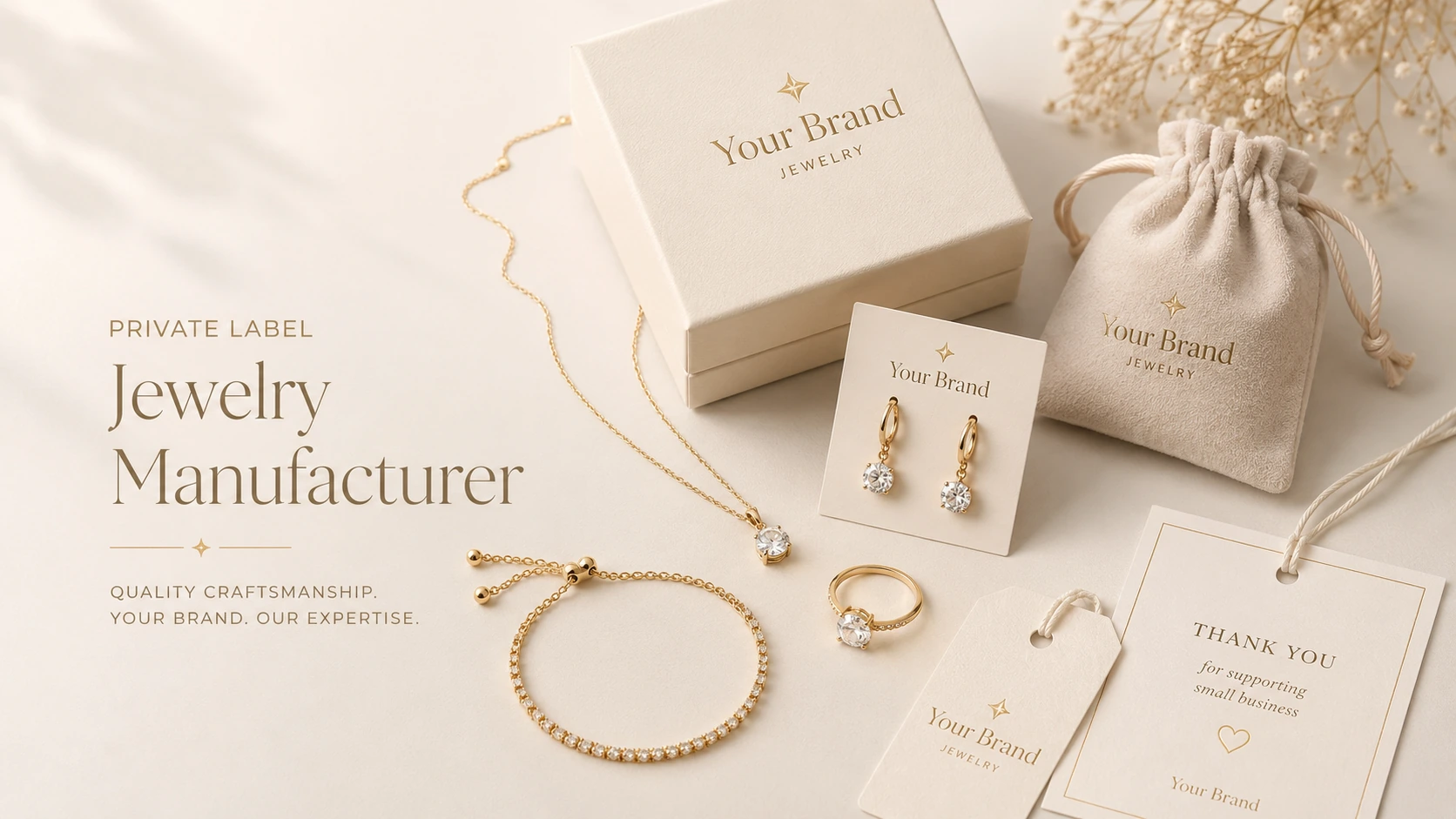
- Jewelry display cards
- Branded pouches
- Jewelry boxes
- Labels and barcode stickers
- Care cards and product inserts
Packaging should be discussed during the product planning stage rather than after bulk production has started. This helps ensure that product dimensions, packaging sizes, logo placement, and retail presentation are compatible.
6. Ask About Quality Control Procedures
Quality control should be part of the manufacturing process, not something considered only when products are ready to ship. Brands should establish clear inspection requirements based on their product specifications.
- Dimensions and construction
- Surface appearance and finishing
- Stone placement and security
- Logo accuracy
- Color consistency
- Packaging and product quantities
For repeat orders, the manufacturer should be able to refer to previously approved product specifications. This reduces the risk of unexpected differences between the original sample and subsequent production batches.
7. Evaluate Communication and Repeat-Order Management
A successful manufacturing relationship should extend beyond the first purchase order. Brands frequently need to introduce new designs, replenish popular products, adjust packaging, or expand existing collections.
A reliable working process should maintain records of:
- Approved product specifications
- Sample revisions
- Material and finish references
- Branding requirements
- Packaging details
- Order quantities and production approvals
Clear communication and documentation make it easier to manage future orders and reduce unnecessary misunderstandings.
8. Confirm Export and Market Requirements
International jewelry buyers should also consider destination-market requirements. Depending on the product category, material, and destination, additional documentation, testing, labeling, or import requirements may apply.
Before production, confirm material specifications, applicable testing requirements, export documentation, shipping arrangements, and packaging and labeling requirements. Do not assume that every supplier can provide the same certifications or compliance documentation. Ask for the specific documents relevant to your products and target market.
What Should Brands Look for in a Manufacturing Partner?
The right partner should offer a suitable combination of product development, sampling, production coordination, branding support, quality checks, and repeat-order planning.
For example, HaoLustra provides private label jewelry solutions for businesses developing their own fashion jewelry collections. Its program covers existing styles, adapted designs, and original product development, alongside sample review, branding and packaging coordination, production support, and reorder planning.
Brands evaluating a private label jewelry manufacturer can review HaoLustra’s published service information to understand how these different stages can be organized within a project.
As with any manufacturing partnership, product feasibility, MOQ, sample costs, and production schedules should be confirmed against the specific requirements of each order.
Final Thoughts
Choosing a jewelry manufacturer is not simply about finding the lowest quotation. A successful partnership depends on whether the supplier understands your products, communicates clearly, supports appropriate customization, maintains approved specifications, and can accommodate future collection development.
For new brands, starting with a carefully planned selection of products and reviewing samples before bulk production can help reduce unnecessary purchasing risks. The objective is not just to manufacture jewelry. It is to establish a production relationship that supports a consistent and recognizable brand.
Author

munjalblogfirm@gmail.com
Related Posts
Reading a Hoodie Label Before the First Wash
- 0
- 1,206 word
Most of us cut it off, which is fair enough, because that narrow woven tag down in the side seam scratches the...
Read out all
Two Tracksuits, Twenty Dollars Apart: What the Price Gap Buys
- 0
- 1,142 word
Scroll the tracksuit grid for half a minute and the math starts bothering you before the clothes do. One set sits at...
Read out all
Civil Regime: What Makes a Streetwear Outfit Feel Complete?
- 0
- 1,527 word
A streetwear outfit does not need multiple statement pieces to stand out. A graphic T-shirt, well-chosen pants, and sneakers can create a...
Read out all
How to Compare Raspberry Hills Clothing Measurements With Your Own
- 0
- 1,510 word
Knowing which measurements are the best fit for your body makes it easy to buy garments online. A proper fit should be...
Read out all
How to Check Essential Hoodie Sleeve Length Without Trying It On
- 0
- 1,309 word
It is so easy to order a hoodie online, but then you have to start to worry. Will the sleeves be too...
Read out all
Elegant Sterling Silver Bracelets for Women Who Love Minimalist Jewelry
- 0
- 1,077 word
Choosing the right accessories can completely transform an outfit and elevate your everyday style. Jewelry carries a unique personal touch, allowing individuals...
Read out all