Language often creates confusion, especially when two similar-looking words appear in emotional or psychological topics. One of the most searched comparisons is Disregulated or Dysregulated, and people frequently wonder which one is correct.
In reality, only one term is widely accepted in psychology. However, the confusion is understandable because both sound similar and relate to emotional control. Let’s break it down clearly so you can use it confidently.
What Does Dysregulated Mean? (Correct Term)
First and foremost, the correct term is dysregulated.
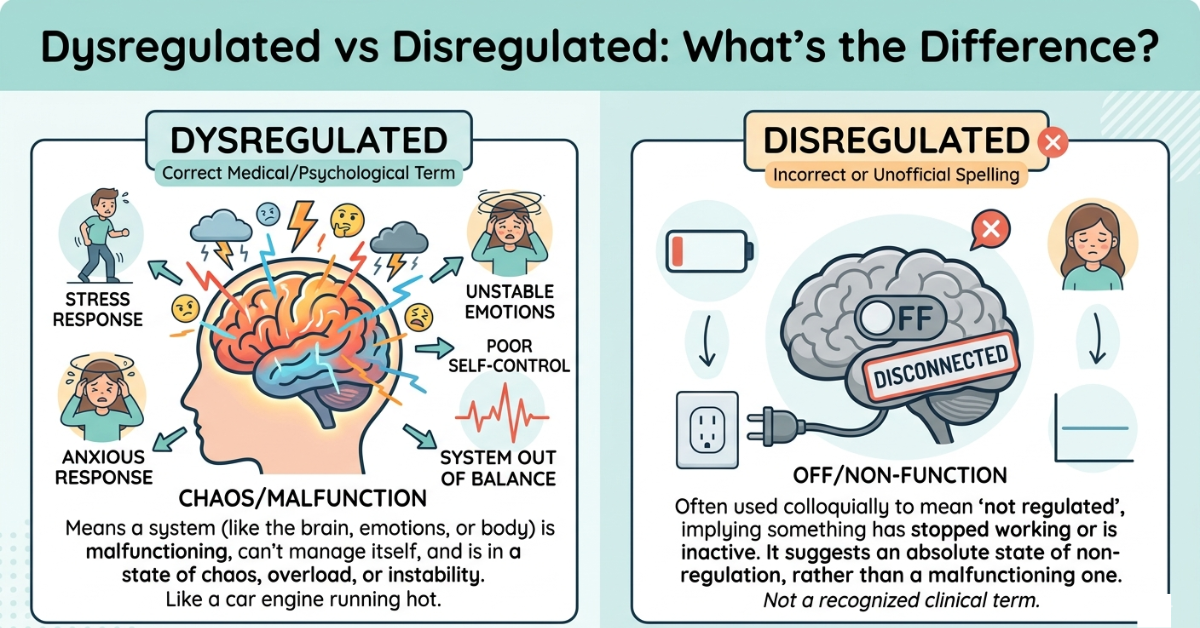
In psychology, dysregulated describes a state where a person struggles to manage emotional responses. Instead of staying balanced, emotions become intense, unpredictable, or overwhelming.
For example, someone who is dysregulated may:
- React strongly to small stressors
- Struggle to calm down after anger or sadness
- Experience rapid mood shifts
- Feel emotionally overwhelmed easily
Moreover, mental health professionals use this term to describe emotional control difficulties in conditions like anxiety, ADHD, and trauma-related disorders.
Is “Disregulated” a Real Word?
Now let’s address the confusion around Disregulated or Dysregulated.
“Disregulated” is not considered a standard or medically accepted English word. People sometimes use it informally, but it does not appear in psychological terminology.
This mistake usually happens because:
- People assume “dis-” is always correct in English
- The pronunciation of “dysregulated” sounds unclear
- Auto-correction or typing errors influence spelling
Therefore, when writing professionally, you should always avoid “disregulated.”
Why Dysregulation Happens in the First Place
To understand Disregulated or Dysregulated better, it helps to explore emotional dysregulation itself.
Emotional dysregulation usually develops when the brain has difficulty processing or controlling emotional responses. As a result, reactions become stronger or harder to manage.
In many cases, it appears in:
- Anxiety disorders
- Depression
- ADHD
- Trauma-related conditions
Additionally, stress, childhood experiences, and environmental factors can contribute to it.
How Emotional Dysregulation Looks in Real Life
To make things clearer, here’s how dysregulated emotions often appear in daily situations:
- A small argument leads to intense anger
- A minor setback causes deep sadness
- Stress triggers impulsive decisions
- Emotional recovery takes longer than usual
However, it is important to understand that dysregulation is not a personality flaw. Instead, it reflects how the emotional system responds under pressure.
Key Difference: Dysregulated vs Disregulated
At this point, the distinction becomes very clear:
- Dysregulated → Correct, medically accepted, used in psychology
- Disregulated → Incorrect or non-standard usage
In short, the difference is not meaning but correctness and professional acceptance. Therefore, if you are writing academically or professionally, always choose the correct term.
Why People Get Confused Between the Two
Interestingly, confusion increases because both prefixes exist in English.
For example:
- “Dis-” appears in words like disconnect or disagree
- “Dys-” appears in medical terms like dyslexia or dysfunction
As a result, many people assume both prefixes work the same way. However, in psychology-related terms, dys- is the accurate prefix used to describe difficulty or abnormal functioning.
How to Use Dysregulated Correctly
Now that the confusion is clear, let’s focus on proper usage.
You should use dysregulated when referring to emotional or behavioral control issues.
For example:
- She felt emotionally dysregulated after the stressful event.
- Therapy helped him manage his dysregulated reactions.
- Children may become dysregulated in overstimulating environments.
By contrast, avoid using “disregulated” in formal writing because it weakens accuracy and credibility.
Practical Tips to Remember the Correct Word
To avoid future mistakes, keep these tips in mind:
- Associate “dys-” with psychology and medicine
- Think of “dysfunctional” as a similar pattern
- Remember that dysregulation always relates to emotional or behavioral imbalance
Additionally, proofreading tools can help catch incorrect usage before publishing.
FAQs
1. Is “disregulated” correct in English?
No, it is not considered correct in formal writing or psychology.
2. What does dysregulated mean in simple words?
It means difficulty controlling emotions or reactions effectively.
3. Is emotional dysregulation a disorder?
No, it is not a disorder itself, but it appears as a symptom in several mental health conditions.
4. Why do people confuse dysregulated and disregulated?
Because both prefixes sound similar and people assume they function the same way.
5. Where is the word dysregulated used most?
It is commonly used in psychology, therapy, and behavioral science.
Conclusion
To summarize, the debate around Disregulated or Dysregulated is simple once you understand the rule. Only dysregulated is correct in psychology and emotional health discussions.
Furthermore, dysregulation describes how emotions become difficult to control, especially under stress. Therefore, using the correct term not only improves your writing but also strengthens clarity and professionalism.
Ultimately, if you remember one thing, let it be this: in emotional and psychological contexts, always choose dysregulated for accuracy and credibility.