
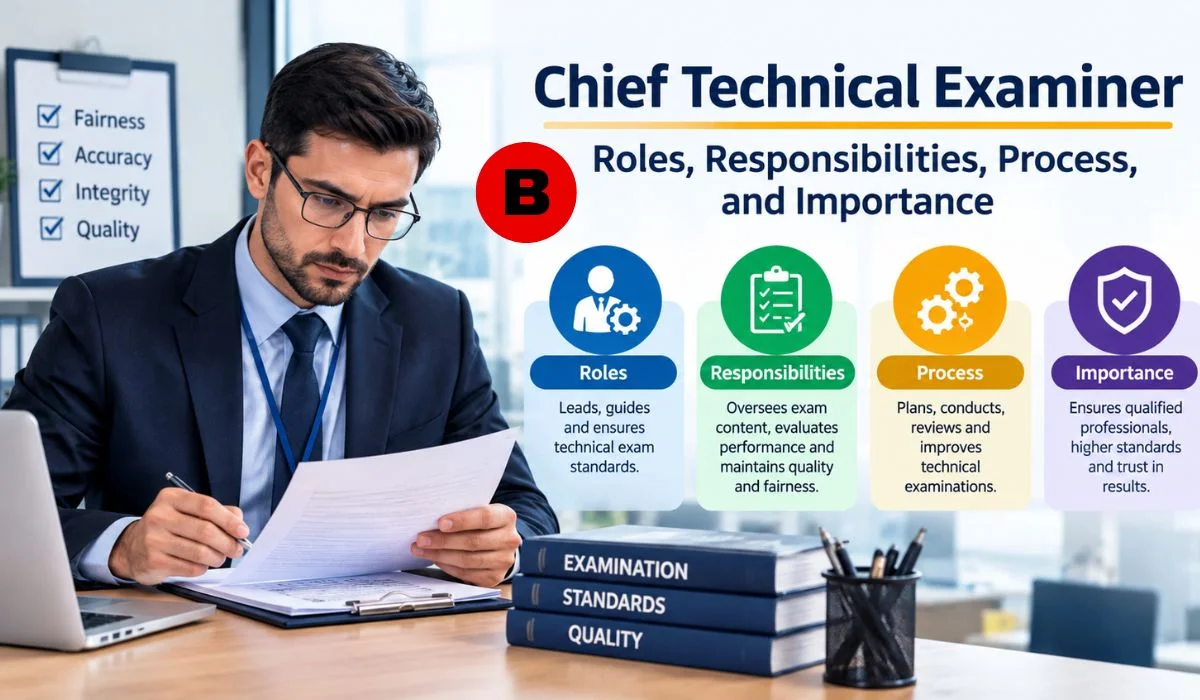
- 0
- 2,372 words
Introduction
The role of a chief technical examiner is important in organizations that depend on technical accuracy, professional standards, quality control, and regulatory compliance. Whether working in government departments, engineering institutions, manufacturing companies, financial organizations, or specialized technical agencies, a chief technical examiner helps ensure that operations meet established requirements. This position combines technical expertise, leadership, analytical thinking, and the ability to evaluate complex systems.
As industries continue to adopt advanced technologies and increasingly demanding quality standards, the need for experienced technical professionals has grown. Organizations require individuals who can examine technical processes, identify weaknesses, assess performance, and recommend practical improvements. A chief technical examiner often takes responsibility for overseeing these activities while coordinating with different departments and senior management.
Understanding this position involves looking at its responsibilities, educational requirements, professional skills, working environment, and long-term career opportunities. Although the exact duties may differ between organizations, the central purpose remains consistent: maintaining technical integrity and ensuring that work is performed according to appropriate standards.
What Is a Chief Technical Examiner?
A chief technical examiner is a senior professional responsible for supervising technical examinations, inspections, assessments, and evaluations within an organization. The position generally involves reviewing technical information, checking compliance with relevant standards, examining equipment or processes, and ensuring that technical activities meet required specifications.
The word “chief” indicates a leadership position. Rather than performing every inspection independently, the individual may supervise a team of engineers, inspectors, auditors, technicians, and other specialists. They establish examination procedures, review findings, distribute responsibilities, and make sure that important technical concerns receive proper attention.
The meaning of this position can vary depending on the organization. In an engineering department, the chief technical examiner might concentrate on infrastructure, machinery, construction quality, or project specifications. In a government institution, the role could involve technical audits, compliance assessments, and investigations into departmental activities.
In every setting, the position requires a combination of practical technical knowledge and management abilities.
Key Responsibilities of a Chief Technical Examiner
The responsibilities of a chief technical examiner are usually broad because the position involves both technical supervision and organizational oversight.
1. Supervising Technical Examinations
One of the primary responsibilities is supervising technical examinations. These examinations help determine whether equipment, projects, systems, and operational procedures meet established requirements.
The examiner develops or approves inspection plans, assigns tasks to qualified employees, and reviews the results. They also ensure that examinations are performed consistently and that the information collected is accurate.
When problems are discovered, the chief technical examiner may investigate their causes and recommend corrective measures.
2. Maintaining Quality Standards
Quality assurance is another important responsibility. Organizations need reliable processes to maintain customer confidence, reduce operational errors, and protect their reputation.
A chief technical examiner reviews technical procedures to determine whether they meet applicable quality standards. This may include checking materials, reviewing project documentation, examining equipment performance, and assessing completed work.
By identifying weaknesses early, the professional can help prevent expensive mistakes and unnecessary delays.
3. Preparing Technical Reports
Technical reports provide a formal record of examinations, inspections, findings, and recommendations.
A chief technical examiner may prepare reports personally or review documents produced by members of the examination team. These reports should explain the purpose of an examination, describe the methods used, identify relevant findings, and suggest appropriate solutions.
Clear reporting is essential because senior management often relies on these documents when making operational decisions.
4. Identifying Technical Problems
Technical problems can affect productivity, safety, quality, and organizational performance.
The chief technical examiner evaluates unusual results, investigates inconsistencies, and determines whether technical failures are connected to equipment, materials, procedures, or human error.
Strong analytical abilities are especially valuable in this area. Instead of simply identifying a problem, an experienced examiner attempts to understand its underlying cause and prevent it from happening again.
5. Leading Technical Teams
A senior examiner may supervise several professionals who perform inspections and technical assessments.
Leadership responsibilities can include assigning work, reviewing employee performance, providing guidance, arranging training, and resolving disagreements about technical findings.
Effective leadership helps ensure that team members understand their responsibilities and follow consistent examination procedures.
6. Ensuring Regulatory Compliance
Many organizations operate under government regulations, industry standards, and internal policies.
The chief technical examiner helps verify that relevant activities comply with these requirements. Depending on the industry, this may involve safety regulations, engineering standards, environmental requirements, procurement procedures, or quality management systems.
Failure to comply with applicable requirements can create financial, legal, and operational problems. Therefore, careful examination and documentation are important parts of the role.
Educational Qualifications and Professional Background
Becoming a chief technical examiner generally requires a strong educational foundation and substantial professional experience. However, the exact qualifications depend on the industry and employer.
A bachelor’s degree in an appropriate technical discipline is commonly useful. Relevant subjects may include:
- Mechanical engineering
- Electrical engineering
- Civil engineering
- Industrial engineering
- Computer science
- Information technology
- Electronics engineering
- Applied sciences
- Quality management
For specialized positions, employers may prefer candidates with postgraduate qualifications or professional certifications.
Academic qualifications provide the theoretical knowledge needed to understand technical systems. However, senior examination positions also require practical experience. Employers generally look for professionals who have worked in technical inspection, engineering supervision, quality assurance, auditing, project management, or related fields.
Experience is particularly valuable because technical examinations frequently involve complicated situations that cannot be solved through theoretical knowledge alone.
Essential Skills Required for the Position
A successful chief technical examiner needs more than technical qualifications. The position requires a balanced collection of professional, analytical, and interpersonal abilities.
Technical Knowledge
A detailed understanding of the relevant industry is essential. The examiner must understand how systems operate, how technical standards are applied, and how to identify possible weaknesses.
Technical knowledge also allows the professional to evaluate the findings of other specialists and recognize when additional investigation is necessary.
Analytical Thinking
Technical examinations often involve large amounts of information. An examiner must be able to interpret measurements, compare results, identify patterns, and reach logical conclusions.
Analytical thinking helps distinguish between minor irregularities and serious problems that require immediate attention.
Communication Skills
Communication is important because the chief technical examiner regularly interacts with employees, technical teams, contractors, managers, and external authorities.
The ability to explain complicated technical findings in understandable language makes reports and recommendations more effective.
Leadership and Management
A senior examiner must be comfortable supervising people and organizing work. Leadership includes setting expectations, monitoring progress, supporting professional development, and maintaining accountability.
Good management also requires the ability to make decisions under pressure without compromising technical accuracy.
Attention to Detail
Small errors can sometimes lead to significant technical failures. Therefore, an examiner must carefully review specifications, documents, measurements, and inspection results.
Attention to detail helps maintain reliable records and reduces the possibility of overlooking important information.
Problem-Solving Abilities
A chief technical examiner should be capable of identifying practical solutions when technical difficulties arise.
This requires understanding the available resources, evaluating different approaches, considering potential risks, and selecting solutions that address the actual problem.
The Role in Government Organizations
Government institutions may employ senior technical examiners to support accountability, transparency, and compliance.
In these environments, the position can involve examining technical projects, reviewing departmental procedures, assessing engineering work, and investigating irregularities in technical operations.
For example, a technical examination might evaluate whether a construction project follows approved specifications or whether purchased equipment meets contractual requirements.
The examiner may also review technical documentation and provide independent observations to senior officials.
In some public-sector systems, a Chief Technical Examiner may work within a specialized examination or vigilance organization. Such positions can carry responsibilities involving technical scrutiny of public works, procurement, contracts, and infrastructure projects.
The precise authority and duties depend on the relevant government department and its legal framework.
The Role in Private Companies
Private organizations also need experienced technical professionals who can maintain quality and improve operational performance.
In manufacturing, the chief technical examiner may supervise inspections of production equipment, raw materials, and finished products. Their work helps reduce defects and maintain consistency.
In construction, they may evaluate building materials, structural specifications, project documentation, and construction quality.
In technology companies, the position may involve reviewing software systems, technical documentation, cybersecurity controls, or infrastructure performance.
Although responsibilities vary across industries, private-sector employers generally value professionals who can reduce technical risks while supporting productivity and business objectives.
Difference Between a Technical Examiner and a Chief Technical Examiner
Although the two positions are related, they usually involve different levels of responsibility.
A technical examiner generally performs inspections, reviews documents, collects technical information, and identifies problems within an assigned area.
A chief technical examiner usually operates at a higher organizational level. They may supervise multiple examiners, approve examination plans, review important reports, coordinate investigations, and advise senior management.
The difference is therefore not simply about technical knowledge. It also involves leadership, decision-making authority, professional accountability, and organizational influence.
A technical examiner concentrates primarily on assigned examination activities, while the chief technical examiner may be responsible for ensuring that the entire examination process operates effectively.
Importance of Technical Examinations
Technical examinations play an important role in maintaining organizational standards.
First, they help identify mistakes before those mistakes become expensive problems. Regular assessments can reveal equipment defects, documentation errors, weaknesses in operational procedures, and deviations from approved specifications.
Second, technical examinations support transparency. Properly documented findings allow managers and other responsible authorities to understand how decisions were made and whether procedures were followed.
Third, examinations improve safety and reliability. In industries involving construction, manufacturing, transportation, and engineering, technical failures can have serious consequences.
Finally, examinations encourage continuous improvement. By studying recurring problems and reviewing operational performance, organizations can develop better procedures and use their resources more effectively.
The chief technical examiner helps coordinate these activities and ensures that findings lead to meaningful improvements.
Challenges Faced by a Chief Technical Examiner
Despite the importance of the position, the work can involve several challenges.
One major challenge is managing complicated technical investigations. Some problems involve multiple departments, incomplete documentation, or conflicting explanations. Finding the actual cause requires patience, experience, and careful evaluation.
Another challenge is maintaining independence. Examiners may sometimes encounter situations in which their findings are inconvenient for particular departments or individuals. A professional must remain objective and base conclusions on evidence rather than personal relationships or organizational pressure.
Keeping up with technological developments is also important. New equipment, software, inspection methods, and industry standards continuously change the way technical examinations are conducted.
Time management can create additional difficulties. Senior examiners may need to supervise multiple projects while responding to urgent issues and preparing detailed reports.
Successful professionals handle these challenges through consistent procedures, professional ethics, effective communication, and continuous learning.
Career Opportunities and Professional Growth
The position of chief technical examiner can represent an important stage in a technical professional’s career.
Many individuals begin in junior engineering, inspection, quality control, or technical support positions. With experience, they may move into supervisory roles and eventually become eligible for senior examination or management positions.
Potential career pathways include:
- Technical Examiner
- Senior Technical Examiner
- Quality Assurance Manager
- Technical Audit Manager
- Engineering Inspection Manager
- Compliance Manager
- Chief Technical Examiner
- Technical Director
- Head of Engineering or Inspection
Professional development can improve career opportunities. Certifications in quality management, project management, occupational safety, engineering inspection, and auditing may be useful depending on the industry.
The most important factor is developing a combination of technical expertise, leadership experience, and a strong professional reputation.
Salary and Job Prospects
The salary of a chief technical examiner varies considerably according to location, employer, industry, experience, and level of responsibility.
Government positions may follow established pay scales and employment structures. Private-sector organizations may offer compensation based on technical specialization, management responsibilities, and business requirements.
Professionals working in highly specialized industries may receive different compensation from those working in general inspection or administrative environments.
Job prospects are influenced by the continuing need for quality assurance, regulatory compliance, infrastructure development, and technical risk management.
As organizations become more dependent on sophisticated systems and specialized equipment, experienced professionals who can evaluate technical performance are likely to remain valuable.
However, the availability of specific chief technical examiner positions depends on departmental structures and recruitment requirements.
How Technology Is Changing the Profession
Technology is transforming the way technical examinations are conducted.
Digital inspection tools allow professionals to collect and analyze information more efficiently. Modern sensors can monitor equipment performance, while automated systems can identify unusual patterns and alert examination teams to possible problems.
Artificial intelligence is also becoming useful in reviewing technical records, identifying inconsistencies, and supporting predictive maintenance.
In construction and engineering, digital modeling tools can help examiners compare actual project conditions with approved designs.
Despite these developments, technology does not eliminate the need for experienced professionals. Automated systems can provide useful information, but human judgment remains essential when interpreting complex findings and making important decisions.
A modern chief technical examiner should therefore be comfortable using digital tools while maintaining strong foundational technical knowledge.
Professional Ethics and Accountability
Professional ethics are essential in any examination-related position.
A chief technical examiner must provide accurate findings, protect confidential information, avoid conflicts of interest, and treat all relevant parties fairly.
Reports should reflect the available evidence rather than personal assumptions. If an examination reveals a serious problem, the professional should communicate it through the appropriate organizational channels.
Accountability is equally important. Technical decisions can influence budgets, project approvals, public resources, workplace safety, and organizational reputation.
Maintaining integrity helps establish confidence in the examination process and strengthens the credibility of the entire department.
Conclusion
A chief technical examiner is an important senior professional who helps organizations maintain technical accuracy, quality standards, regulatory compliance, and operational reliability. The position combines specialized technical knowledge with leadership, investigation, reporting, and decision-making responsibilities.
Whether working in government institutions, engineering departments, manufacturing facilities, or private companies, this professional plays a valuable role in identifying problems and recommending improvements.
The career generally requires relevant education, substantial practical experience, strong analytical abilities, and a commitment to professional ethics. As technology and industry standards continue to evolve, continuous learning will remain essential.
Ultimately, the chief technical examiner contributes to better organizational performance by ensuring that technical work is properly examined, important weaknesses are addressed, and decisions are supported by reliable evidence. It is a demanding but valuable career path for professionals who enjoy technical problem-solving, leadership, and maintaining high standards.
Author

blowouttaper.co.uk@gmail.com
Related Posts

How Real Estate Brands Can Build Buyer Trust Through Digital Marketing in Pune
- 0
- 583 words
Buying a property is a process which requires thorough research, planning and many decisions. Home buyers of today do not want just...
Read out all
What Equipment Propane Suppliers Use for Safe Fuel Delivery
- 0
- 721 words
Propane delivery requires specialized equipment to transfer liquefied petroleum gas between storage facilities and customer tanks. Each component serves a specific purpose,...
Read out all
Uecht: Exploring Its Meaning, History, Location, and Fascinating Connections
- 0
- 2,422 words
The word Uecht may look unfamiliar to many people, but it has several interesting connections to European geography, language, history, and astronomy....
Read out all
songoftruth.org: A Complete Guide to Its Purpose, Content, Features, and What Visitors Should Know
- 0
- 1,890 word
The internet provides countless websites designed to inform, educate, entertain, and inspire people. However, finding a platform that offers useful information in...
Read out all
Printely: Everything You Need to Know About Its Features, Uses, Benefits, and Growing Popularity
- 0
- 2,036 words
In today’s digital world, printing and design solutions continue to play an important role in personal, educational, and professional activities. From creating...
Read out all
Comerlin: Meaning, Origin, History, and Everything You Need to Know
- 0
- 2,006 words
Some words attract attention because they are unusual, unfamiliar, or difficult to identify. Comerlin is one such term. People searching for Comerlin...
Read out all