
- 0
- 1,963 word
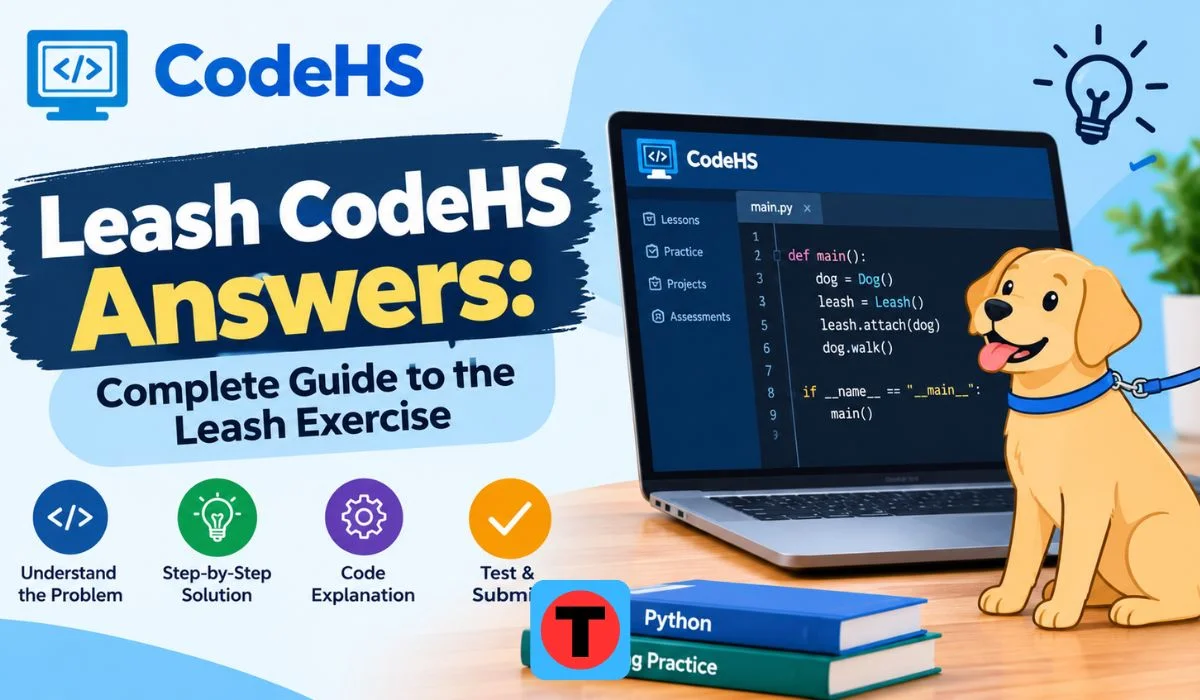
Searching for leash CodeHS answers is common among students who are working through programming exercises and need help understanding a particular challenge. CodeHS is designed to teach coding through hands-on practice, and assignments often require students to think logically, understand program structure, and test their solutions carefully.
The word “leash” may refer to a specific exercise, project, or programming task within a CodeHS course. While it can be tempting to look for a ready-made solution, the best approach is to understand how the program works. Learning the logic behind an answer can help students complete the current assignment and build skills that will be useful in future coding projects.
This guide explains how to approach leash CodeHS assignments, understand common programming concepts, avoid common mistakes, and develop solutions with confidence.
What Is CodeHS?
CodeHS is an educational platform that helps students learn computer science and programming. It offers courses covering different programming languages and topics, from beginner-level coding concepts to more advanced computer science subjects.
One of the biggest benefits of CodeHS is its interactive learning environment. Students do not simply read about programming. Instead, they write code, run programs, identify errors, and improve their solutions.
Many assignments involve characters, objects, animations, or real-world situations. An exercise involving a leash, for example, may ask students to control an object’s movement, connect two elements, or create a visual representation using code.
Because every course can use different programming languages and instructions, students should always read the requirements of their specific assignment before writing a solution.
Why Students Search for Leash CodeHS Answers
Programming can sometimes feel challenging, especially when a student understands the goal but does not know how to begin. A search for leash CodeHS answers often happens when someone is facing one of the following problems:
- The instructions seem confusing.
- The code produces an error.
- The program runs but does not create the expected result.
- A student does not understand which functions or commands to use.
- The assignment requires several steps that are difficult to organize.
- A small mistake is preventing the program from working.
These challenges are completely normal. Even experienced programmers spend time debugging and looking for better ways to solve problems.
The important thing is to use outside help as a learning tool rather than simply copying a complete answer. Understanding each line of code makes it easier to complete future assignments independently.
Start by Reading the Assignment Carefully
Before searching for leash CodeHS answers, take a few minutes to read the assignment from beginning to end. Programming instructions often contain important details that can easily be missed.
Look for the following information:
Understand the Goal
What should the finished program do? Try to describe the goal in simple language. For example, you might say, “The program needs to create an object and make another object follow it.”
Once you understand the final goal, the assignment becomes easier to break into smaller tasks.
Identify the Required Tools
Many CodeHS exercises expect students to use specific functions, variables, loops, or classes. Pay attention to these requirements.
If the assignment is teaching a new concept, the expected solution may focus on that concept rather than using a shortcut.
Check the Starting Code
Some exercises provide starter code. Do not immediately delete or replace it. Read the existing code and try to understand what each part does.
Starter code often includes important functions or structures that are needed for the program to work correctly.
Break the Problem Into Smaller Steps
One of the most useful programming habits is breaking a large problem into smaller pieces.
Suppose a leash-related assignment requires you to create two objects and make them behave in a connected way. Instead of trying to write the entire program at once, you could think about the task in stages.
First, create the main object.
Next, create the second object.
Then, determine how the two objects should be connected or positioned.
After that, add movement or interaction.
Finally, test the complete program.
This method makes programming less overwhelming. If something goes wrong, you can identify which step caused the problem.
Understand Variables and Object Positions
Many beginner programming exercises use variables to store information. A variable might hold a number, a position, a name, or another piece of data.
For a visual programming assignment, position is often important. Objects may have an X-coordinate and a Y-coordinate that determine where they appear on the screen.
For example, imagine that one object represents a person and another represents a pet. If the pet needs to stay nearby, the program may need to calculate its position based on the position of the person.
This introduces an important programming idea: relationships between values.
Instead of assigning a completely random position, you can use existing information to determine a new position. Learning how values relate to one another is an essential skill in coding.
Functions Can Make Your Code Easier to Manage
A function is a group of instructions that performs a particular task. Functions help programmers organize their code and avoid repeating the same instructions.
A leash CodeHS assignment may require several actions, such as creating an object, moving it, or updating its position. Rather than placing all instructions in one large section, you can separate the program into meaningful functions when the assignment allows it.
For example, you might organize your thinking around tasks such as:
- Creating the main object
- Creating the connected object
- Updating positions
- Checking movement
- Drawing the visual elements
Even if the exact function names are different in your course, this way of thinking can make a program easier to read and debug.
Common Mistakes When Working on CodeHS Assignments
Students often make small errors that can stop an otherwise good program from working. Here are some common problems to check when your code is not producing the expected result.
Misspelled Names
Programming languages are very specific. If you create a variable with one name and later use a slightly different spelling, the program may produce an error.
Always check the spelling and capitalization of variables and functions.
Missing Punctuation
Depending on the programming language, missing parentheses, quotation marks, brackets, or other symbols can cause errors.
When you see an error message, look closely at the line mentioned by the program. The actual mistake may be on that line or just before it.
Incorrect Order of Instructions
Programs follow instructions in a specific order. If you try to move an object before creating it, the program may fail.
Think about the sequence of events and make sure the required objects and variables exist before they are used.
Forgetting to Update Values
If an object is supposed to move or follow another object, its position may need to be updated repeatedly.
A common mistake is setting a position only once and expecting the relationship to continue automatically. Depending on the assignment, the program may need a loop, event handler, or repeated update.
How to Debug a Leash CodeHS Assignment
Debugging is the process of finding and fixing problems in a program. It is one of the most important skills a programmer can develop.
When working on a difficult assignment, avoid changing everything at once. Instead, test one part of the program at a time.
Start by asking these questions:
Does the program run at all?
If not, read the error message and check for syntax problems.
Are all objects being created?
Make sure each required object appears or is properly initialized.
Are the positions correct?
If objects appear in unexpected locations, review the coordinate values.
Does the program update when something moves?
Check whether the code that changes positions is actually being called.
Does the output match the assignment instructions?
A program can run without errors and still fail to meet the requirements. Compare your result carefully with the instructions.
Testing frequently can save a lot of time. It is much easier to find a mistake after writing five lines of code than after writing fifty.
Why Copying Answers Is Not the Best Strategy
Finding a complete solution may seem like the fastest way to finish an assignment, but copying code without understanding it can create bigger problems later.
Programming courses are usually designed so that each lesson builds on earlier concepts. If you skip the learning process for one assignment, the next assignment may be even more difficult.
A better strategy is to study an example and ask yourself questions such as:
- What does this line do?
- Why is this variable needed?
- What happens if I change this value?
- Why does the function need these inputs?
- Can I write the same logic in my own way?
By answering these questions, you turn a possible shortcut into a genuine learning opportunity.
A Better Way to Find Help
If you are stuck on a leash CodeHS exercise, try several methods before giving up.
First, review the lesson material connected to the assignment. The answer is often based on a concept that was introduced earlier.
Second, read the instructions again and compare them with your current code.
Third, simplify your program. Remove or temporarily ignore complicated sections and focus on getting one feature to work.
Fourth, ask a teacher, classmate, or tutor for an explanation of the concept. Instead of asking only for the final answer, explain where you are stuck.
For example, you could say, “I understand how to create the objects, but I do not understand how to keep one object connected to the other.” This type of question makes it easier for someone to provide useful guidance.
Building Skills Beyond One Assignment
The real value of solving CodeHS exercises is not just completing the current task. Each assignment helps build problem-solving skills.
As you work through programming challenges, you begin to recognize patterns. You learn how to break down a problem, organize instructions, test your code, and fix mistakes.
These skills apply to many programming languages and projects.
A student who learns how to debug a simple object movement problem today may later use similar thinking to create a website, mobile application, game, or software project.
That is why understanding the process behind leash CodeHS answers is more valuable than memorizing a single solution.
Tips for Becoming More Confident With Code
Confidence in programming develops through practice. Here are a few simple habits that can make a big difference.
Write code regularly, even if you only practice for a short time.
Read your code after writing it. Try to explain what each section does in your own words.
Experiment with small changes. Change a value and observe what happens.
Do not be afraid of error messages. Errors are information that can help you locate a problem.
Keep your code organized. Clear variable names and logical sections make programs easier to understand.
Most importantly, be patient. Programming is often a process of trying, testing, failing, and improving.
Final Thoughts
Searching for leash CodeHS answers may help you find explanations and examples, but the most effective approach is to focus on understanding the programming concepts behind the assignment.
Start by reading the instructions carefully and identifying the goal. Break the challenge into smaller steps, create and test each part of the program, and use debugging techniques when something does not work as expected.
Avoid relying completely on copied solutions. Instead, use examples to understand how variables, functions, positions, and program logic work together.
Every challenging CodeHS assignment is an opportunity to become a better problem solver. The code you write today may seem simple, but the habits you develop while creating, testing, and debugging it can support your learning for years to come.
With patience, practice, and a willingness to understand each step, even a difficult leash-related programming exercise can become a valuable learning experience rather than just another assignment to complete.
Author

blowouttaper.co.uk@gmail.com
Related Posts

How Real Estate Brands Can Build Buyer Trust Through Digital Marketing in Pune
- 0
- 583 words
Buying a property is a process which requires thorough research, planning and many decisions. Home buyers of today do not want just...
Read out all
What Equipment Propane Suppliers Use for Safe Fuel Delivery
- 0
- 721 words
Propane delivery requires specialized equipment to transfer liquefied petroleum gas between storage facilities and customer tanks. Each component serves a specific purpose,...
Read out all
Chief Technical Examiner: Roles, Responsibilities, Qualifications, and Career Opportunities
- 0
- 2,372 words
Introduction The role of a chief technical examiner is important in organizations that depend on technical accuracy, professional standards, quality control, and...
Read out all
Uecht: Exploring Its Meaning, History, Location, and Fascinating Connections
- 0
- 2,422 words
The word Uecht may look unfamiliar to many people, but it has several interesting connections to European geography, language, history, and astronomy....
Read out all
songoftruth.org: A Complete Guide to Its Purpose, Content, Features, and What Visitors Should Know
- 0
- 1,890 word
The internet provides countless websites designed to inform, educate, entertain, and inspire people. However, finding a platform that offers useful information in...
Read out all
Printely: Everything You Need to Know About Its Features, Uses, Benefits, and Growing Popularity
- 0
- 2,036 words
In today’s digital world, printing and design solutions continue to play an important role in personal, educational, and professional activities. From creating...
Read out all