×
Sail vs Sale: Meaning, Differences & Easy Tips to Remember
In

If you’ve ever paused while writing or reading and wondered whether it should be Sail vs Sale, you’re not alone. These two words sound exactly the same but have completely different meanings, which makes them a classic example of English homophones that often confuse learners and even native speakers.

In this article, we’ll break down the difference between Sail vs Sale, explain their meanings in simple terms, and share easy memory tricks so you never mix them up again.

What Does Sail vs Sale Mean? (Quick Overview)

At the core, the confusion around Sail vs Sale comes from pronunciation, not meaning.

  • Sail → related to boats, ships, and movement over water or air
  • Sale → related to selling, discounts, or transactions

Even though they sound identical, their usage depends entirely on context.

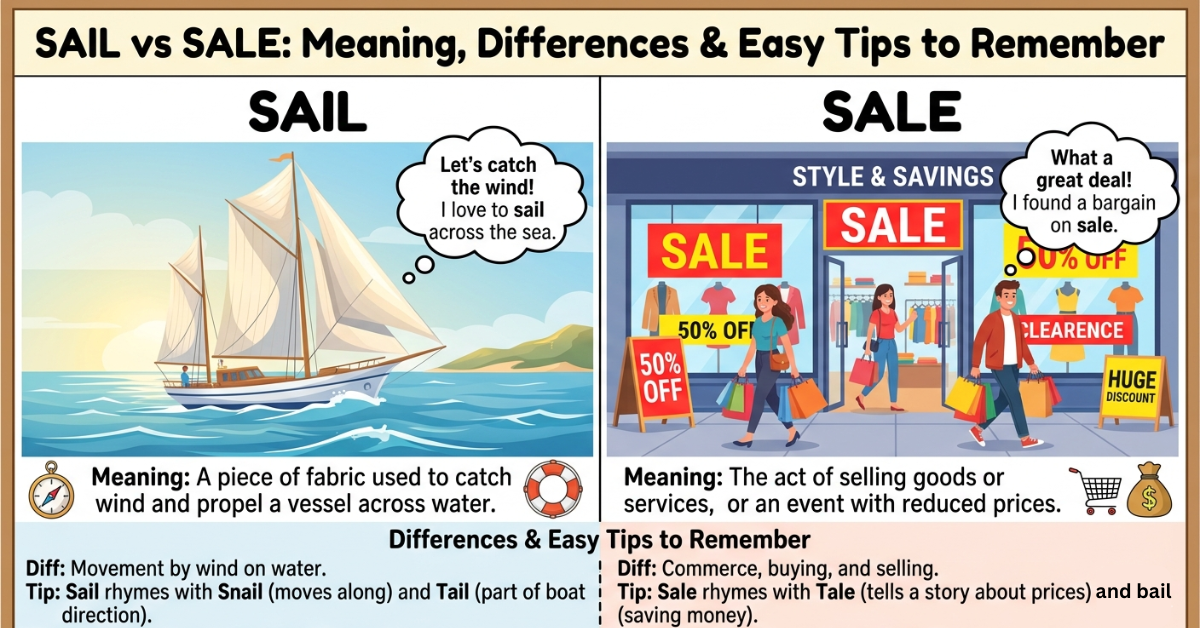
Meaning of “Sail” – Travel, Boats & Movement

The word sail is mostly used in the context of water travel or navigation. It can also be used as a verb or noun.

As a noun:

  • A large piece of fabric used to catch wind and move a boat

As a verb:

  • To travel on water using a boat or ship
  • To glide smoothly through air or space

Examples:

  • The boat’s sail was bright white against the blue sea.
  • We will sail across the ocean next summer.
  • The bird seemed to sail effortlessly in the sky.

So whenever you’re talking about travel, wind, or water movement, the correct word is sail, not the other option in Sail vs Sale confusion.

Meaning of “Sale” – Shopping, Discounts & Business

On the other hand, sale belongs to the world of commerce and shopping.

It refers to:

  • Selling goods or services
  • Discount offers in stores
  • The act of exchanging products for money

Examples:

  • The shop is having a big sale this weekend.
  • I bought this dress during the winter sale.
  • The house is up for sale.

Whenever money, buying, or discounts are involved, the correct term is sale.

Why Do People Confuse Sail vs Sale?

The confusion between Sail vs Sale happens mainly because they are homophones—words that sound the same but have different meanings and spellings.

Here’s why people mix them up:

  • They sound identical when spoken
  • Both are short, simple words
  • Context is not always clear in casual writing
  • Autocorrect may sometimes mislead users

This makes it important to understand the context before choosing the right word.

Easy Tricks to Remember Sail vs Sale

If you struggle with Sail vs Sale, here are some simple memory hacks:

1. Think of the “A” in Sale = Advertising

  • Sale = shopping, ads, discounts
  • The “A” reminds you of “advertisements in stores”

2. Think of Sail = Sea

  • Sail = boats, ocean, water
  • Both start with “S” and feel natural together

3. Visual Memory Trick

  • Imagine a boat when you see “sail”
  • Imagine a shopping mall when you see “sale”

These mental images help you instantly choose the correct word.

Common Mistakes with Sail vs Sale

Even experienced writers sometimes slip up. Here are common errors:

  • Incorrect: The shop is on sail this weekend” 
     Correct: “The shop is on sale this weekend”
  • Incorrect: “We went for a sale across the river” 
     Correct: “We went for a sail across the river”
  • Incorrect: Mixing both in emails or captions due to autocorrect

Being mindful of context helps avoid these mistakes easily.

Real-Life Examples of Sail vs Sale

Let’s see both words in action:

Travel Context:

  • The yacht began to sail at sunrise.
  • They learned how to control the sails during the storm.

Shopping Context:

  • Black Friday sale attracts thousands of buyers.
  • Everything in the store is 50% off during the sale season.

When you place them side by side, the difference becomes much clearer.

Quick Comparison Table

Word Meaning Context Example
Sail Travel on water/air Navigation Sail across the sea
Sale Discount/selling Shopping Summer sale on clothes

This simple breakdown makes it easy to remember.

FAQs about Sail vs Sale

1. What is the main difference between sail and sale?

The main difference is meaning. “Sail” relates to boats or movement on water, while “sale” relates to buying and selling.

2. Why do sail and sale sound the same?

They are homophones, meaning they are pronounced the same but spelled differently and have different meanings.

3. How can I remember sail vs sale easily?

Link “sail” with sea and boats, and “sale” with shopping and discounts.

4. Is it common to confuse sail vs sale?

Yes, especially in writing or typing quickly, because they sound identical.

5. Can sail be used in business context?

No, “sail” is not used in commerce. Only “sale” is correct for business or shopping contexts.

Conclusion

Understanding the difference between Sail vs Sale is simple once you break it down. One belongs to the world of water, wind, and travel, while the other belongs to shopping, discounts, and business.

By remembering the context and using the memory tricks shared above, you can confidently avoid mistakes in writing and speaking. Whether you’re writing an essay, a social media caption, or a professional email, choosing the right word will make your communication clearer and more accurate.

If you found this helpful, keep practicing with other commonly confused English words to strengthen your language skills even more.

Leave a Reply

Your email address will not be published. Required fields are marked *

Author

britsx85@gmail.com

Related Posts

Leak vs Leek: Meaning, Difference & Easy Guide
In

Leak vs Leek: Meaning, Difference & Easy Guide

Have you ever seen the words leak and leek and wondered why they look almost identical but mean completely different things? This...

Read out all
Knead vs Need: Meaning, Difference & Usage Guide
In

Knead vs Need: Meaning, Difference & Usage Guide

English can be tricky, especially when two words sound the same but mean completely different things. One such confusing pair is Knead...

Read out all
Jam vs Jamb: Meaning, Difference & Usage Explained
In

Jam vs Jamb: Meaning, Difference & Usage Explained

The confusion around jam vs jamb is more common than you might think, especially among English learners and even native speakers. At...

Read out all
Incite vs Insight: Meaning, Difference & Usage Explained
In

Incite vs Insight: Meaning, Difference & Usage Explained

Have you ever stumbled while writing and wondered whether to use incite vs insight? You’re not alone. These two words sound similar...

Read out all
Idle vs Idol: Meaning, Difference & Usage Guide
In

Idle vs Idol: Meaning, Difference & Usage Guide

The confusion between idle vs idol is more common than you might think, especially in spoken and written English where both words...

Read out all
Hanged vs Hung: Meaning, Grammar & Usage Explained
In

Hanged vs Hung: Meaning, Grammar & Usage Explained

The confusion between hanged vs hung often troubles English learners and even native speakers. Many people mix them up because both forms...

Read out all