- 0
- 663 words
Writing becomes much clearer when ideas are connected smoothly, and that’s exactly where on the other hand transition words come in. These phrases help you show contrast between two ideas in a natural and easy-to-understand way.
If you’ve ever struggled to compare opinions, arguments, or situations in your writing, learning how on the other hand transition words work can instantly improve your clarity. In this guide, we’ll break down their meaning, usage, examples, and alternatives in a simple, human-friendly way.
What Are “On the Other Hand Transition Words”?
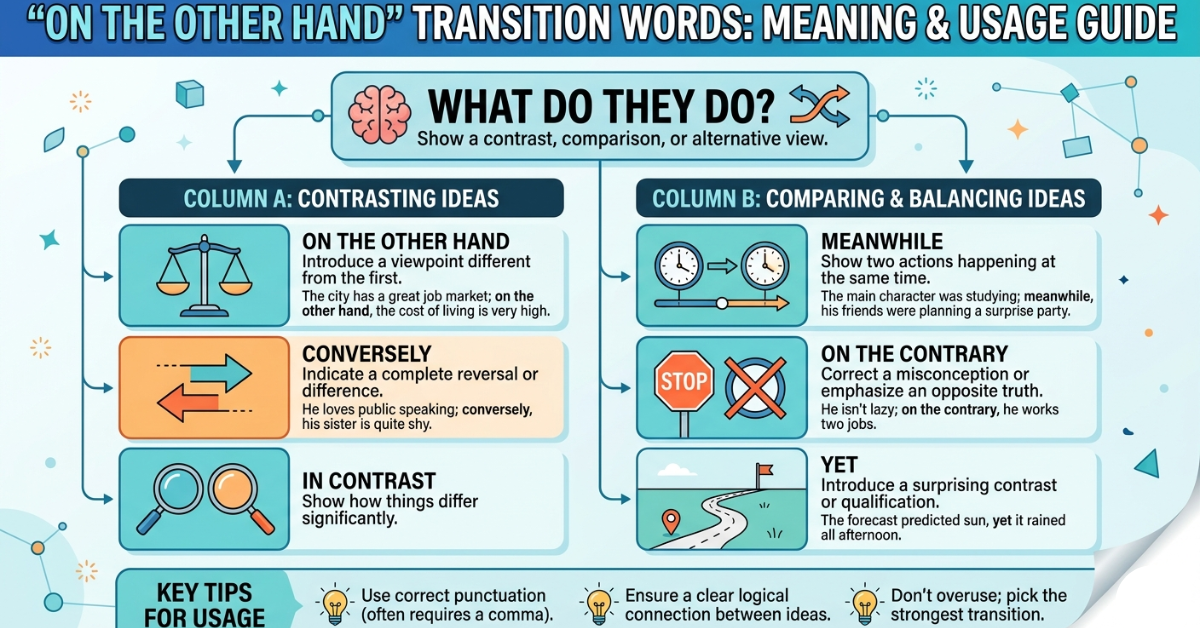
On the other hand transition words are linking phrases used to present a contrasting idea or opposite point of view. They help writers show balance in arguments by introducing an alternative perspective.
For example:
- I love summer weather. On the other hand, winter is perfect for cozy evenings.
These transition words act like bridges between two different thoughts, making your writing more logical and readable.
Why Are These Transition Words Important?
Using on the other hand transition words improves your writing in several ways:
- They create smooth flow between contrasting ideas
- They make arguments more persuasive and balanced
- They improve readability and structure
- They help avoid abrupt or confusing sentences
In academic writing, essays, emails, and even blog posts, these transitions make your ideas feel more professional and organized.
How to Use “On the Other Hand” in Sentences
The phrase “on the other hand” is usually placed at the beginning or middle of a sentence to show contrast.
Examples:
- I enjoy working independently. On the other hand, group projects help build teamwork skills.
- The hotel was expensive. The food, on the other hand, was worth every penny.
- She prefers tea. I, on the other hand, can’t start my day without coffee.
When using on the other hand transition words, always ensure the second idea clearly contrasts with the first.
Common Mistakes to Avoid
Even though these transition words are simple, people often misuse them. Here are some common mistakes:
1. Using without contrast
Don’t use it when ideas are similar. It only works for opposing ideas.
2. Overusing the phrase
Repetition can make writing feel robotic. Try to vary your transitions.
3. Incorrect punctuation
Usually, it is followed by a comma when used at the start:
- On the other hand, I prefer working at night.
Alternatives to “On the Other Hand”
If you want to avoid repetition, here are some useful alternatives:
- However
- In contrast
- Conversely
- On the flip side
- Nevertheless
- Yet
- Still
Using these alternatives helps keep your writing fresh while maintaining the same meaning as on the other hand transition words.
Tips for Better Usage
To master contrast writing, keep these simple tips in mind:
- Use transition words only when comparing opposite ideas
- Keep sentences short and clear
- Mix different transition phrases for variety
- Practice by rewriting simple sentences into contrasting ones
The more you practice, the more natural your use of on the other hand transition words will become.
FAQs
1. What are “on the other hand transition words” used for?
They are used to show contrast between two ideas or opinions in writing.
2. Can I start a sentence with “on the other hand”?
Yes, it is commonly used at the beginning of a sentence followed by a comma.
3. Is “on the other hand” formal or informal?
It is neutral, meaning it works well in both formal and informal writing.
4. What is a simpler alternative?
Words like “however” or “in contrast” can be simpler alternatives.
5. Can I overuse transition words?
Yes, overusing them can make writing repetitive, so it’s best to use them naturally and sparingly.
Conclusion
On the other hand transition words are powerful tools for expressing contrast in writing. They help you present balanced arguments, improve clarity, and make your content more engaging and professional.
By practicing their use and exploring alternatives, you can significantly improve your writing style and flow. The key is to keep it natural, simple, and purposeful—so your ideas connect smoothly without confusion.
Author

linguaezone.com@gmail.com
Related Posts
Kill Two Birds With One Stone Alternative: 50 Better Options
- 0
- 1,569 word
Have you ever paused before saying “kill two birds with one stone” because it sounded too violent or simply didn’t fit the...
Read out all
Happy Sabbath Meaning: A Complete Guide to Its Significance
- 0
- 1,632 word
Have you ever received the message “Happy Sabbath” and wondered what it truly means? Is it simply another way of saying “have...
Read out all
I’m So Proud of You in Other Words: 120+ Heartfelt Alternatives
- 0
- 1,562 word
Have you ever wanted to tell someone you’re proud of them but felt like saying “I’m so proud of you” sounded repetitive?...
Read out all
How Do You Spell Happy Anniversary? Correct Spelling Guide
- 0
- 1,221 word
Have you ever paused before writing an anniversary card and wondered, “How do you spell happy anniversary?” You’re not alone. Whether you’re...
Read out all
Waiting for Your Response Email: Best Examples & Tips
- 0
- 1,483 word
Have you ever sent an important email and found yourself wondering whether you should follow up or simply wait? Whether you’re communicating...
Read out all
Great Asset to the Team: Meaning, Examples & Tips
- 0
- 1,494 word
Have you ever wanted to compliment a coworker but struggled to find words that sound professional and sincere? One of the most...
Read out all