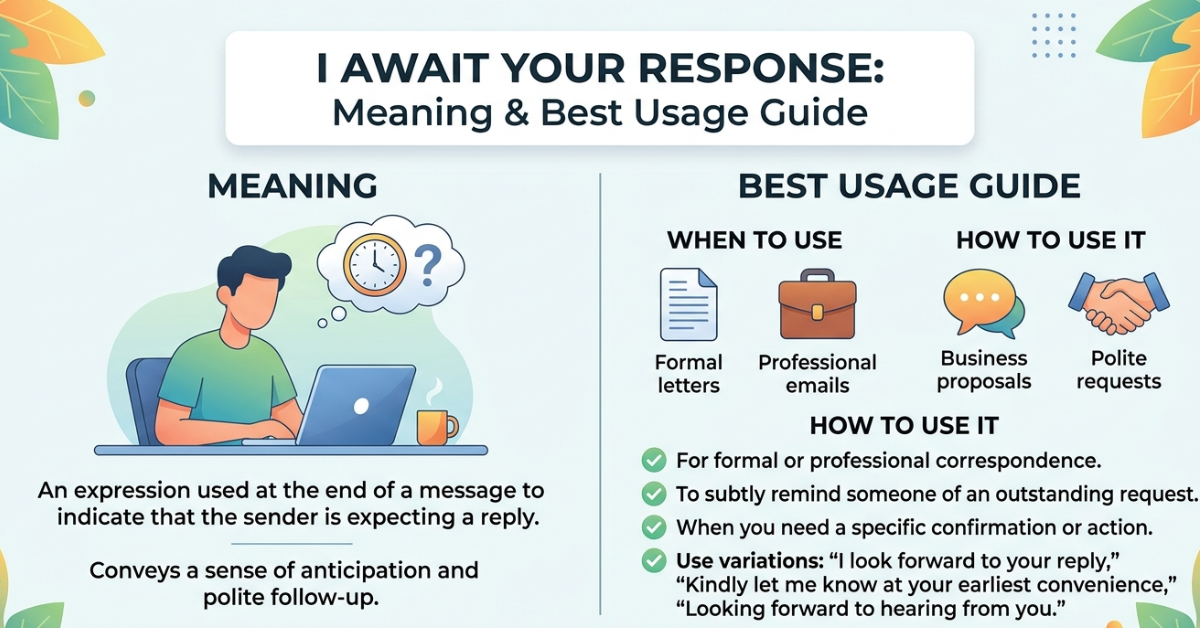
I Await Your Response: Meaning & Best Usage Guide
- 0
- 619 words
In professional communication, choosing the right words can shape how others perceive you. One commonly used phrase is “i await your response”, often found in emails, business letters, and formal messages.
But what does it really mean, and when should you use it? In simple terms, i await your response is a polite and formal way of saying you are expecting a reply from someone. It signals patience, respect, and professionalism while keeping communication open.
In this article, we’ll break down its meaning, usage, tone, and better alternatives so you can use it confidently in both formal and semi-formal situations.
What Does “I Await Your Response” Mean?
The phrase i await your response means that you are waiting for someone to reply to your message, request, or inquiry.
It is commonly used in:
- Business emails
- Formal letters
- Job applications
- Client communication
- Academic correspondence
This phrase reflects politeness and patience, rather than pressure or urgency.
When to Use “I Await Your Response”
Understanding the right context is important. You should use this phrase when you want to sound respectful and professional.
Appropriate situations include:
- After sending a job application or interview follow-up
- When requesting approval or confirmation
- In formal business communication
- When contacting authorities or institutions
Example usage:
- “I have attached the required documents. i await your response regarding the next steps.”
Tone and Communication Style
The tone of i await your response is:
- Formal
- Polite
- Neutral
- Respectful
However, it can sometimes sound slightly rigid or old-fashioned in modern communication. That’s why it’s important to balance it depending on your audience.
Better Alternatives to “I Await Your Response”
If you want a more natural or modern tone, consider these alternatives:
Formal alternatives:
- I look forward to your response
- I look forward to hearing from you
- Kindly respond at your earliest convenience
Semi-formal alternatives:
- I’d appreciate your reply
- Please let me know your thoughts
- Waiting for your feedback
These variations often sound smoother and more conversational.
Common Mistakes to Avoid
When using i await your response, avoid these errors:
- Overusing it in casual chats
- Using it in urgent situations without clarity
- Writing it without context
- Making it sound demanding instead of polite
A small change in tone can significantly improve how your message is received.
Why This Phrase Still Matters in Communication
Even though modern communication is becoming more casual, phrases like i await your response still hold value in professional environments.
It is especially useful because it:
- Shows respect for the recipient’s time
- Maintains formal etiquette
- Keeps communication structured
- Works well in international business writing
FAQs About “I Await Your Response”
1. Is “I await your response” still correct English?
Yes, it is grammatically correct and widely used in formal writing.
2. Is it too formal for emails?
It depends on context. In corporate or official emails, it is perfectly fine. In casual emails, it may feel too stiff.
3. What is a simpler alternative?
You can use “I look forward to your reply,” which is more natural and modern.
4. Can I use it in job applications?
Yes, it is commonly used at the end of job application emails or cover letters.
5. Does it sound demanding?
Not usually, but tone matters. Pairing it with polite language keeps it respectful.
Conclusion
The phrase i await your response remains a powerful tool in formal communication when used correctly. It expresses patience, professionalism, and respect while clearly signaling that a reply is expected.
However, depending on your audience, you may want to use softer or more modern alternatives to keep your message natural and engaging. The key is balance—being polite without sounding overly rigid.
If used thoughtfully, this simple phrase can strengthen your professional communication and leave a positive impression.
Author
britsx85@gmail.com
Related Posts
Aura vs Ora: Key Differences, Meaning & Easy Guide
- 0
- 789 words
When people come across Aura vs Ora, it’s easy to get confused. These two words sound similar, but their meanings, usage, and...
Read out all
Arcade vs Arcane: Meaning, Differences & Uses Explained
- 0
- 678 words
The confusion between Arcade vs Arcane is more common than you might think, especially because the words look and sound somewhat similar...
Read out all
Altar vs Alter: Meaning, Differences & Examples Explained
- 0
- 620 words
The confusion between altar vs alter is more common than you might think. These two words sound exactly the same, but they...
Read out all
Aisle vs Isle: Meaning, Difference & Examples Explained
- 0
- 526 words
Ever found yourself stuck between two words Aisle vs Isle that look or sound similar but mean completely different things? That’s exactly...
Read out all
On the Other Hand Transition Words: Meaning & Usage Guide
- 0
- 663 words
Writing becomes much clearer when ideas are connected smoothly, and that’s exactly where on the other hand transition words come in. These...
Read out all
Thank You As Always – Meaning, Usage & Examples
- 0
- 698 words
In everyday communication, small phrases can carry a lot of meaning. One such expression is “thank you as always”, a polite and...
Read out all