
- 0
- 1,529 word
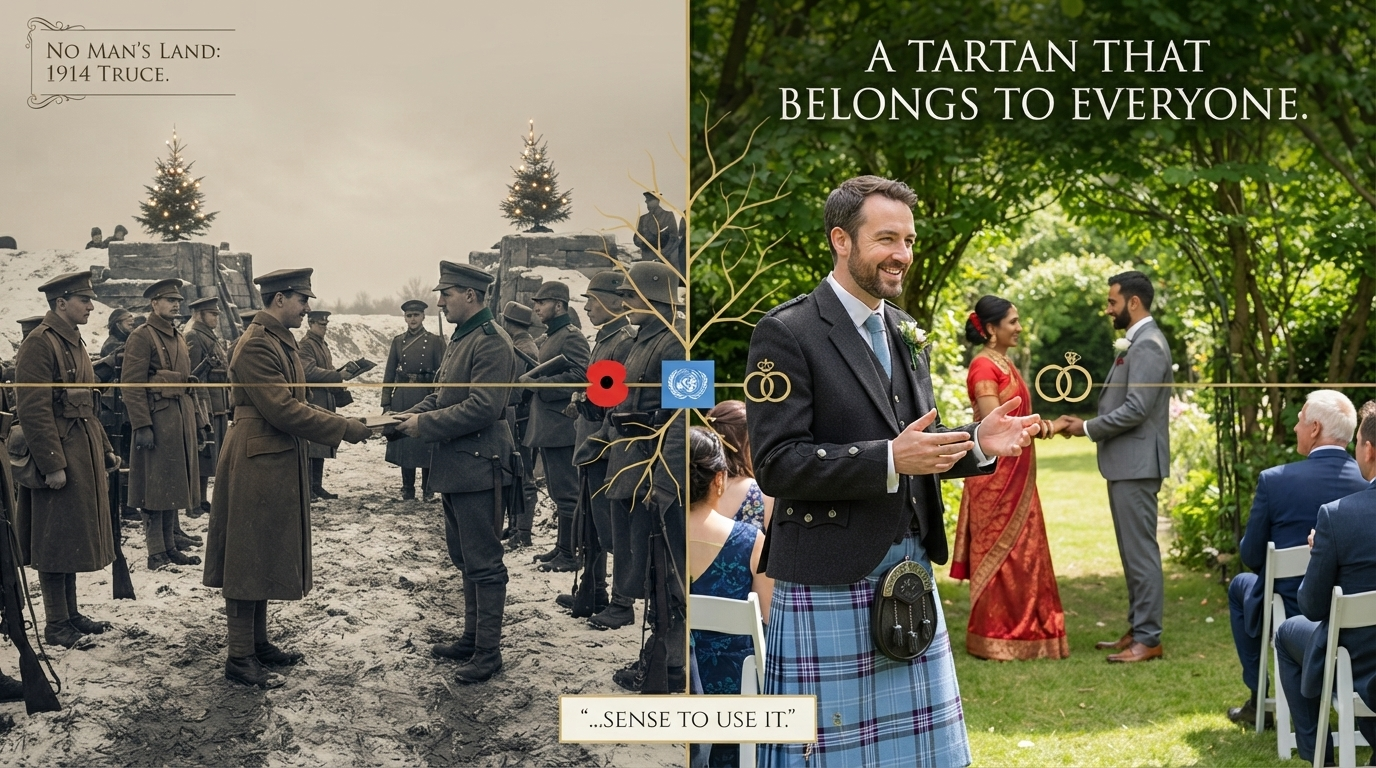
The story of the World Peace tartan begins with an idea that has echoed through history: that people can choose cooperation even when the world around them is divided by conflict. On the evening of 24 December 1914, along parts of the British line in northern France and Flanders, men in the trenches heard something they had not heard for months. It was singing.
The German trenches were in places only sixty or seventy yards away. Little fir trees had appeared on their parapets, lit with candles. The carols drifted across the frozen mud, Stille Nacht and O Tannenbaum, and after a while the British sang back. Then somebody shouted across. Then somebody stood up, unarmed, in full view, and was not shot.
By the morning of Christmas Day, in sector after sector, men were walking out into no man’s land. They shook hands. They swapped cigarettes, buttons, tinned beef and chocolate. They showed each other photographs of wives and children. They buried the dead who had lain between the lines since the autumn, and in places held joint services over them. There are stories of football, and at least one of them seems to be true. Scottish battalions were in the thick of it. Men of the Gordon Highlanders and the Seaforths, in kilts, in the frost, stood in the open talking to Saxons, some of whom had waited tables in London before the war and spoke English.
It lasted a day, in some places two, in a few until after the New Year. Then the generals on both sides put a stop to it, the guns started again, and it never happened on that scale again in the whole of the war.
What it meant
The truce has been turned into a Christmas card since, and it was more complicated than that. It was patchy. Many units had nothing to do with it. Some of the men who walked out that morning were killed by the same men they had talked to, within the year. Nobody who was there thought it had changed anything.
And yet it has never been forgotten, because of what it showed. For a day, ordinary men had decided among themselves that they would rather not kill each other, and had managed it. The war went on for four more years and killed millions, and the memory of that one morning has outlasted almost everything else about it.
A tartan with a message
Nearly a century later, in Edinburgh, a man called Victor Spence set out to say something similar in cloth.
Spence was General Secretary of the Edinburgh Inter-Faith Association, an organisation that brings the city’s religions into the same room. In 2011 he designed a tartan, and had it registered with the Scottish Register of Tartans on 24 May of that year. He called it the World Peace tartan, and the entry in the register sets out its thinking with unusual care.
Tartan, the note begins, is one of the most recognisable cultural icons in the world, but it is also a metaphor for interconnectedness, interdependence and diversity, and so it can be used to illustrate humanity’s desire for a harmonious and sustainable future. The design was created as a contribution from fashion and design to promote a global message of peace.
Then it goes through the colours. The ground is a light, clear blue, the blue of the United Nations flag, representing the presence, hope and potential of that organisation. Scotland is present in the purple and green of the thistle. Two narrow lines of red and black run through the design, and they are there on purpose, to represent and remind us of the realities of war and violence and the great need for a new culture of non-violence. White threads run through the pattern as a counterbalance, a symbol of peace and light.
It is an asymmetric sett, one that repeats without mirroring, and it is unlike any clan tartan in existence. Most tartans are dark and earthbound. This one is mostly sky.
It has been worn since by people who wanted to make its point, among them Archbishop Desmond Tutu, who was photographed in a scarf of it, and it is, by design, a tartan that belongs to nobody in particular. Retailers list World Peace tartan as a fashion or universal sett, made to order as kilts, skirts, scarves, ties and sashes or sold by the yard, and anyone may wear it who agrees with what it says.
Edinburgh, a Saturday in June
Tom Adair is fifty-one and a humanist celebrant. He conducts weddings and funerals for people who want a ceremony without a church, and in Scotland, where such weddings have had legal standing for years, that is a great many people. In an average summer he marries sixty couples. Today’s are called Priya and Ben.
He has been asked to wear a kilt at a wedding perhaps two hundred times, and for years he said no, for a reason he found hard to explain. His own name is Lowland and has a tartan he could perfectly well wear. But the couples in front of him are a Sikh marrying a Jew, a Catholic marrying an atheist, a Nigerian marrying a girl from Fife. He is there for all of them, and it seemed wrong to stand between them in the colours of one family.
The World Peace tartan solved it. It is a kilt that belongs to everybody in the room. He has worn it for six years and it has never once been the wrong thing.
The rest of the outfit is arranged on the same principle. A charcoal Argyll jacket, which is right for a daytime ceremony and does not shout. Hose in a soft grey. Plain black brogues. And at the front, a sporran, which for a celebrant is a working object rather than an ornament, because it carries his script, his glasses, the rings if the best man has lost his nerve, and a spare pen.
He learned early that the sporran a hire shop gives you, with a fur front and a chrome cantle, is for black tie and looks wrong at a garden wedding at two in the afternoon. What he wanted was the plain leather pouch that Highlanders carried for centuries before the army made it fancy. Outfitters call that register the day sporran, and Scottish Kilt, where he has bought his kilts, files its day sporrans in one place: plain and lightly tooled leather, black and brown, with or without tassels, the most versatile kind and the right first sporran for almost everyone.
His is not leather at all. Four years ago he married a couple who were both vegan and had gone to a lot of trouble over the flowers, the food and the shoes, and it occurred to him at the rehearsal that he was about to stand in front of them with a dead animal hanging from his belt. The same range includes a vegan sporran, in a leather-like fabric with the same flap and stud, and he bought one that week. It has done every wedding since. Nobody has ever noticed, which is the point of a day sporran.
He wears it a hand’s width below his belt buckle, on a leather strap rather than a chain, because chains catch on the script and because a chain, at a quiet moment in a vow, makes a noise. Before the ceremony he checks that the rings are where he put them. Then he walks out under the trees to where a hundred and forty people from four countries and three religions are sitting on white chairs, and a woman in a red sari and a man in a grey suit are waiting for him.
Afterwards Priya’s grandmother, who is eighty-four and had been worried about the whole business, takes hold of the edge of his kilt and asks what tartan it is.
“It’s the World Peace tartan. Somebody made it in Edinburgh, so it would belong to everyone.”
“The blue is for the sky?”
“For the United Nations, officially. But yes. The sky.” He shows her the thin lines. “The red and the black are for war. They’re in there so nobody forgets.”
She considers this. “That’s sensible,” she says. “You should always keep a little of the bad thing in, so you remember.”
Sixty yards
The men who walked out into no man’s land in December 1914 did not have a tartan for what they were doing, and they did not need one. They had a morning, and the sense to use it. Most of what has been built since, from the United Nations to a small interfaith office in Edinburgh, is an attempt to make that morning last longer than a day.
A length of sky-blue cloth with a thread of red and black in it is a modest contribution to that. But it is worn by people who marry strangers to each other for a living, and it goes with a plain pouch that carries the rings. That is about as peaceful as a kilt gets.
Author

hyderghumro3@gmail.com
Related Posts

How Duolingo Helps Language Learners Build Daily Study Habits
- 0
- 1,003 word
My cousin has tried to learn Spanish four separate times. Bought a textbook once. Signed up for a class that met Tuesday...
Read out all
10 Best Wedding Florists in Miami for Luxury Floral Arrangements
- 0
- 1,764 word
A wedding in Miami is an opportunity to bring together beautiful venues, tropical surroundings, elegant décor, and unforgettable floral arrangements. From romantic...
Read out all
Wenrath: Understanding the Meaning, Uses, and Importance of a Unique Term
- 0
- 1,576 word
In the world of online searches, names, words, and unfamiliar terms can sometimes appear without much context. One such interesting keyword is...
Read out all
Yes, Roots Up Tree Company Provides Safe Tree Removal Service in Boulder, CO for Hazardous Trees
- 0
- 1,944 word
Key Takeaways A dead, leaning, split, or storm-damaged tree can create an urgent concern for a home, driveway, sidewalk, fence, or utility...
Read out all
Park View City Islamabad Downtown Commercial: Shops, Plots & Investment Guide
- 0
- 1,461 word
Park View City Islamabad Downtown Commercial has emerged as one of the most talked-about business destinations in the twin cities, drawing the...
Read out all
Summer Camp: Why Holiday Experiences Can Build Confidence and Curiosity
- 0
- 595 words
School holidays give children time to step away from their regular routine and enjoy something different. A well-planned summer camp can transform...
Read out all