Looking Forward to Seeing You: Meaning & Alternatives
- 0
- 1,355 word
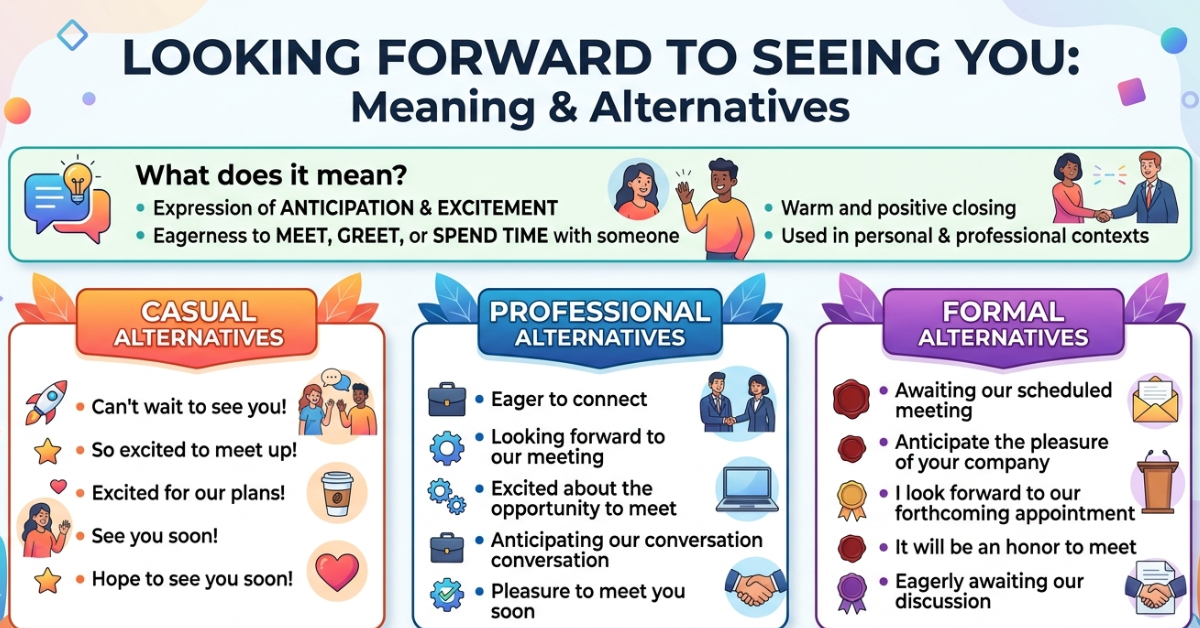
There are some phrases in English that feel warm, polite, and instantly familiar—and looking forward to seeing you is one of them. It is short, friendly, and works in everything from casual texts to professional emails. But many people still wonder what it really means, when to use it, and what to say instead when they want to sound a little more natural, flirty, or creative.
In this guide, we will break down the looking forward to seeing you meaning, show you how to use it correctly, and give you plenty of real-life alternatives for different situations.
What Does “Looking Forward to Seeing You” Mean?
At its core, the phrase simply means that you are excited or pleased about meeting someone in the future. It shows anticipation, warmth, and interest.
It can sound:
- polite and professional
- friendly and casual
- emotional and affectionate
- slightly flirty, depending on the context
For example, if you write, “I’m looking forward to seeing you tomorrow,” you are saying that you are happy about the upcoming meeting and expecting it with positive feelings.
Why This Phrase Works So Well
People use this expression so often because it is easy to understand and hard to misuse. It feels natural in both spoken and written English.
Here is why it is so effective:
- It sounds sincere without being too dramatic.
- It fits formal and informal situations.
- It leaves a positive impression.
- It works well in emails, texts, and invitations.
In a world where communication can feel rushed, a phrase like this adds a little warmth.
When to Use It
This phrase is useful whenever you want to show anticipation for seeing someone soon. It is especially common in messages about:
- meetings
- appointments
- dates
- reunions
- events
- friendly catch-ups
For example:
- “We are looking forward to seeing you at the event.”
- “I’m looking forward to seeing you again after so long.”
- “Looking forward to seeing you soon!”
It works especially well when you want to end a message on a positive note.
Looking Forward to Seeing You Soon in Real Life
A phrase like looking forward to seeing you soon is often used when the meeting is close but not immediate. It feels warm and natural without sounding too formal.
You might use it when:
- replying to a friend
- confirming a dinner plan
- ending a work email politely
- writing to someone you have not seen in a while
Example:
“Thanks for your message. I’m looking forward to seeing you soon.”
That sentence feels simple, kind, and easy to understand.
Better Ways to Say It
Sometimes you may want a different tone. Maybe you want to sound more casual, more polished, or more personal. That is where another way of saying looking forward to seeing you becomes useful.
Here are some strong alternatives:
Friendly and casual
- Can’t wait to see you
- See you soon
- Excited to catch up
- Hope to see you soon
Polite and professional
- I look forward to our meeting
- I’m eager to meet you
- I anticipate our discussion
- I look forward to connecting with you
Warm and personal
- It will be great to see you again
- I’ve been thinking about our meetup
- I’m really happy we’ll get to meet
- It means a lot to see you soon
Flirty and playful
- Can’t wait to see that smile again
- I’ve been looking forward to this
- Seeing you soon is the best part of my day
- Counting down until I get to see you
These options help you match your message to the situation instead of using the same line every time.
How to Sound Natural in Text Messages
Texting is usually less formal than email, so shorter wording often works better. That is why looking forward to seeing you tomorrow can sometimes feel a little stiff in a casual chat, while something like “Can’t wait to see you tomorrow!” sounds more natural.
A few easy tips:
- Keep it short.
- Match the other person’s tone.
- Add emotion only if it fits the relationship.
- Use punctuation and emojis sparingly, depending on the vibe.
Examples:
- “Looking forward to seeing you tomorrow.”
- “Can’t wait to see you tomorrow!”
- “See you tomorrow—really excited.”
Using It in Emails
In professional writing, this phrase is especially common at the end of an email. It sounds courteous and confident without being too formal.
Example:
“Thank you for your time. We are looking forward to seeing you at the presentation.”
This version works well for:
- clients
- customers
- interview candidates
- event guests
- colleagues
In business communication, it is often better to keep the tone clear and respectful rather than too emotional.
What About Flirty Messages?
A flirty looking forward to seeing you text should feel light, fun, and natural. The goal is to show interest without sounding forced.
Here are a few examples:
- “I’ve been looking forward to seeing you.”
- “Can’t wait to see you later.”
- “Seeing you is definitely the best part of my day.”
- “I hope you know I’m counting down the hours.”
The key is balance. Too much intensity can feel awkward, but a little warmth makes the message memorable.
Can You Use It for Reunions?
Absolutely. Looking forward to seeing you again is perfect when you have already met someone before and are eager for another meeting. It feels especially genuine because it adds the idea of reunion.
This works well for:
- old friends
- family members
- classmates
- coworkers
- travel buddies
Example:
“It’s been too long. I’m really looking forward to seeing you again.”
That sounds warm, simple, and sincere.
What About Images and Search Intent?
Some people search for looking forward to seeing you images because they want a quote graphic, greeting card text, or social media caption. That usually means they are not only looking for the phrase itself, but also for a visual way to share it.
Common image uses include:
- greeting cards
- WhatsApp statuses
- Instagram captions
- invitation posts
- reunion messages
If you are creating text for an image, keep it short and emotional. A clean line like “Looking forward to seeing you” often works better than a long sentence.
Common Mistakes to Avoid
This phrase is simple, but people still make a few common mistakes.
Avoid:
- overusing it in every message
- making it sound too stiff in casual texts
- using it when the message should sound more urgent
- repeating the same wording in every email
Try to vary your language so your writing feels more human and less copied.
Quick Examples You Can Use
Here are a few ready-to-use options:
- “Looking forward to seeing you soon.”
- “We are looking forward to seeing you.”
- “I’m really looking forward to seeing you again.”
- “Can’t wait to see you tomorrow.”
- “I look forward to our meeting.”
These cover most everyday situations without sounding repetitive.
FAQ
What does “looking forward to seeing you” mean?
It means you are happy, excited, or pleased about meeting someone in the future.
Is it formal or informal?
It can be both. It works in professional emails, friendly messages, and personal notes.
What is another way of saying looking forward to seeing you?
You can say “Can’t wait to see you,” “I look forward to our meeting,” or “Hope to see you soon.”
Is “looking forward to seeing you tomorrow” correct?
Yes, it is correct and commonly used when the meeting will happen the next day.
Can I use this phrase in a flirty text?
Yes, as long as the tone matches the relationship. A softer version often sounds more natural.
Conclusion
Looking forward to seeing you is one of those simple phrases that never really goes out of style. It is warm, polite, and easy to adapt for emails, texts, reunions, and social posts. Whether you need looking forward to seeing you meaning, a friendlier alternative, or a more playful version, the best choice is the one that matches your tone and your relationship with the other person.
The next time you want to sound natural and thoughtful, try one of the variations above and make your message feel a little more personal.
Author
britsx85@gmail.com
Related Posts
Aura vs Ora: Key Differences, Meaning & Easy Guide
- 0
- 789 words
When people come across Aura vs Ora, it’s easy to get confused. These two words sound similar, but their meanings, usage, and...
Read out all
Arcade vs Arcane: Meaning, Differences & Uses Explained
- 0
- 678 words
The confusion between Arcade vs Arcane is more common than you might think, especially because the words look and sound somewhat similar...
Read out all
Altar vs Alter: Meaning, Differences & Examples Explained
- 0
- 620 words
The confusion between altar vs alter is more common than you might think. These two words sound exactly the same, but they...
Read out all
Aisle vs Isle: Meaning, Difference & Examples Explained
- 0
- 526 words
Ever found yourself stuck between two words Aisle vs Isle that look or sound similar but mean completely different things? That’s exactly...
Read out all
On the Other Hand Transition Words: Meaning & Usage Guide
- 0
- 663 words
Writing becomes much clearer when ideas are connected smoothly, and that’s exactly where on the other hand transition words come in. These...
Read out all
Thank You As Always – Meaning, Usage & Examples
- 0
- 698 words
In everyday communication, small phrases can carry a lot of meaning. One such expression is “thank you as always”, a polite and...
Read out all