
- 0
- 1,753 word
Have you ever typed a word that looked right, only to stop and think, “Wait… is that actually a real word?” That’s exactly what happens with knaw. A lot of people search for knaw meaning because they’ve seen it online, heard a word that sounds similar, or want to know whether it’s correct English.
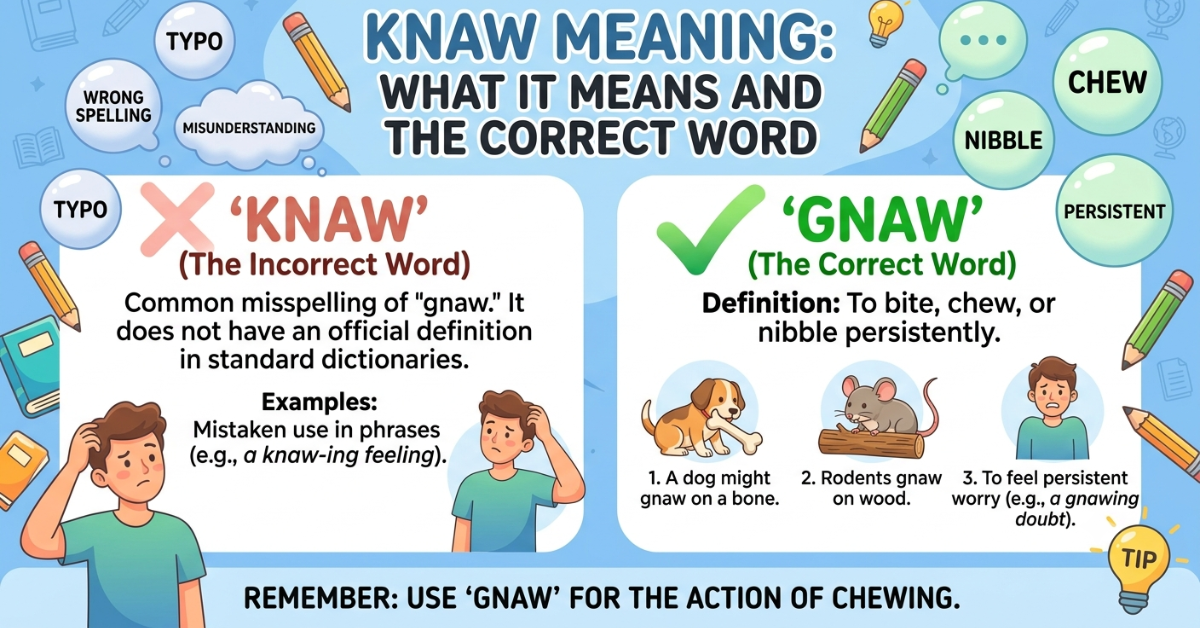
The short answer is simple: in most modern English contexts, “knaw” is usually a misspelling of “gnaw.” But that’s not the whole story. In some older or dialect-based writing, knaw has appeared as a historical spelling, and in very specific cases it may also show up as an acronym or part of slang. In this guide, you’ll learn the true knaw meaning, how it differs from gnaw, why people confuse the two, and which spelling you should actually use in formal and everyday writing.
What Is the Meaning of “Knaw”?
If you’re looking up knaw meaning, the most accurate answer is this:
- In modern standard English, “knaw” is not the accepted spelling of the word most people mean.
- In most cases, the person actually means gnaw.
- Gnaw means:
- to bite or chew something repeatedly
- to wear away slowly
- to trouble or bother someone persistently
So if someone writes:
- The dog knawed the bone
- Worry kept knawing at her mind
the correct spelling in standard English would be:
- The dog gnawed the bone.
- Worry kept gnawing at her mind.
In other words, when people search knaw meaning, they are often really trying to understand the meaning of gnaw.
The Correct Word Is Usually “Gnaw”
What does “gnaw” mean?
Gnaw is a verb with both literal and figurative meanings.
1) Literal meaning: to bite or chew repeatedly
This is the physical sense of the word.
Examples:
- The puppy gnawed on the chair leg.
- Rats can gnaw through wires.
- The rabbit gnawed at the carrot.
Here, the word describes repeated biting, nibbling, or chewing.
2) Figurative meaning: to trouble or eat away at someone mentally
This is where gnaw becomes more expressive.
Examples:
- Doubt gnawed at him all night.
- Guilt began to gnaw at her conscience.
- Hunger was gnawing at the hikers by evening.
In this sense, gnaw suggests a feeling that keeps bothering someone little by little, almost like emotional erosion.
Why Do People Search for “Knaw Meaning”?
There are a few very understandable reasons this spelling mistake happens so often.
The pronunciation is misleading
Gnaw is pronounced like “naw.”
The g is silent.
That creates a problem: when people hear the word first and write it later, they often guess the spelling based on sound. Since English has words like:
- know
- knife
- knee
- knock
it feels natural to assume the word might start with kn-. That’s how knaw happens.
English spelling patterns are inconsistent
English is full of silent letters and odd spelling patterns. A word can sound simple but look completely different on paper. So if you’ve written knaw before, you’re not alone—it’s a very common phonetic mistake.
People know the sound, not the spelling
Many people hear gnaw in conversation, movies, or storytelling, but don’t often see it written. Without repeated visual exposure, the brain fills in the spelling on its own.
Is “Knaw” a Real Word?
This is where the answer gets slightly more nuanced.
In modern English: not as a standard word
If you’re writing in:
- school assignments
- blog posts
- business emails
- captions
- essays
- professional documents
then knaw is not the correct modern spelling for the word meaning “chew” or “bother persistently.” You should use gnaw.
In older or dialectal texts: it may appear
Historically, knaw has shown up in some older texts or dialect spellings. In those cases, it may be used as:
- an old spelling related to gnaw
- a dialectal spelling related to know in some regional writing
That said, this is not how the word is used in present-day standard English. So for practical writing purposes, the safest rule is:
If you mean “to chew,” “to wear away,” or “to trouble someone,” use gnaw, not knaw.
Knaw vs Gnaw: What’s the Difference?
Here’s the distinction in the clearest possible way:
| Word | Is it standard modern English? | Meaning |
| Knaw | No, usually a misspelling | Often intended to mean gnaw, but not the accepted spelling |
| Gnaw | Yes | To bite repeatedly, wear away, or trouble persistently |
Quick comparison examples
Incorrect:
- The dog knawed the toy.
- Fear kept knawing at him.
Correct:
- The dog gnawed the toy.
- Fear kept gnawing at him.
How to Use “Gnaw” Correctly in Sentences
If your search for knaw meaning is really about how to use the correct word, these examples will help.
Physical action examples
- The puppy gnawed on the slipper for an hour.
- Mice had gnawed through the cardboard box.
- The beaver gnawed at the tree trunk.
Emotional or figurative examples
- A sense of failure gnawed at him for days.
- Jealousy began to gnaw at her confidence.
- The unanswered question kept gnawing at my mind.
Everyday expression patterns
You’ll often see gnaw in phrases like:
- gnaw at someone’s mind
- gnaw at someone’s confidence
- gnaw away at
- gnaw on a bone
These are common, natural, and fully standard.
How to Remember the Correct Spelling
If you keep mixing up knaw and gnaw, try these tricks.
1) Remember the silent G family
Think of words like:
- gnome
- gnat
- gnarl
- gnaw
They all begin with gn-, and the first letter is silent.
2) Link gnaw with chewing
Picture a dog chewing a bone and mentally label it:
G = gnaw = grinding teeth
The image makes the spelling stick better than memorizing a rule.
3) Use a sentence cue
Try this memory sentence:
“Go gnaw the bone.”
Even though the g is silent, seeing it repeatedly helps train your eye.
Common Mistakes People Make With “Knaw”
When people search knaw meaning, they’re often running into one of these issues.
Mistake 1: spelling by sound
Because gnaw sounds like naw, people write knaw or even naw by mistake.
Mistake 2: assuming “kn-” is correct because of words like “know”
This is logical, but in this case it’s still wrong.
Mistake 3: using “knaw” in formal writing
Even if a teacher or reader understands what you mean, it will usually be treated as a spelling error.
Mistake 4: thinking gnaw only refers to animals
It doesn’t. It also works for emotional discomfort, worry, hunger, guilt, and mental stress.
Can “Knaw” Mean Something Else?
Sometimes, yes—but only in niche contexts.
1) Historical or dialect use
In older literature or regional spellings, knaw may appear in ways that aren’t standard today. This matters mainly if you’re reading old texts, not if you’re writing modern English.
2) Acronyms
In some contexts, KNAW may appear as an acronym rather than a normal English word. For example, it can refer to the Royal Netherlands Academy of Arts and Sciences by its Dutch abbreviation. In that case, it’s not related to gnaw at all.
3) Slang or stylized spellings
Very occasionally, people use unusual spellings online for humor, dialect, or stylized speech. But that doesn’t make knaw a correct standard spelling.
When Should You Use “Gnaw” Instead of “Knaw”?
Use gnaw whenever you mean any of the following:
- chewing repeatedly
- biting into something over time
- wearing something away gradually
- emotional discomfort that won’t go away
- hunger, guilt, anxiety, or worry bothering someone
Use “gnaw” in:
- essays
- articles
- school assignments
- professional writing
- fiction
- captions and social posts
- product descriptions
- everyday messages when you want correct spelling
Why Correct Spelling Matters
It’s easy to dismiss a word like knaw as “close enough,” but spelling affects how your writing is received.
It improves clarity
Readers don’t have to stop and decode what you meant.
It builds credibility
Correct spelling makes your writing look polished, careful, and trustworthy.
It matters for students and content writers
If you’re writing for grades, clients, blogs, SEO, or public-facing content, small spelling errors can weaken the overall impression.
It helps with search intent and accuracy
When someone searches knaw meaning, they usually want a direct answer. Giving the correct form—gnaw—clears up the confusion immediately.
Key Takeaways About Knaw Meaning
Here’s the short version if you just want the essentials:
- Knaw is usually a misspelling of gnaw in modern English.
- Gnaw means:
- to bite or chew repeatedly
- to wear away slowly
- to trouble someone mentally or emotionally
- Knaw may appear in old or dialect writing, but it is not standard for modern use.
- If you’re writing today, use “gnaw,” not “knaw.”
- The confusion happens because gnaw is pronounced like “naw.”
FAQ: Knaw Meaning
1) What is the meaning of knaw?
In most modern contexts, knaw doesn’t have a separate accepted meaning of its own. It’s usually a misspelling of gnaw, which means to chew repeatedly or to trouble someone persistently.
2) Is knaw a real English word?
Not in standard modern English for everyday writing. It may appear in historical or dialect sources, but if you mean “chew” or “bother,” the correct spelling is gnaw.
3) What does gnaw mean if someone searched knaw meaning?
Gnaw means to bite or chew something repeatedly. It can also describe a feeling—like guilt, fear, or hunger—that keeps bothering someone over time.
4) Why do people write knaw instead of gnaw?
Because gnaw is pronounced like “naw,” and English has many words beginning with kn-, such as know and knife. People often guess the spelling based on sound.
5) Is knaw correct in formal writing?
No. In formal, academic, or professional writing, knaw would usually be considered a spelling mistake. Use gnaw instead.
6) How do you remember the correct spelling of gnaw?
Think of other silent-g words like gnome and gnat. Even though it sounds like naw, the correct spelling is gnaw.
Final Thoughts
If you came here searching for knaw meaning, the most important thing to know is this: the word you probably want is “gnaw.” In modern English, knaw is usually just a spelling mistake caused by pronunciation. And honestly, it’s an easy one to make—English isn’t exactly famous for being predictable.
The good news is that once you understand the pattern, you’re unlikely to forget it. Gnaw is the correct word for repeated chewing, gradual wearing away, or a feeling that keeps bothering someone. So the next time you’re tempted to type knaw, pause for a second and swap in gnaw instead. It’s a small change, but it makes your writing much stronger and more accurate.
Author

linguaezone.com@gmail.com
Related Posts

I’m Patient: Understanding the Meaning, Mindset, and Power of Patience
- 0
- 1,816 word
I’m Patient: What Does It Really Mean? Have you ever found yourself waiting for something important and realized that getting frustrated will...
Read out all
Do and Not: Understanding the Difference and Using Both Correctly
- 0
- 2,303 words
Introduction: Why “Do and Not” Matters in Everyday Communication Have you ever written a sentence and wondered whether you should use “do,”...
Read out all
Proscribed: Meaning, Definition, Examples, and Correct Usage
- 0
- 2,338 words
Introduction: What Does “Proscribed” Mean? Have you ever come across the word proscribed and wondered what it actually means? It is one...
Read out all
Imput: Meaning, Common Usage, and Why People Often Use It Instead of Input
- 0
- 1,592 word
What Does Imput Mean? Have you ever typed “imput” instead of “input” and wondered whether you made a mistake? You are certainly...
Read out all
Emaculate vs Demasculate: Understanding the Difference and Correct Usage
- 0
- 2,156 words
Introduction: Emaculate vs Demasculate Have you ever come across the words emasculate and demasculate and wondered whether they mean the same thing?...
Read out all
What Does LYK Mean in Text? Simple Guide
- 0
- 1,029 word
Ever received a message that says “LYK” and paused for a second? You are not alone. If you have been wondering what...
Read out all