
Naturally Aspirated Meaning: A Complete Guide
- 0
- 1,196 word
Have you ever read a car specification sheet and come across the term “naturally aspirated” without knowing exactly what it means? You’re not alone. Whether you’re shopping for a vehicle, comparing engine types, or simply curious about automotive technology, understanding the naturally aspirated meaning can help you make more informed decisions.
In simple terms, a naturally aspirated engine is an engine that draws air into its cylinders without the help of forced-induction systems such as turbochargers or superchargers. While modern vehicles increasingly use turbocharged engines, naturally aspirated engines remain popular for their reliability, smooth power delivery, and straightforward design.
This guide explains what naturally aspirated engines are, how they work, their benefits and drawbacks, and how they compare to turbocharged alternatives.
What Is the Naturally Aspirated Meaning?
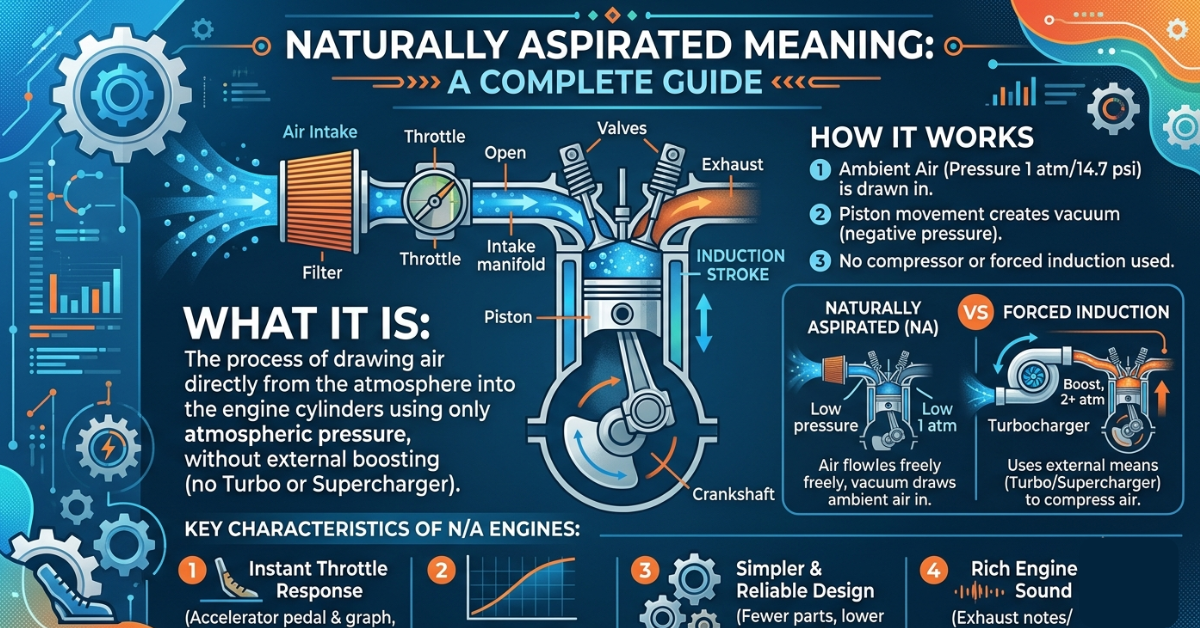
The naturally aspirated meaning refers to an engine that relies solely on atmospheric pressure to pull air into the combustion chamber.
Unlike turbocharged or supercharged engines, which force additional air into the engine, naturally aspirated engines depend on the natural movement of pistons and pressure differences to intake air.
When the piston moves downward during the intake stroke, it creates a vacuum that draws air through the intake system. This air mixes with fuel, and the mixture is ignited to produce power.
Simple Definition
A naturally aspirated engine is:
- An engine without a turbocharger
- An engine without a supercharger
- Powered by normal atmospheric air intake
- Known for predictable and linear power delivery
How Does a Naturally Aspirated Engine Work?
To understand the concept better, it helps to look at the engine’s basic operation.
Step-by-Step Process
- The intake valve opens.
- The piston moves downward.
- Air is drawn into the cylinder naturally.
- Fuel mixes with the incoming air.
- The mixture is compressed.
- A spark ignites the mixture.
- Combustion creates power that drives the vehicle.
Because no forced-induction system is involved, the amount of air entering the engine is limited by atmospheric pressure and engine design.
Key Characteristics of Naturally Aspirated Engines
Naturally aspirated engines have several unique traits that distinguish them from turbocharged engines.
Linear Power Delivery
One of their biggest advantages is smooth and predictable acceleration. Power builds gradually as engine speed increases, creating a more connected driving experience.
Simpler Design
Since there are no turbochargers, intercoolers, or complex boost-control systems, the engine contains fewer components.
Instant Throttle Response
Drivers often appreciate the immediate response when pressing the accelerator because there is no turbo lag.
Higher Revving Capability
Many performance-focused naturally aspirated engines are designed to operate efficiently at higher RPMs, producing exciting engine sounds and responsive performance.
Advantages of Naturally Aspirated Engines
Although turbocharged engines dominate many modern markets, naturally aspirated engines still offer significant benefits.
1. Greater Reliability
Fewer moving parts generally mean fewer potential failure points. Without a turbocharger operating under extreme heat and pressure, maintenance can be simpler.
2. Lower Maintenance Costs
The absence of turbo-related components often reduces repair and replacement expenses over time.
3. Better Throttle Feel
Drivers enjoy immediate engine response because power delivery is directly linked to pedal input.
4. Consistent Performance
Power delivery remains smooth and predictable throughout the RPM range.
5. Simpler Engineering
A less complicated system can make diagnostics and repairs easier for mechanics and vehicle owners.
Disadvantages of Naturally Aspirated Engines
Despite their strengths, naturally aspirated engines also have limitations.
Lower Power Output
Compared with similarly sized turbocharged engines, they generally produce less horsepower and torque.
Reduced Fuel Efficiency
Manufacturers often use smaller turbocharged engines to achieve similar performance while consuming less fuel.
Less Torque at Low RPM
Turbocharged engines usually generate stronger low-end torque, making them feel quicker during everyday driving.
Performance at High Altitudes
Since they rely on atmospheric pressure, naturally aspirated engines can lose more power at higher elevations where air is thinner.
Naturally Aspirated vs Turbocharged Engines
Many car buyers wonder which option is better. The answer depends on driving preferences and priorities.
| Feature | Naturally Aspirated | Turbocharged |
| Air Intake | Atmospheric pressure | Forced induction |
| Complexity | Simpler | More complex |
| Reliability | Generally higher | More components to maintain |
| Throttle Response | Immediate | May experience turbo lag |
| Power Output | Lower | Higher |
| Fuel Efficiency | Moderate | Often better |
| Maintenance Costs | Lower | Potentially higher |
For drivers who value simplicity and smooth performance, naturally aspirated engines remain an excellent choice. Those seeking maximum power and efficiency may prefer turbocharged options.
Why Do Some Enthusiasts Prefer Naturally Aspirated Engines?
Car enthusiasts often praise naturally aspirated engines for delivering a more engaging driving experience.
Reasons include:
- More predictable power delivery
- Better engine sound characteristics
- Immediate throttle response
- Strong connection between driver and vehicle
- Mechanical simplicity
Many iconic sports cars have earned legendary status thanks to their naturally aspirated engines and high-revving performance.
Common Vehicles That Use Naturally Aspirated Engines
Although turbocharging has become widespread, many vehicles still utilize naturally aspirated powerplants.
Examples include:
- Economy sedans
- Hybrid vehicles
- Compact SUVs
- Certain sports cars
- Pickup trucks designed for long-term durability
Manufacturers continue to use these engines where reliability, affordability, and simplicity are important priorities.
Is a Naturally Aspirated Engine Better?
There is no universal answer because “better” depends on what matters most to the driver.
A naturally aspirated engine may be better if you value:
- Reliability
- Lower maintenance costs
- Smooth acceleration
- Simpler engineering
- Immediate throttle response
A turbocharged engine may be better if you prioritize:
- Higher horsepower
- Strong low-end torque
- Fuel economy
- Compact engine size with greater performance
The Future of Naturally Aspirated Engines
Automotive technology continues to evolve, with turbocharging, hybrid systems, and electric vehicles becoming increasingly common.
However, naturally aspirated engines still maintain a loyal following. Their straightforward design, durability, and engaging driving characteristics ensure they remain relevant in specific vehicle segments and among driving enthusiasts.
Frequently Asked Questions (FAQs)
What is the naturally aspirated meaning in simple words?
It means an engine draws air naturally through atmospheric pressure without using a turbocharger or supercharger.
Is a naturally aspirated engine faster?
Not necessarily. Turbocharged engines often produce more power, but naturally aspirated engines can offer smoother and more predictable acceleration.
Does naturally aspirated mean no turbo?
Yes. A naturally aspirated engine operates without a turbocharger or supercharger.
Are naturally aspirated engines more reliable?
In many cases, yes. Their simpler design and fewer components can reduce the likelihood of mechanical issues.
Why do sports car enthusiasts like naturally aspirated engines?
Many enthusiasts appreciate their instant throttle response, linear power delivery, high-revving nature, and distinctive engine sound.
Do naturally aspirated engines use less fuel?
Generally, modern turbocharged engines are more fuel-efficient, though actual consumption depends on driving habits and vehicle design.
Can a naturally aspirated engine be modified with a turbocharger?
Yes. Many naturally aspirated engines can be converted to turbocharged setups, although significant modifications may be required.
Conclusion
Understanding the naturally aspirated meaning is essential when comparing modern engine technologies. A naturally aspirated engine relies on atmospheric pressure to draw air into the combustion chamber, eliminating the need for turbochargers or superchargers. This results in simpler engineering, reliable performance, and immediate throttle response.
While turbocharged engines often deliver greater power and efficiency, naturally aspirated engines continue to appeal to drivers who value durability, predictability, and a more traditional driving experience. As automotive technology advances, these engines remain an important part of the industry and a favorite among many enthusiasts.
Author
britsx85@gmail.com
Related Posts
Isn’t the Moon Lovely Meaning: Hidden Romantic Message
- 0
- 1,180 word
At first glance, the phrase “Isn’t the moon lovely?” sounds like a simple observation about the night sky. But for many people,...
Read out all
Red Rose Meaning: Love, Symbolism & Hidden Messages
- 0
- 1,076 word
Few flowers speak the language of emotions quite like the red rose. Whether gifted during romantic moments, anniversaries, or heartfelt apologies, roses...
Read out all
CW Meaning in Text: What It Really Means Online
- 0
- 892 words
Ever received a message with “CW” and paused for a second trying to figure out what it meant? You’re not alone. Text...
Read out all
Kickback Meaning Explained: Business, Parties & More
- 0
- 1,042 word
The term kickback meaning often sparks curiosity because it can mean very different things depending on the context. In one conversation, it...
Read out all
Integral Meaning Explained: Simple Definition & Uses
- 0
- 901 words
Have you ever come across the word integral and wondered what it actually means? The term appears in mathematics, everyday English, science,...
Read out all
Pegasus Meaning: Myth, Symbolism, and Modern Uses
- 0
- 1,171 word
Few mythical creatures are as recognizable as Pegasus. From ancient legends to modern logos and movies, this winged horse has captured human...
Read out all