
- 0
- 1,370 word
Go into any kitchen, any automotive display room, any area of work, and you’ll find yourself amidst bloodless rolled metal and now not even recognize it. The handy freezer door, the dent-proof vehicle part, the skinny drawer of the metal table all began their existence as a bulky coil that had been squeezed, annealed, and polished beyond recognition. Consumers, however, have a tendency to view those coils as a commodity and pursue the lowest cost per tonne. Therein lies the difficulty. This handbook will reveal to you the technique of producing the cloth, how you can examine its grades and thickness, in which it is ideal, and how you can identify a business that you need to remember.
From Hot Band to Mirror-Smooth Coil: How Cold Rolling Works
The cold-rolled metals are initially produced as warm-rolled coil that is picked in acid to remove the scale. The strip is subsequently subjected to a rolling process at room temperature, hence making it thinner, more dimensionally accurate, and having a smoother surface finish. The process hardens the metal; thus, most of the coils have to be annealed to regain their ductility and then put through a skin pass to control flatness and roughness.
Why the Difference is Worth Paying For
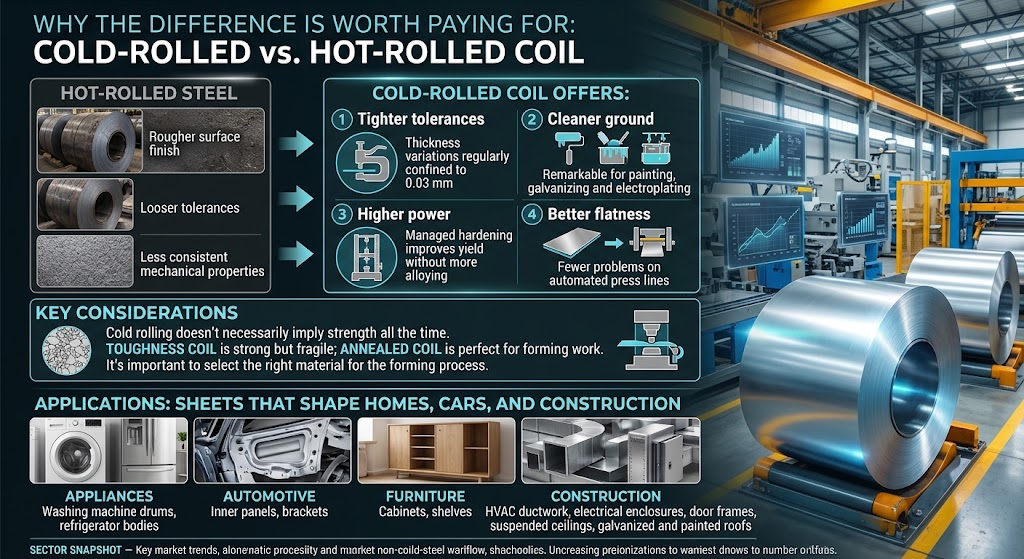
Compared with warm temperature rolled product, cold rolled coil offers:
- Tighter tolerances: thickness variations are regularly confined to three hundredths of a millimetre
- Cleaner ground: remarkable for painting, galvanizing and electroplating
- Higher power: managed hardening improves yield without more alloying
- Better flatness: fewer problems on automated press lines
Significant to keep in mind that cold rolling doesn’t necessarily imply strength all the time. Toughness coil is strong but fragile; however, at the same time, annealed coil is perfect for job artwork. It’s important to maintain ga ood mood in relation to the forming process.
Applications: Sheets That Shape Homes, Cars and the Work of a Construction Company in Oman.
Cold-rolled steel is the backbone of light production because of its hardness and uniformity. It is used by appliance manufacturers to produce the drums for washing machines and the bodies of refrigerators. In automobile manufacturing facilities, it is stamped for use in inner panels and brackets. In furniture manufacturing, it is formed into cabinets and shelves. As a construction material, it serves as HVAC ductwork, electrical enclosures, door frames, suspended ceilings, and the base material for galvanized and painted roofs.
Sector Snapshot
- Appliances: panels, drums, compressor housings
- Automotive: door inners, seat frames, exhaust hangers
- Building services: ducts, cable trays, switchgear shelves
- Packaging: drums, cans and tinplate substrate
- Furniture: lockers, filing cabinets, place of work partitions
Business Approach
Demand in the Gulf is very much related to infrastructure and investment in assets.
As new enterprise corporation towers, warehouses, and enterprise industrial organization enterprise employer parks open, so does the call for protected coil implemented in cladding, ceilings, and mechanical structures. Buyers who plan portions early, in desire to ordering in panic within the route of net net internet web page peaks, typically sturdy better pricing and shorter shipping.
Decoding Grades: What CR1, DC01 and SPCC Really Mean
Grade names range with the useful useful useful aid of well-known, but the exceptional judgment is the identical: they describe how with out problem the metal can be actual. A low-carbon business employer grade bends properly in clean shapes.
Table 1: Cold Rolled Steel Grades and Uses
| EN Grade | JIS Equivalent | Formability | Typical Application |
| DC01 | SPCC | Commercial quality | Furniture, ducts, enclosures |
| DC03 | SPCD | Drawing quality | Appliance panels, mild stamping |
| DC04 | SPCE | Deep drawing | Automotive internal panels, tanks |
| DC05 | SPCF | Extra deep drawing | Complex pressed parts |
| DC06 | (IF metal) | Extra deep, non-aging | Premium automobile and device components |
Always confirm equivalence with the actual mill; take a look at certificates, due to the truth necessities overlap however are not equal.
Three Properties to Check on Every Certificate:
- Yield strength and elongation (formability)
- Surface spot and roughness (paint adhesion)
- Chemical composition, in particular carbon and manganese
Thickness and Tolerance Definition: Specifications that Are Checked Before Approval of Metal by Construction Management Companies
Thickness problems arise in almost any controversy. Cold-rolled coils normally vary between 0.2 mm and several. Zero mm thick, with widths between 1,250ando 1,500 mm. A mission organization auditor will not just rely on nominal specifications but will be interested in knowing 3 things: tolerance, how it is calculated (by edge or center), and whether it is confirmed to be within the normal range by the company using the coil.
Even a slight error will spread very fast. In case the needed duct thickness is 0.8 mm and the added metal is 0.75 mm thick, there will be a deficiency of metal of more than 6%.
Table 2: Output for 10 Ton Coil of 1250 mm Width
| Thickness | Approximate Length | Approximate Number of 1250 x 2500 mm Sheets | Uses |
| 0.5 mm | 2,038 m | 815 | Appliance Panels, Packaging |
| 0.8 mm | 1,274 m | 510 | Ducts |
| 1.0 mm | 1,019 m | 408 | Cabinets, Enclosures |
| 1.5 mm | 679 m | 272 | Shelving, Framework |
| 2.0 mm | 510 m | 204 | Brackets, Levers |
Ordering Recommendations
- Nominal thickness plus its tolerance should be specified in the Purchase Order.
- Coil Inner Diameter, which would typically be 508 mm or 610 m,m and maximum weight of the coil as per your decoiler requirement.
- Case Problem – could be either a mill problem or a slit problem
- Inspection of Micrometry on arrival
Questions Tech Buyers should Ask about
Online floor evaluation to detect scratches and roll marks before delivery.
Electronic mill certificates and QR-tagged coil labels for traceability
Annealing strains that deliver greater regular mechanical properties
Software system for tracking coiled metal: heat variety, chemical composition, and trial information.
What Influences the Cost: Cold Rolled Coil Cost Analysis
The cold rolling fees check raw cloth, energy, and freight. According to the graph above, it appears that the indicative collection price would be as follows: the rolled substrate currently comprises no less than three-quarters of the total cost; hence, the movements of iron ore, scrap, and coking coal affect the price quickly. The processing, finishing, transportation, and margin constitute the rest.
Price Movements
- Grade and temper: deep drawing and IF grades cost more
- Thick coils and wide coils cost more to roll
- Order size: entire problem tons and direct mill tonnage receive a premium
- Coatings and finishing: oiled, special packaging,g and extra floor work add costs
- Conditions of Payment and Modes of Delivery: L/C, rating, and Long Routes influence landed cost.
- Purchase Advice: In case the ex-works price is low, then it can be with freight, demurrage, and cost of rejection. Look at landed cost per ton consumed.
- Supplier Selection: What Can Be Learned from Stainless Steel Manufacturers
- Steel agency firms have one major feature: they write down everything. The corrosion-resistant alloy firms have taken their desire to show.
Suppliers Checklist
- ISO 9001 Certification for all Coils
- Reference to those requirements which conform to EN, ASTM & JIS Standards
- Willingness to supply samples and permitthird-party inspection.33-party inspection
- Stable stock ranges and sincere lead times
- Packaging that protects against moisture, with element guards and water-evidence wrapping
- Customer service regarding claims and technical support.
Final Words
The cold-rolled metal coil may appear to be a simple commodity to buy, but every single one of those lines, whether the grade, the temper, the tolerance, or the packaging, has an effect on the price as well as the performance of the product. You have to be aware of the various grades; you must ensure that the thickness is written down; you need to know what factors affect the price; and you need to choose manufacturers that display their product’s quality where it counts.
FAQ
1. What is the difference between cold rolled and hot rolled coils?
Hot rolled is treated at medium temperatures and hence has a rough surface and a wider tolerance range. Cold rolled, in addition to being treated at room temperature, gives a smooth surface and a similar, exact thickness.
2. What thickness range is most common?
Zero. Four mm to 1.0 mm is the thickness range most commonly used by commercial businesses for defense, domestic tools, ducting, furniture, and enclosures.
3. Can cold-rolled steel be galvanized?
Yes. It is the same grade substrate for galvanized and pre-coated coil since it has excellent coating adhesion due to its smooth surface.
4. How do I check coil quality on delivery?
Check the temperature range on the label against the certificate, check thickness at different points, check the surface and edges, and test for formability in case of applications where such quality is required.
Author

Skybloominc@gmail.com
Related Posts
Why Your Roof Still Leaks After a Repair
- 0
- 743 words
The first heavy rain after a roof repair should not bring another wet patch on the ceiling. When it does, the immediate...
Read out all
Garage Door Safety Sensors: Small Checks That Prevent Big Problems
- 0
- 879 words
A garage door that refuses to close can turn an ordinary morning into a frustrating delay. Sometimes the cause is a leaf...
Read out all
Still Working, Still Unpaid: When Your Paycheck Is a Month Late
- 0
- 719 words
Rent is due, the grocery bill keeps growing, and another payday passes without a deposit. Meanwhile, you are still arriving on time...
Read out all
How to Prepare Your Home Before Professional Cleaners Arrive
- 0
- 705 words
Scrubbing the sink the evening before a cleaning appointment defeats the purpose of booking one. Leave the sink alone. The cleaning team...
Read out all
What Happens to Your Business After Everyone Goes Home
- 0
- 683 words
At 6:15 p.m., the last employee sets the alarm and heads home. Behind the building, a delivery gate remains open. A box...
Read out all
From Prototype to Production: What Changes When Orders Grow
- 0
- 724 words
A plastic enclosure snaps shut perfectly during testing. Then the first large batch arrives, and some lids refuse to close. The prototype...
Read out all